Signs of Autism in a 4-Year-Old: Play, Conversation, and the School Door
At four, the signs shift to pretend play, conversation, and flexibility, and the evaluation door shifts to your school district. CDC milestones, the shortlist, and both routes.

At four, the phone number changes. For a younger child with developmental concerns, the call goes to early intervention; at four, it goes to your school district, because at age three the system quietly hands responsibility for evaluations and services from Part C early intervention to the public schools. Many parents of four-year-olds don't know this, and it is the single most practical fact in this article: the door is now the district, it is open before kindergarten, and you can knock on it yourself, in writing, this week.
Four is also the age when the signs themselves change character. The infant and toddler markers, babbling, pointing, first words, have given way to richer terrain: pretend play, friendship, conversation, and flexibility. And four is squarely within the window when most families get answers: in the CDC's most recent national surveillance data, the median age of earliest known autism diagnosis was 47 months, just under four years, though it ranged from 36 months in one community to nearly 70 months in another (Shaw et al., 2025). If you are asking these questions now, you are not late, and you are not early. You are exactly where most families are.
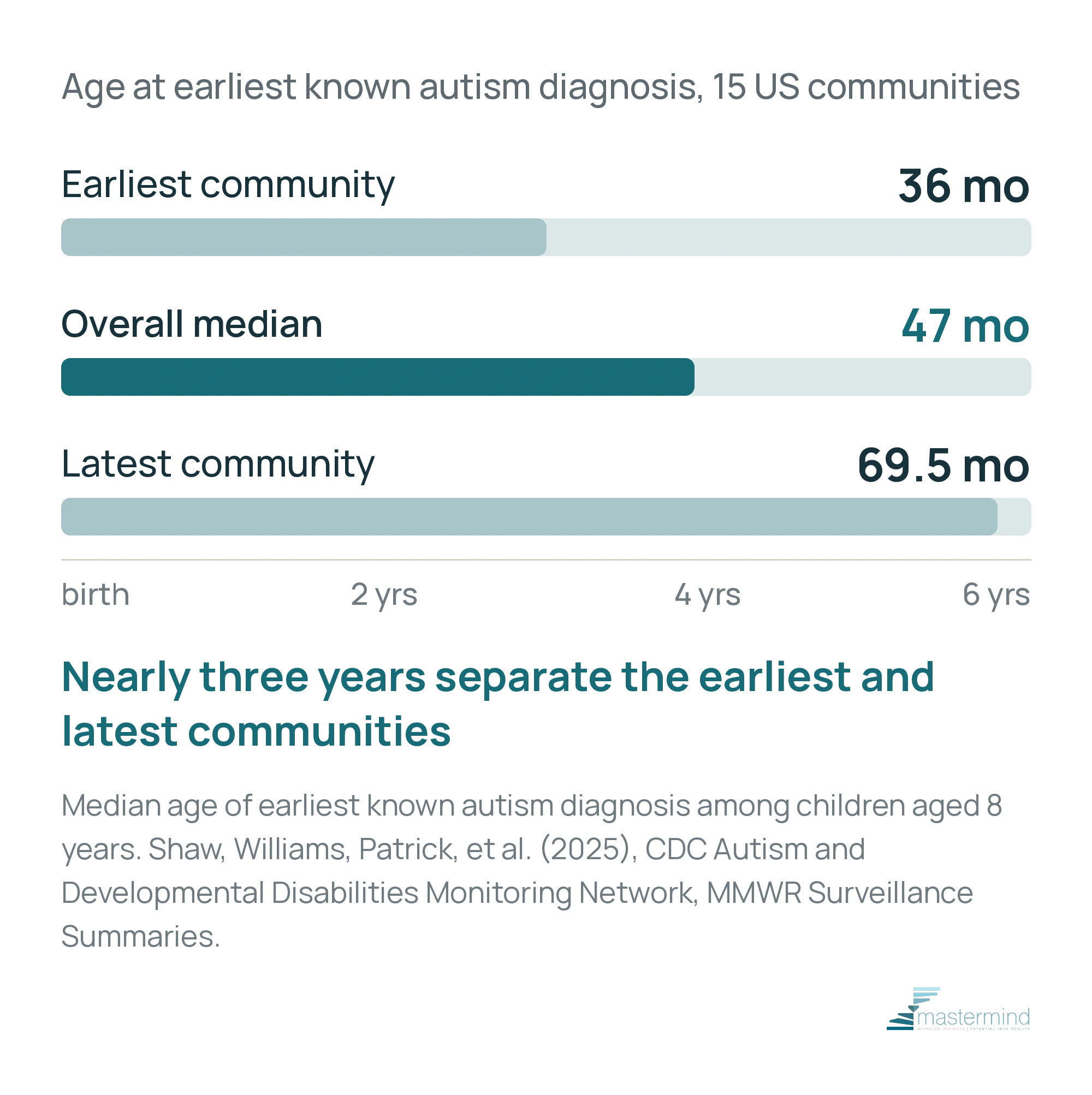
That spread is worth sitting with. The same report found the median age of diagnosis differed by nearly three years depending on which community a child lived in, which says more about local evaluation capacity and referral habits than about children. It is the practical case for starting the process yourself rather than waiting to be told it is time.
This guide covers what most four-year-olds do according to the CDC's milestone checklist, the differences most worth noting at this age, and both evaluation routes open to you.
What Most Children Do by Age 4
The CDC's Learn the Signs. Act Early. checklist, revised in 2022, includes by age four:
- Social and emotional: pretends to be something else during play, like a teacher, superhero, or dog; asks to go play with children if none are around; comforts others who are hurt or sad; avoids danger; likes to be a helper; changes behavior based on where he is, like a library versus a playground
- Language and communication: says sentences with four or more words; says some words from a song, story, or nursery rhyme; talks about at least one thing that happened during his day; answers simple questions like "what is a coat for?"
- Cognitive: names a few colors; tells what comes next in a well-known story; draws a person with three or more body parts
- Movement: catches a large ball most of the time; serves himself food or pours water with supervision; unbuttons some buttons; holds a crayon between fingers and thumb
The Differences That Matter Most at Four
As always: each item is a "may," not an "is," patterns beat moments, and losing previously mastered skills warrants prompt evaluation at any age. At four, the shortlist centers on play, conversation, and flexibility:
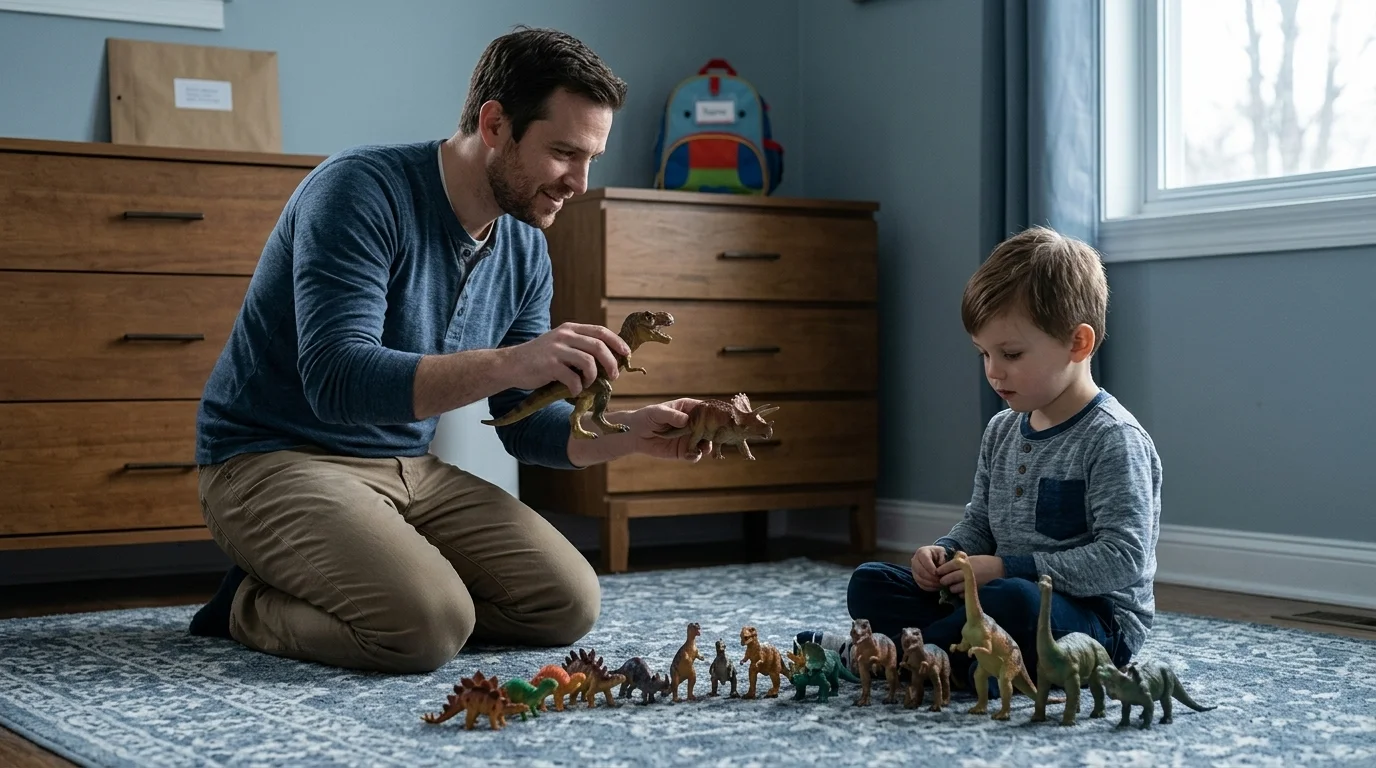
- Pretend play that is absent or mechanical. Pretending to be someone else is a formal four-year milestone. A four-year-old whose play is arranging, sorting, and reenacting the same sequences, rather than inhabiting roles and inventing scenarios, is showing one of this age's most meaningful differences. Reviews of the research find that the difficulty is specifically in producing pretend play spontaneously, and that it eases considerably when an adult structures the game or simply asks the child to act something out (Jarrold, 2003). Some preschoolers do not develop symbolic play even though they have the language and thinking skills it would normally require (Westby, 2022). This is worth knowing before you conclude anything from a single session of playing along at your prompting.
- Peers held at a distance. Not asking to play with other children, playing alongside but never with, or interacting mainly by directing rather than sharing.
- Conversation without back-and-forth. Plenty of speech, sometimes remarkably sophisticated speech, but monologues on preferred topics, answers that don't connect to the question, or difficulty telling you one thing about their day.
- Scripted and echoed language. Long passages from shows delivered verbatim, or repeating your question back instead of answering it, especially when scripts do the work real sentences would.
- Rigidity that organizes the family. Routines, routes, and rituals whose disruption produces distress out of scale with the change, and intense, narrow interests that crowd out everything else.
- Context blindness. Behaving the same way in the library, the playground, and the doctor's office is the inverse of the four-year milestone of adjusting behavior to the setting.
- Sensory and motor patterns carried forward: covering ears, seeking crashes and pressure, stimming that is frequent and preferred, persistent toe walking.
A Note on Girls
Four-year-olds with strong language sometimes carry these differences quietly for years, and girls in particular are diagnosed later on average. In the CDC's 2022 surveillance data, autism was identified 3.4 times as often in boys as in girls (Shaw et al., 2025), while a meta-analysis of 54 studies estimated the true ratio at closer to 3 to 1 than the roughly 4 to 1 seen in diagnosed populations (Loomes, Hull, and Mandy, 2017). Research comparing children with equally high levels of autistic traits found that girls were less likely than boys to meet diagnostic criteria unless they also had additional intellectual or behavioral difficulties (Dworzynski et al., 2012). In practice, that means a girl whose scripted speech and rule-following hold up in a structured preschool classroom can be missed for years. If you are the parent of a daughter and something feels off, say so plainly and ask for the evaluation rather than waiting for the school to raise it.
Two Evaluation Doors, Both Open
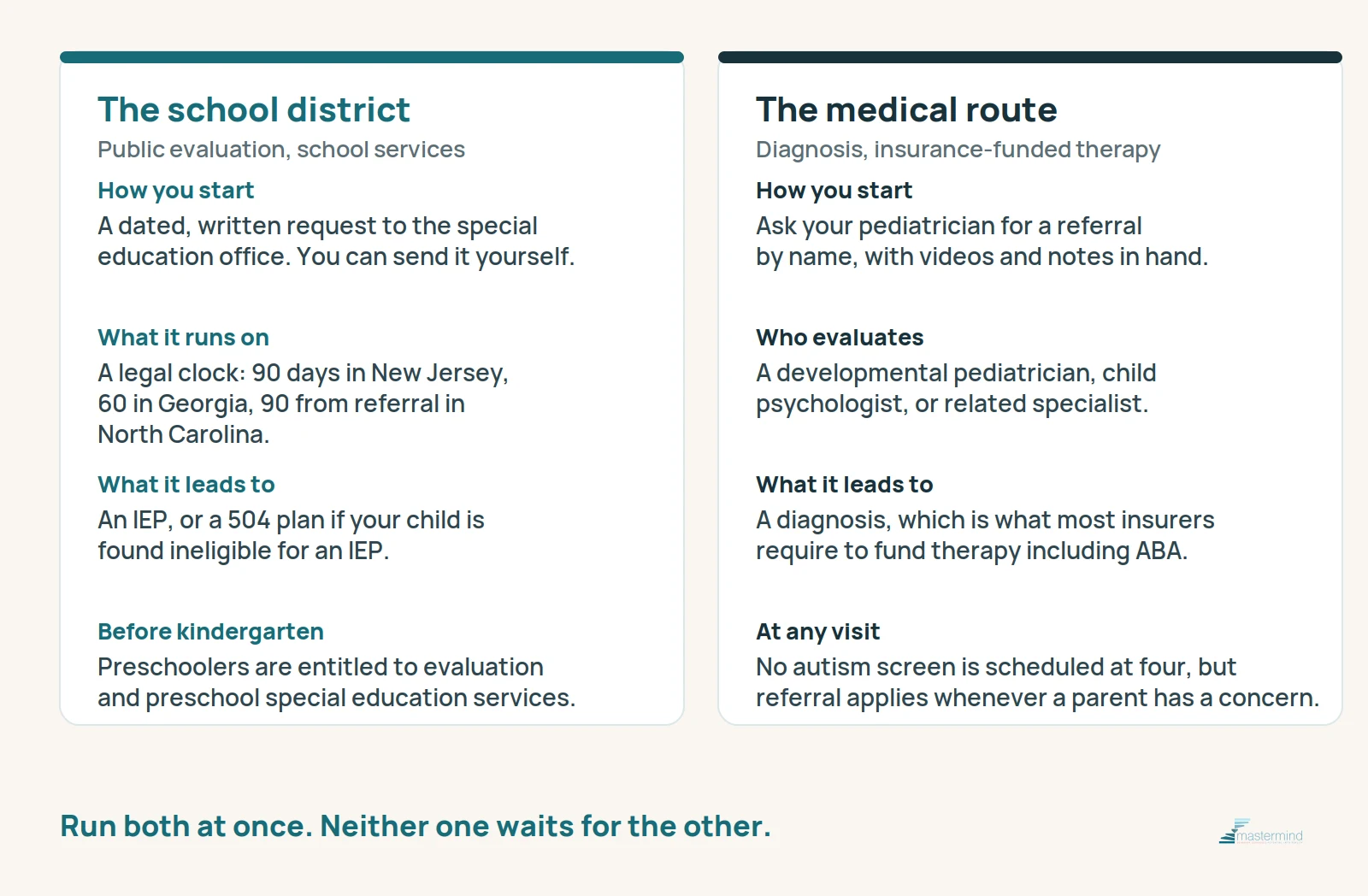
The school district. Because your child is over three, the district is now the public evaluation route. A dated, written request to the district's special education office triggers the IDEA evaluation process, on legal timelines that differ by state, 90 days in New Jersey, 60 in Georgia, 90 from referral in North Carolina, all broken down in our IEP guide. This applies before kindergarten: preschoolers are entitled to evaluation and, if eligible, preschool special education services. If the district finds your child ineligible for an IEP, a 504 evaluation is the immediate next request.
The medical route. A developmental pediatrician, child psychologist, or related specialist can evaluate and diagnose, which matters for insurance-funded therapy including ABA. There is no scheduled autism screening at the four-year well visit, the formal screens sit at 18 and 24 months, but the AAP's standing rule applies at every age: screening and referral whenever a parent or provider has a concern. Raise it explicitly, bring videos and your written observations, and ask for the referral by name.
Run both doors in parallel. They serve different purposes, school services and medical/insurance services, and neither waits for the other. If your child is in preschool or pre-K, ask the teacher for written observations; a teacher's account of peer play and transitions is evidence both doors take seriously. And if your concerns are broader than autism, our guide on behavioral concerns at five covers the neighboring territory.
Questions Worth Asking at Four
- To the pediatrician: given these videos and notes, will you refer us for a developmental evaluation now?
- To the district: what does the preschool evaluation process involve, and what is the legal timeline in our state?
- To the preschool teacher: how does he play when other children invite him in, and what happens at transitions?
- To any evaluator: are we assessing autism specifically, or development broadly, and why?
- To yourself: which of these differences show up across every setting, and which only at home or only at school?
Why Mastermind Behavior
Mastermind Behavior is a BCBA-owned and operated in-home ABA therapy provider serving families across New Jersey, Georgia, and North Carolina, and our Georgia early intervention program helps when the signs are just coming into focus. Four is not too late; it is when many families' clearest picture finally arrives, and we help parents move through both evaluation doors at once, prepare for district meetings, and turn diagnosis into an assessment-driven treatment plan. Our parent training makes you a working part of the team, at home and in every school meeting. With a 90%+ staff retention rate and no onboarding waitlist, most families begin direct services within six weeks of their initial assessment.
If your four-year-old's play, language, or flexibility is raising questions, schedule a free consultation or call us at 732.813.7333. We'll walk you through what's possible and help you figure out the right next step. No pressure, no commitment.
References
- Important Milestones: Your Child by Four Years, CDC, Learn the Signs. Act Early.
- CDC's Developmental Milestones, Centers for Disease Control and Prevention
- Recommendations for Preventive Pediatric Health Care (Periodicity Schedule), American Academy of Pediatrics
- Shaw KA, Williams S, Patrick ME, et al. Prevalence and Early Identification of Autism Spectrum Disorder Among Children Aged 4 and 8 Years, Autism and Developmental Disabilities Monitoring Network, 16 Sites, United States, 2022. MMWR Surveillance Summaries, 2025
- Jarrold C. A review of research into pretend play in autism. Autism, 2003
- Westby C. Playing to Pretend or "Pretending" to Play: Play in Children with Autism Spectrum Disorder. Seminars in Speech and Language, 2022
- Loomes R, Hull L, Mandy WPL. What Is the Male-to-Female Ratio in Autism Spectrum Disorder? A Systematic Review and Meta-Analysis. Journal of the American Academy of Child and Adolescent Psychiatry, 2017
- Dworzynski K, Ronald A, Bolton P, Happé F. How different are girls and boys above and below the diagnostic threshold for autism spectrum disorders? Journal of the American Academy of Child and Adolescent Psychiatry, 2012