Does ABA Therapy Work? What the Research Actually Shows
What the evidence says about whether ABA therapy works: pooled effect sizes from 25 controlled studies, where the findings are strong, and where they are not.

If you have just been handed a referral for ABA, the question underneath every other question is simple. Does ABA therapy work?
The honest answer is more interesting than yes or no. ABA is the most-studied behavioral intervention for autism, and across dozens of controlled trials it produces measurable average gains in language, thinking and learning, and everyday skills. It is also an area where the research is less settled than most provider websites admit, where results vary a great deal between children, and where a serious body of criticism deserves a hearing rather than a dismissal.
Parents rarely ask us this question in the abstract. It usually arrives attached to something specific: a four-year-old who understands almost nothing that is said to him, a mealtime that has become unmanageable, a school placement that depends on the next six months. What a family wants to know is not whether ABA works in general. It is whether it will move the thing in front of them. The research below answers a narrower version of that question than most families expect, and being clear about which version is the useful place to start.
This article lays out what the evidence supports, where it is weaker, and what that means for a decision about your own child. If you are still working out what the therapy actually involves, our guide to the basics of applied behavior analysis covers the mechanics first.
The Short Answer
Yes, on average. How much, and for which skills, is where the honest answer gets complicated.
A 2025 meta-analysis pooled 25 controlled studies of ABA-based intervention in children on the autism spectrum and found moderate to large average improvements in receptive language, cognitive skills, everyday communication, social skills, and daily living skills, plus a smaller average reduction in autism symptom severity (Mutschler Collins et al., 2025).
Three qualifications belong in the same breath as that finding.
Averages are not predictions. For most outcomes, the range in which a new study would be expected to land still includes no measurable change.
Study quality is uneven. In that same analysis, the average study met only about six or seven of fourteen quality criteria. Only five of the twenty-five used random assignment.
Independent reviews grade the certainty of most findings as low. A separate 2025 systematic review pooled sixteen randomized trials covering 893 children and found significant improvements in adaptive behavior, daily living skills, language, socialization, and joint attention. Under the GRADE framework it rated the certainty of the language finding as moderate, and every other outcome as low or very low (Han et al., 2025).
So the question of whether ABA therapy works for autism is better framed as: how much, for which outcomes, for which children, and how confident can anyone be.
What the Strongest Evidence Supports
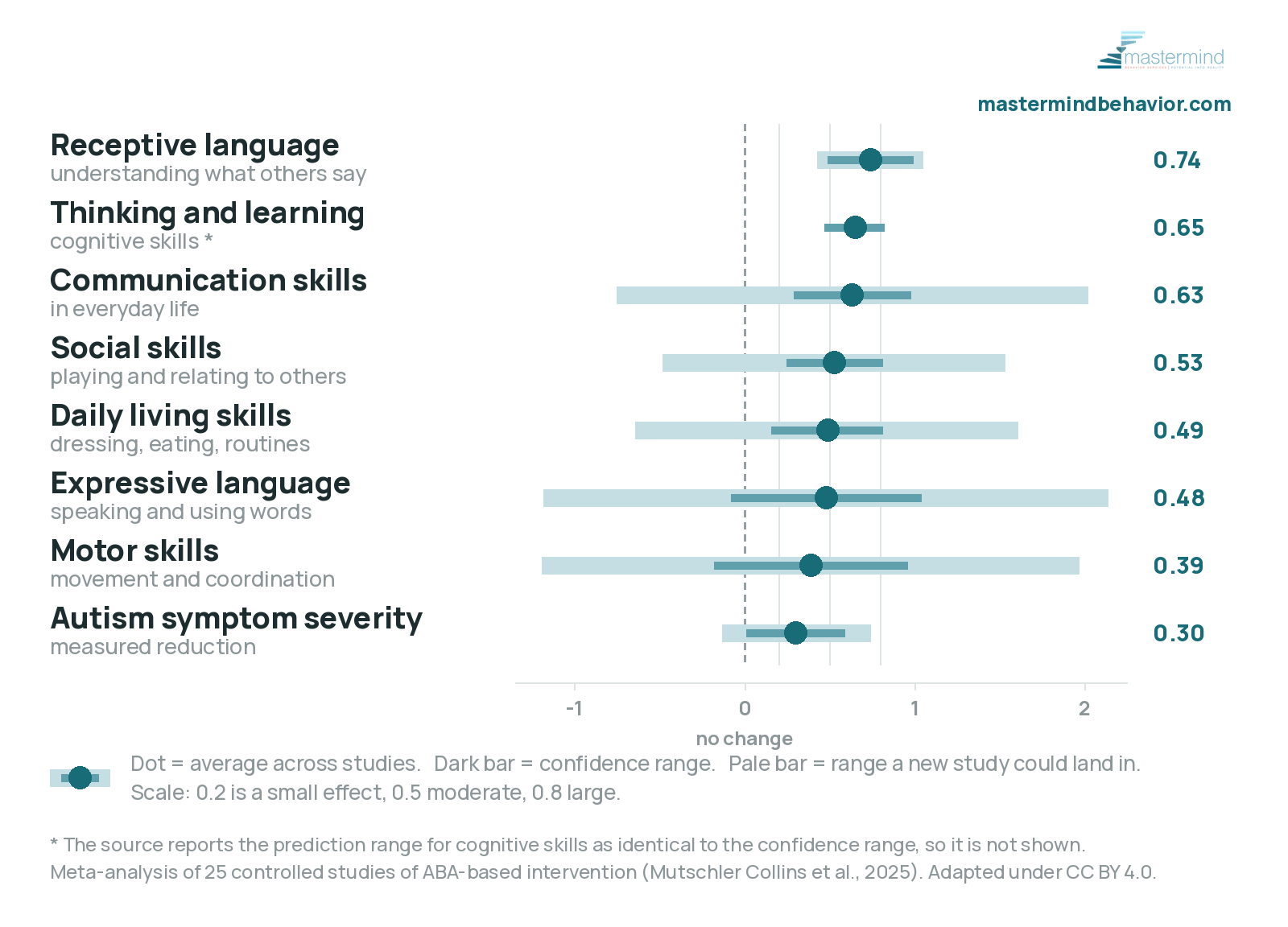
The chart above shows the pooled result for each outcome measured across those 25 studies. The dot is the average. The dark bar is the confidence range around that average. The pale bar is the range in which a new study would be expected to fall.
A word on what those numbers actually are, because they are not percentages and they have no ceiling. Each one is measured in standard deviations, the unit researchers use so that results from studies running completely different tests can be averaged together. To put it in familiar terms: on the Vineland, where the average score is 100 and one standard deviation is 15 points, an effect of 0.74 works out to roughly an eleven-point shift. By convention 0.2 counts as a small effect, 0.5 moderate, and 0.8 large, but nothing stops a result landing above 1.0, and individual studies here range from below zero to above 2.5. The very large ones almost always come from very small studies, and the enormous uncertainty around those results is part of why the pooled averages are more modest.
Read the chart this way. Receptive language, meaning a child's ability to understand what is said to them, is the outcome with the most consistent finding. At 0.74 the average gain sits in the large range, and the prediction range stays positive across its whole width. Cognitive skills are close behind at 0.65. Those two are where the evidence base is genuinely strong, and they are not minor outcomes: understanding language and learning are what most other skills are built on.
For everything else, including social skills and daily living skills, the average is moderate and positive, but the evidence is not as firm as it is for the two above. Results vary more, so your own child's data is the better guide.
Where the Evidence Is Weaker Than You May Be Told
Before the gaps, one thing about the studies themselves. Every trial in the evidence base gets graded for risk of bias, and the picture looks alarming until you understand what drives it.
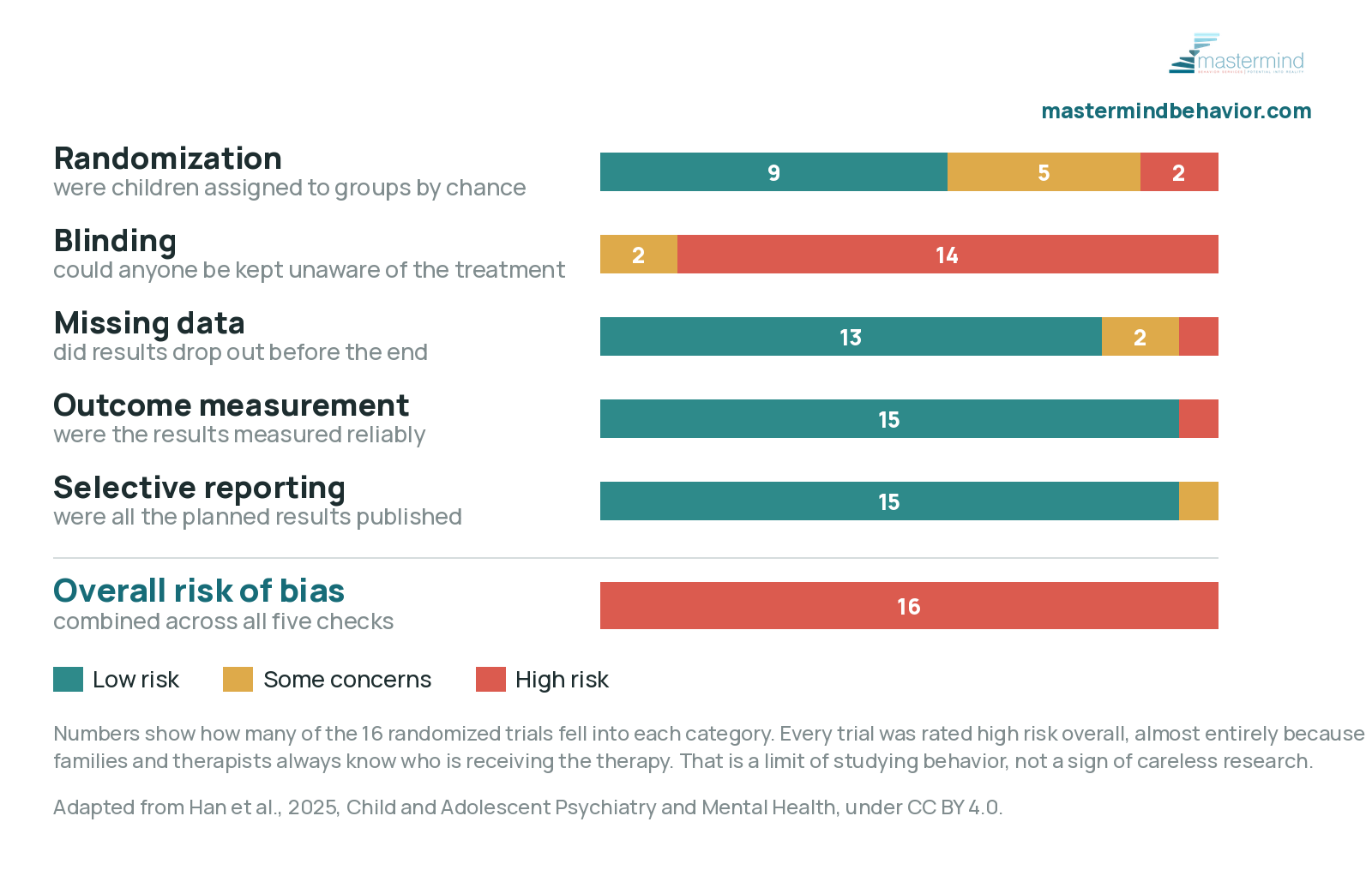
Read the bottom row first. All sixteen randomized trials were rated high risk of bias overall. That sounds damning, and it is not nothing, but the cause is almost entirely the blinding row above it. In a drug trial you can give one group a placebo and nobody knows who got what. You cannot do that with therapy. A child knows they are in a session, a therapist knows they are delivering it, and a parent filling in a questionnaire knows their child has been receiving treatment. That single structural fact pushes fourteen of sixteen trials into high risk on its own.
On the checks researchers can control, the record is much better: fifteen of sixteen reported all their planned results, fifteen measured outcomes reliably, and thirteen had no meaningful loss of data. Randomization is the weakest of the controllable domains, with five trials describing their method too vaguely to judge and two doing it without concealment.
The honest reading is that the ceiling on certainty here is set by what behavioral research can do, not by whether researchers did it carefully. That is also why no future study is likely to settle the question cleanly.
Three further gaps are worth naming plainly.
Long-term outcomes are thinly studied. Only three of the twenty-five studies in the 2025 meta-analysis included any follow-up assessment after the intervention ended. Whether gains hold years later is largely an open question.
Core autism traits are not the strong suit. Reduction in autism symptom severity showed the smallest effect of any outcome measured, and its prediction range crosses zero. The source reports this one as a negative number, because on symptom measures a lower score is the better result; the chart above shows it as a positive so that every bar reads in the same direction. The 2025 systematic review reached the same conclusion from a different set of trials: it found no statistically significant effect on autism symptom severity at all, with very high disagreement between the studies measuring it. ABA has better evidence for teaching skills than for changing autism itself, which is arguably the right way round.
Heterogeneity is visible in the data. Funnel plots in the same paper show studies scattered well outside the expected range on both sides, meaning the individual trials disagree with each other substantially.
A good provider should be able to say all of this out loud without flinching.
What Makes This Look Like a Real Effect
Set against those limits, three features of the evidence point in the other direction, and they are worth weighing properly.
The dose-response gradient replicates. The 2025 meta-analysis found through meta-regression across all 25 studies that greater treatment dose and longer duration produced larger gains in adaptive behavior. The separate systematic review found the same gradient by a different method: interventions delivering twenty or more hours a week produced a notably larger effect on language than lower-intensity programs, 0.72 against 0.34. Two papers, two analytic approaches, the same direction. A dose-response relationship that holds up across independent datasets is one of the standard markers separating a genuine effect from noise, because random variation does not usually arrange itself in a gradient.
Two outcomes clear the hardest test in the chart. Prediction ranges are a stricter bar than confidence intervals, and most outcomes above do not clear it. Receptive language and cognitive skills do. For those two, the range in which a new study would be expected to land stays entirely above zero.
Two independent reviews agree. The meta-analysis and the systematic review drew on overlapping but different sets of studies, applied different statistical models, and arrived at the same conclusions about language and adaptive behavior. Agreement between independent syntheses is worth considerably more than a single striking result from one.
None of that makes the evidence conclusive, and this article has already said why it is not. It does mean the evidence behaves the way real effects behave.
Does ABA Therapy Work for Mild Autism?
This is one of the most common versions of the question, and the honest answer is that the research does not cleanly address it.
Most of the trials in the evidence base recruited young children with significant support needs. Children described as having mild autism, or a Level 1 diagnosis, are underrepresented. That does not mean ABA cannot help them. It means the effect sizes above were not measured on that population and should not be assumed to transfer.
What is more defensible for a child with lower support needs is targeted, time-limited work on specific goals rather than a comprehensive forty-hour program. If a provider recommends high-intensity comprehensive ABA for a child with mild autism, ask them to explain the reasoning in terms of that child's specific goals, and ask what would count as evidence the program should end.
Does ABA Therapy Work for ADHD?
Behavioral intervention has strong support for ADHD, but it is important to be precise about what kind.
The American Academy of Pediatrics recommends evidence-based parent training in behavior management, and behavioral classroom interventions, as the first-line treatment for preschool-aged children with ADHD, ahead of medication (Wolraich et al., 2019). Parent training in behavior management is strongly recommended for children through middle school age.
That recommendation rests on the same behavioral principles ABA uses: identifying antecedents and consequences, reinforcing target behaviors, collecting data on whether it is working. It is not, however, the same thing as comprehensive ABA therapy as delivered for autism. Parent training programs are typically short, group-delivered, and focused on caregiver skills rather than direct one-to-one work with the child.
So: does ABA therapy work for ADHD, or for kids with ADHD alongside autism? Behavioral approaches have a strong evidence base for ADHD symptoms, and where a child has both diagnoses, an ABA program can reasonably target ADHD-related goals. A provider proposing comprehensive ABA for ADHD alone, without autism, is going beyond what the guidelines support and should be asked to explain why.
How Quickly Does ABA Therapy Work?
There is no reliable timeline, and providers who give you one are guessing.
What the research supports is that dose and duration matter, which implies the opposite of a quick answer. The studies showing the largest adaptive-behavior gains ran longer and delivered more hours. Most comprehensive programs in the evidence base ran for a year or more.
What you should see much sooner than a year is data. A well-run program takes a baseline measurement at assessment and collects data on every goal from the first sessions onward. Within the first two to three months you should be able to look at a graph for each goal and see whether the line is moving. If your provider cannot show you that, the problem is the program, not the timeline.
Who Does ABA Therapy Work For?
The evidence base is heavily concentrated on one group: young autistic children, mostly under ten, receiving intervention from clinicians or from clinicians and caregivers together.
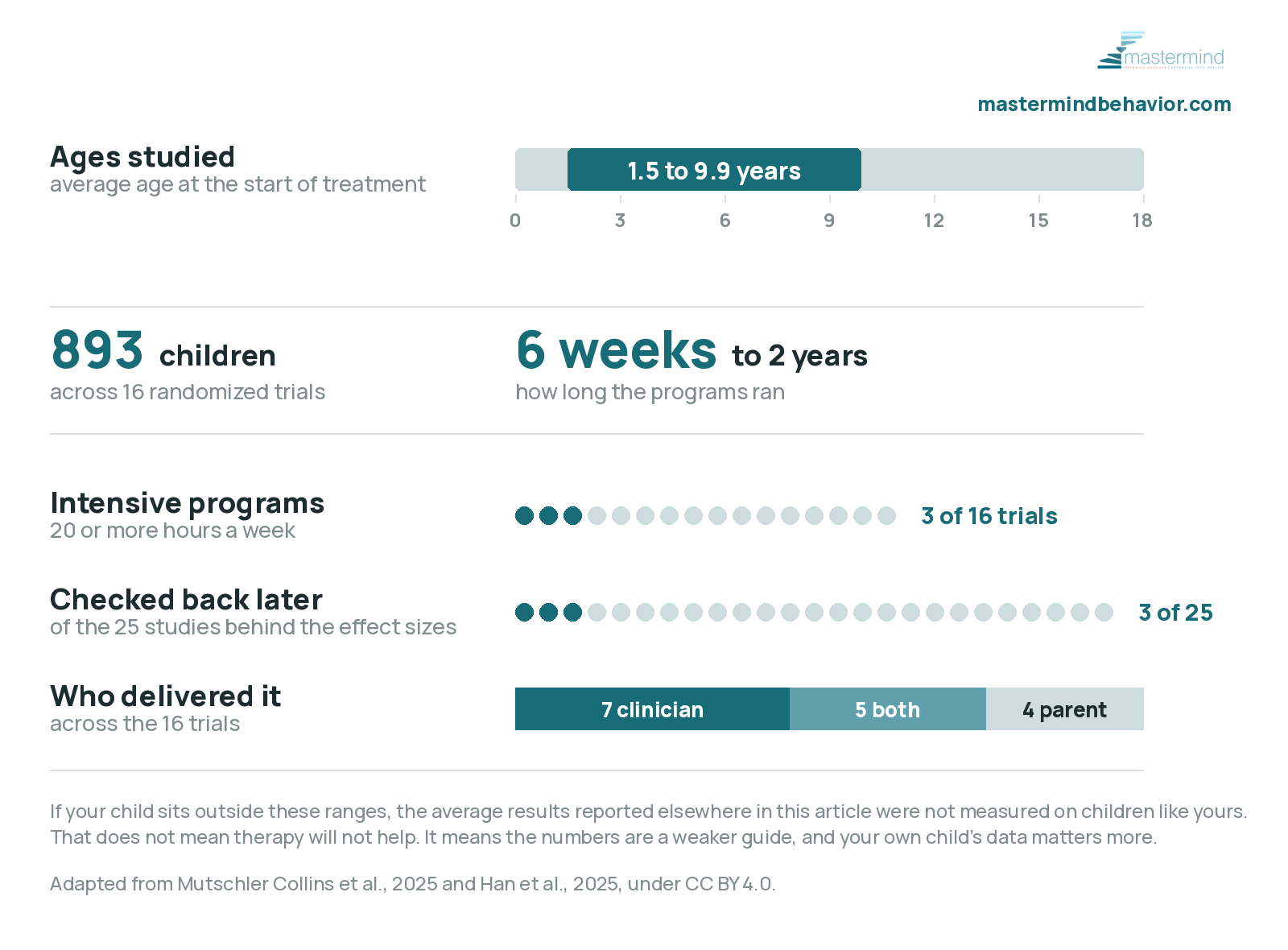
That picture is worth sitting with, because it sets the limits on everything above. The effect sizes came from trials whose participants averaged between eighteen months and just under ten years old at intake. Only three of sixteen trials ran at the intensity most families are quoted, twenty or more hours a week. And only three of the twenty-five studies behind those numbers ever checked back after the intervention ended.
Within that group, two moderators showed up consistently. Children who started younger tended to do better. Programs delivered with greater intensity and duration tended to produce larger adaptive-behavior gains.
Outside that group, the evidence thins quickly.
Does ABA therapy work for adults? The controlled research is very limited. Most trials cap intake age around ten years. Behavioral approaches are used with autistic adults, particularly for specific skill goals and for challenging behavior, but the pooled effect sizes above do not apply.
Does ABA therapy work on social skills? The pooled average for socialization was moderate, and the prediction range crossed zero. Social skills are a legitimate target, and results vary widely.
What group of people does ABA therapy work for beyond autism? Behavioral principles are applied in ADHD, in education, in brain injury rehabilitation, and elsewhere. The autism evidence base is by far the largest.
The Criticism, Taken Seriously
Search for opinions on ABA and you will find autistic adults, including many who received it as children, describing it as harmful. Those accounts deserve engagement, not a defensive brochure paragraph.
The substance of the concerns tends to cluster around a few things: historical use of aversive procedures, which are no longer accepted practice; goals oriented toward making a child appear non-autistic rather than toward the child's own quality of life; suppression of self-regulating behaviors like stimming; and compliance training that teaches a child their own refusal does not count.
Several of these criticisms describe real practice, historically and in some settings currently. The most-cited study claiming a link between ABA exposure and PTSD symptoms has been criticized on methodological grounds, including its sampling and its use of a measure not validated for the purpose, so it is not strong evidence in either direction. The underlying concerns do not stand or fall with that one paper.
What the concerns should change, practically, is what you ask a provider. Whether goals are chosen with the family and, where possible, the child. Whether stimming is targeted for reduction and on what justification. Whether the child's assent is tracked. Whether the program has an exit plan. A provider who treats those questions as hostile is telling you something useful.
How to Tell Whether It Is Working for Your Child
The population-level question is interesting. The question that matters to you is narrower, and it is answerable.
- Ask for the baseline. Every goal should have a starting measurement from the initial assessment.
- Ask to see graphs, not summaries. Progress on each goal should be visible as data over time.
- Ask what happens if a goal is not moving. The answer should involve changing the intervention, not extending the timeline.
- Ask whether the skills show up outside sessions. A skill that only appears with the therapist present has not generalized, and generalization is the point.
- Ask what the end looks like. A program with no conception of its own conclusion is not a treatment plan.
Why Mastermind Behavior
We wrote those five questions because we expect to be asked them. Here is how we answer.
Your child's baseline comes from a BCBA assessment conducted in your home, and every goal in the treatment plan is measured against it. Progress is shown to you as data on each goal, not as a summary of how the month went. When a goal stops moving, the intervention changes rather than the timeline extending. And because we work in your home rather than a clinic, generalization is not a separate phase added at the end. It is the condition the skill is learned in.
Two things in the research above are worth raising with any provider you consider, including us. The evidence points consistently toward dose and duration mattering, and staff turnover interrupts both, which is why our 90%+ retention rate is a clinical fact rather than an administrative one. And starting earlier is better supported than starting later, which is why we run no onboarding waitlist and most families begin direct services within six weeks of their initial assessment.
Mastermind Behavior is a BCBA-owned and operated in-home ABA therapy provider serving families across New Jersey, Georgia, and North Carolina.
If you are weighing whether ABA is right for your child, schedule a free consultation or call us at 732.813.7333. We will talk through what the evidence supports and what it does not, and help you figure out the right next step. No pressure, no commitment.
References
- Mutschler Collins I, Halter F, Schächinger Tenés LT, Lieb R, Meyer AH. A Meta-Analysis of Applied Behavior Analysis-Based Interventions to Improve Communication, Adaptive, and Cognitive Skills in Children on the Autism Spectrum. Review Journal of Autism and Developmental Disorders, 2025
- Han D-G, Lee Y, Kim H-S, Suh H-W, Lee J, Shin S-H, et al. Effectiveness and experiences of early intensive behavioral and naturalistic developmental behavior interventions for autism spectrum disorders: a mixed-methods systematic review and meta-analysis. Child and Adolescent Psychiatry and Mental Health, 2025;20:14
- Sandbank M, Bottema-Beutel K, Crowley LaPoint S, Feldman JI, Barrett DJ, Caldwell N, et al. Autism intervention meta-analysis of early childhood studies (Project AIM): updated systematic review and secondary analysis. BMJ, 2023;383:e076733
- Hyman SL, Levy SE, Myers SM. Identification, Evaluation, and Management of Children With Autism Spectrum Disorder. Pediatrics, 2020;145(1):e20193447
- Wolraich ML, Hagan JF Jr, Allan C, Chan E, Davison D, Earls M, et al. Clinical Practice Guideline for the Diagnosis, Evaluation, and Treatment of Attention-Deficit/Hyperactivity Disorder in Children and Adolescents. Pediatrics, 2019;144(4):e20192528
- Hurl K, Wightman J, Haynes SN, Virues-Ortega J. Does a pre-intervention functional assessment increase intervention effectiveness? A meta-analysis of within-subject interrupted time-series studies. Clinical Psychology Review, 2016;47:71-84