Signs of Autism in Toddlers: 15 Months to 3 Years, Age by Age
Toddlerhood is when autism becomes identifiable. Signs at 15-18 months, 2 years, and 3 years, the two language deadlines, and what an M-CHAT flag actually means.


Twenty yes-or-no questions. That is the entire M-CHAT, the screening questionnaire your pediatrician will hand you somewhere between 16 and 30 months, and it is the reason the toddler years are different from everything that came before. Infancy is the age of watching; toddlerhood is the age when autism can actually be identified, screened for on a schedule, and reliably diagnosed. If the signs are there, these are the months they become visible.
This guide walks the toddler window age by age, 15 to 18 months, two years, and three years, using the CDC's milestone checklists as the backdrop, explains what the M-CHAT does and what a flagged result means, and covers the two developmental deadlines clinicians quote most. The standing rules apply at every age: no single behavior is diagnostic, patterns and trends outweigh moments, and skill loss is never a wait-and-see signal.
The Two Deadlines Clinicians Quote
Two thresholds come up in almost every professional conversation about toddler language: single words by around 16 months, and two-word phrases, like "more milk," by 24 months. The CDC's checklists put "tries to say three or more words besides mama or dada" at 18 months and "says at least two words together" at two years. A toddler behind these markers is not necessarily autistic, language delay has many causes, but a toddler behind these markers warrants evaluation rather than reassurance, whatever the cause turns out to be.
Signs of Autism at 15 to 18 Months
By 18 months, the CDC's checklist expects a toddler to point to show you something interesting, look at a few pages in a book with you, try to say three or more words, follow one-step directions without gestures, copy you doing chores, play with toys in a simple way like pushing a toy car, and check back to make sure you are close by while exploring. Against that backdrop, the differences most worth noting:
- Not pointing to show. Pointing to ask for things and pointing to share interest are different skills, and it is the sharing kind, point at a dog, then look at you to see if you saw it too, whose absence matters most.
- No words, or words that appeared and faded. The 12-to-24-month window is when parents most often report regression, and lost words are an evaluate-now signal at any age.
- Not following your point or your gaze, the receiving half of joint attention.
- Play that is mostly physical repetition: spinning, lining up, flipping objects to watch parts move, rather than simple pretend like feeding a stuffed animal.
- Little checking back with your face in new situations.
Signs of Autism at 2 Years
The two-year checklist adds social referencing and combined communication: notices when others are hurt or upset, looks at your face to see how to react in a new situation, says at least two words together, points to things in a book when you ask, points to at least two body parts, and uses gestures beyond waving and pointing, like blowing a kiss or nodding yes. Differences worth noting at this age:
- No two-word phrases, the second of the two deadlines, or speech that is mostly repeated phrases from shows and songs rather than the child's own combinations
- Limited response to others' feelings: not noticing or reacting when someone nearby is hurt or crying
- A narrow gesture vocabulary: waving and reaching but little nodding, kissing, or shrugging
- Strong insistence on sameness: significant distress at small changes in routine, route, or object placement
- Repetitive movements that are frequent and preferred, such as hand flapping, rocking, or spinning, covered in depth in our guide to stimming behaviors, along with patterns like persistent toe walking
- Unusual sensory responses: covering ears at everyday sounds, seeking or avoiding specific textures, staring at lights or spinning objects
Signs of Autism at 3 Years
By three, most children play near and increasingly with other children, hold simple back-and-forth conversation, engage in real pretend play, and separate from caregivers without prolonged distress. The differences that stand out at three: little interest in other children or parallel play that never turns interactive, pretend play that is absent or purely mechanical, conversation that does not go back and forth, pronoun reversal or extensive scripted speech, and rigid rituals that organize the day. Three is also the age when the system changes underneath you: children age out of Part C early intervention at three, and evaluation and services shift to the school district, the door our IEP guide walks through.
The M-CHAT: What It Is and What a Flag Means
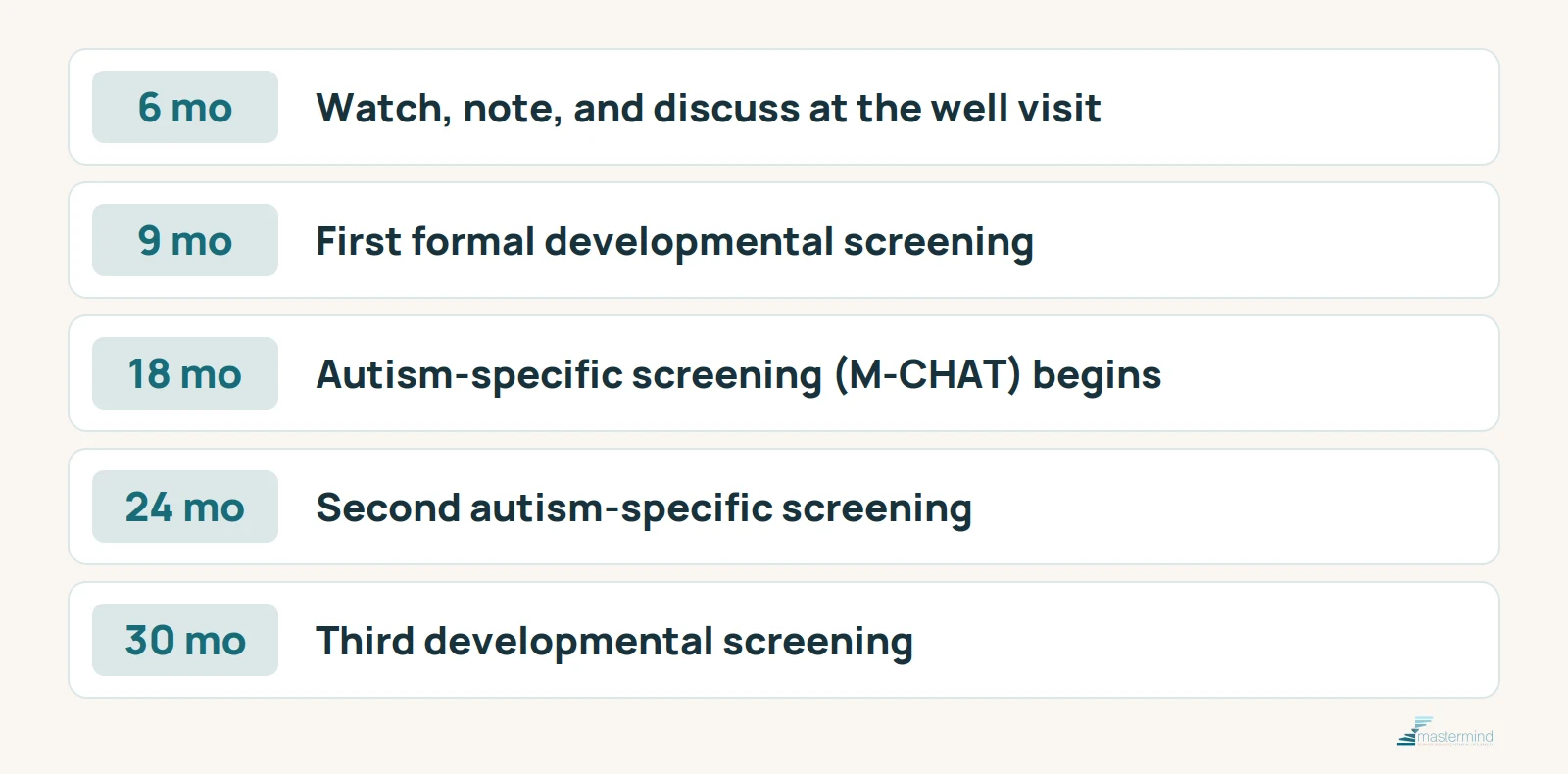
The M-CHAT-R (Modified Checklist for Autism in Toddlers, Revised) is a free, validated, 20-question parent questionnaire for children 16 to 30 months old, administered at the 18- and 24-month well visits per AAP guidance, and available directly from its authors at mchatscreen.com. It works in two stages: parents answer the questionnaire, and if the score falls in a middle range, a nurse or physician asks a short set of structured follow-up questions about the specific items that were flagged. Most families never get past stage one; in the validation study of more than 16,000 toddlers, 93 percent scored in the low-risk range and needed nothing further (Robins et al., 2014).
What a Flagged Result Actually Means
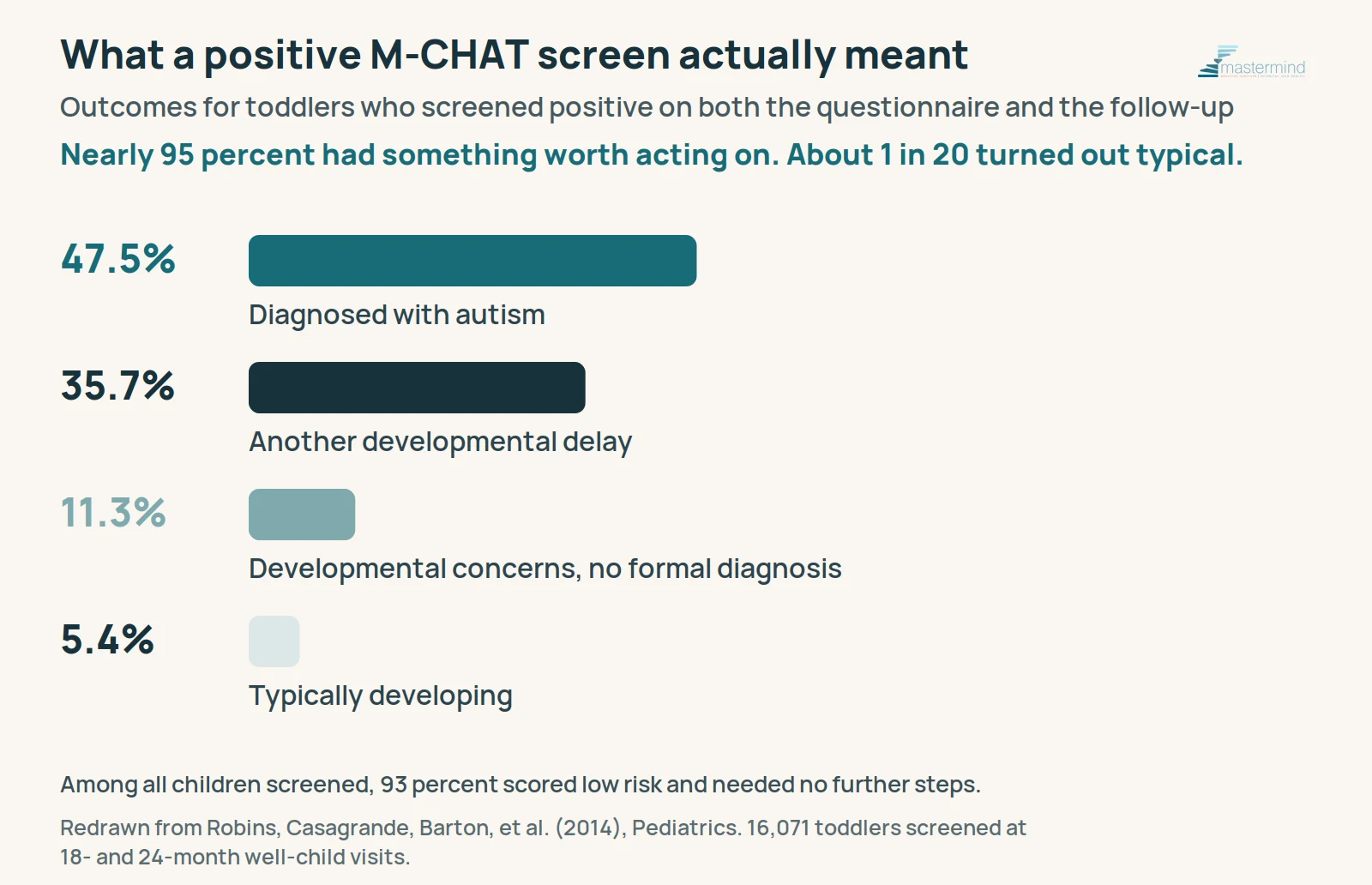
A flagged score is not a diagnosis, and it is also not a false alarm. Among the children in that study who screened positive on both stages and completed a full evaluation, 47.5 percent were diagnosed with autism, another 35.7 percent had a different developmental delay, 11.3 percent had developmental concerns that did not meet the threshold for a formal diagnosis, and 5.4 percent were found to be developing typically. In other words, roughly nineteen of every twenty children who screened positive had something worth addressing, though for about half of them that something was not autism.
That is the practical meaning of a flag: it is a reason to evaluate, not a verdict, and the evaluation is worth doing whichever way it resolves. There is one more finding from that study worth carrying into the pediatrician's office. Children identified through this kind of routine screening were diagnosed around their second birthday, roughly two years earlier than the national median age of diagnosis at the time, and those two years are exactly the window when early intervention does the most good.
One more thing every parent should know: a passing score with a persistently concerned parent still triggers the AAP's concern clause. Screening and referral are appropriate whenever a parent or provider has a concern, at any visit, whatever the questionnaire said.
What to Do in the Toddler Years if You're Concerned
Under age three: call your state's Part C early intervention program directly, no diagnosis or referral needed, while pursuing the pediatric evaluation in parallel. The evidence for acting early is unambiguous, and waitlists for developmental evaluations make parallel tracks the rational move.
At or after three: the request goes to your school district in writing, and the pediatric route continues alongside. Bring the same evidence at every age: short videos of the specific behaviors, a list of what you observe across settings, and any screening results.
Questions for the 18- and 24-Month Well Visits
- Can we complete the M-CHAT today, and can you walk me through the result with me?
- Given her language today, where does she sit against the 16- and 24-month markers?
- If the screen is negative but these behaviors continue, what is the plan and the date?
- What is the current wait for a developmental evaluation locally, and should we get on the list now?
- Should we start early intervention in parallel, and how do we contact them in our state?
Why Mastermind Behavior
Mastermind Behavior is a BCBA-owned and operated in-home ABA therapy provider serving families across New Jersey, Georgia, and North Carolina. The toddler window is where most of our families' stories begin: a flagged M-CHAT, a pediatrician's referral, a waitlist that felt too long to do nothing in. We help parents read screening results, prepare for evaluations, and start early intervention conversations, and when services begin, our assessment-driven treatment planning and parent training make the plan yours, not just ours. With a 90%+ staff retention rate and no onboarding waitlist, most families begin direct services within six weeks of their initial assessment.
If your toddler's screening or development is raising questions, schedule a free consultation or call us at 732.813.7333. We'll walk you through what's possible and help you figure out the right next step. No pressure, no commitment.
References
- Important Milestones: Your Child by 18 Months, CDC, Learn the Signs. Act Early.
- Important Milestones: Your Child by Two Years, CDC, Learn the Signs. Act Early.
- M-CHAT-R/F: Modified Checklist for Autism in Toddlers, Revised with Follow-Up, official site (Robins, Fein, & Barton)
- Recommendations for Preventive Pediatric Health Care (Periodicity Schedule), American Academy of Pediatrics
- Robins DL, Casagrande K, Barton M, et al. Validation of the Modified Checklist for Autism in Toddlers, Revised with Follow-Up (M-CHAT-R/F). Pediatrics, 2014