Who Pays for ABA Therapy in Georgia?
Ava's Law after SB 118: age 20, a $35,000 cap, no visit limits, and the quiet change to who decides medical necessity. Plus Medicaid, Katie Beckett and appeals.


Short answer: usually one of four systems, and occasionally two at once. Which one applies to your child decides how much you can get, who signs off on it, and what you can do when the answer is no.
Every figure below is taken from a Georgia or federal government document, and each one is dated, because coverage rules change and a guide that does not tell you when it was checked is not much use. Where we could not source something, we say so rather than filling the gap.
Checked 11 August 2026.
Before anything else: is your plan self-funded?
This is the question that decides whether the rest of the insurance section applies to you at all, and almost nobody thinks to ask it.
Ava's Law is a requirement on insurance. Many employers, particularly larger ones, do not buy insurance. They pay claims out of their own money and hire an insurance company only to administer the plan. That is a self-funded plan, and a state insurance mandate does not reach it. Georgia's independent review process does not reach it either, because that process applies to managed care entities the state regulates.
The reason is federal. ERISA preserves state insurance regulation, then removes self-funded plans from its reach: an employee benefit plan shall not "be deemed to be an insurance company or other insurer ... or to be engaged in the business of insurance ... for purposes of any law of a State purporting to regulate insurance companies, insurance contracts, banks, trust companies, or investment companies."
How to find out, in two minutes. Ask your employer's plan administrator whether the plan is self-funded or fully insured. Read the Summary Plan Description, which the administrator must provide free of charge and which sets out "how it works, what benefits it provides, how to file a claim for benefits, and any limitations that may apply." Or look at a denial letter: the US Department of Labor notes that "the external review process used by the plan depends on whether the plan is self-funded or provides benefits through an insurance company. The claim denial notice from your plan will describe the external process and your rights." A denial pointing you to a federal external review route rather than to Georgia's independent review indicates a self-funded plan.
Being self-funded is not a dead end. Those plans have their own federal appeal rights, and many cover ABA anyway. It only means the Georgia rules below are not leverage you have. If the obstacle is the vocabulary in your plan documents, our plain English guide to insurance terms works through it.
Ava's Law, and what SB 118 actually changed
Georgia's autism mandate is Ava's Law, at O.C.G.A. 33-24-59.10. It first reached plans "issued or renewed in Georgia on or after July 1, 2015." Three years later SB 118 rewrote it, and the rewrite is the part most summaries get wrong. SB 118 was signed in May 2018 but states "This Act shall become effective January 1, 2019."
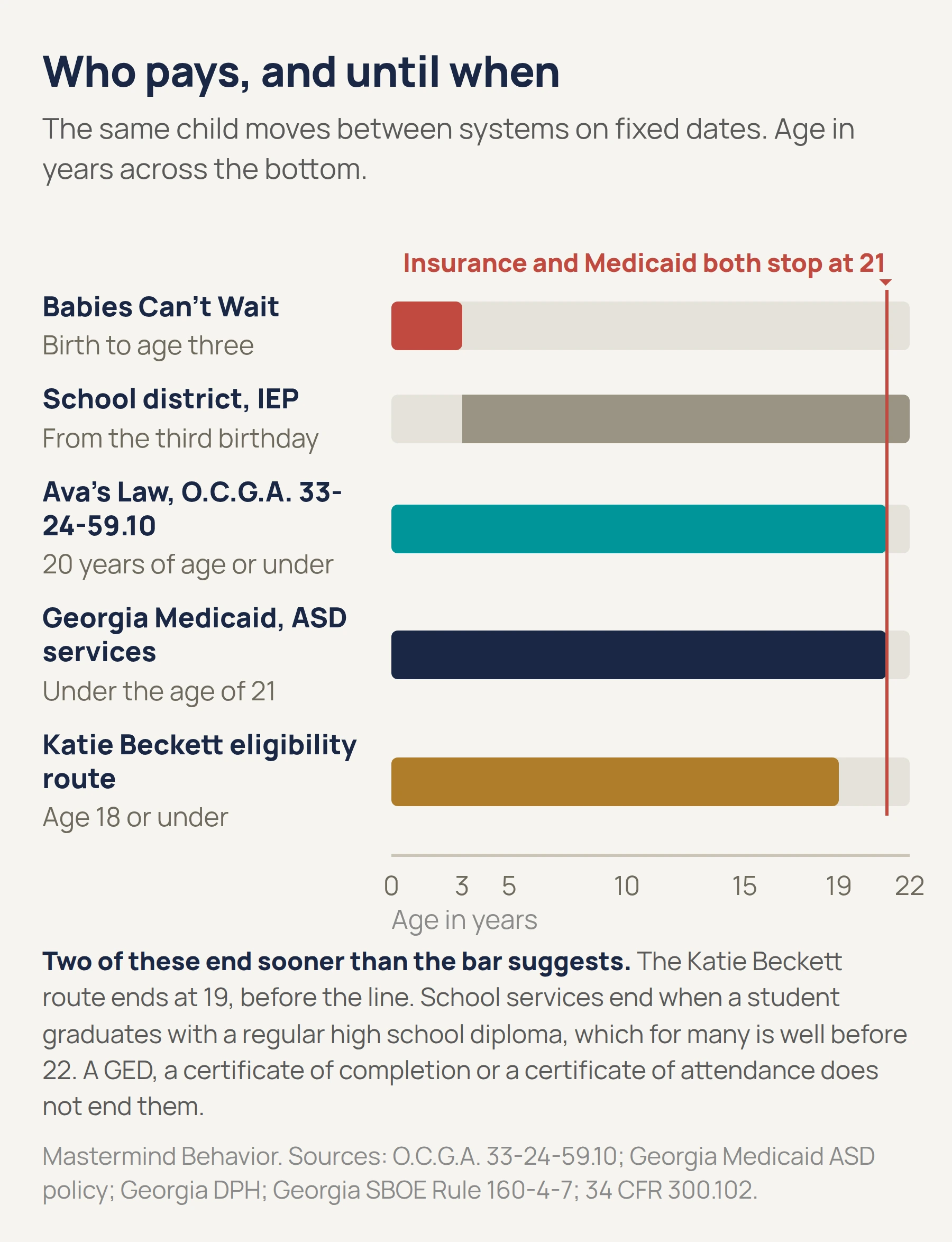
The age limit went from six to twenty. SB 118 struck "six" and inserted "20". Coverage is required for a child who is "20 years of age or under". If you were told years ago that Georgia coverage stops at six, that has been wrong since the start of 2019.
The cap went from $30,000 to $35,000. The statute reads that "The policy or contract may limit coverage for applied behavior analysis to $35,000.00 per year. An insurer shall not apply payments for coverage unrelated to autism spectrum disorders to any maximum benefit established under this paragraph."
Two things about that number. It is a ceiling the plan may apply, not an allowance you are entitled to spend. And Georgia's cap is written as a limit on applied behavior analysis specifically, which makes the federal parity argument less clear cut here than in some states. Read your plan documents, and if the cap is applied to a plan subject to federal parity rules, raise parity with the insurer rather than assuming the number is final.
There is no visit limit. The statute is unambiguous: "The policy or contract shall not include any limits on the number of visits." A plan telling you it will authorize a set number of sessions is not applying Ava's Law.
Diagnosis is covered too. The plan "shall provide coverage for any assessments, evaluations, or tests by a licensed physician or licensed psychologist to diagnose whether an individual has an autism spectrum disorder." That matters, because the assessment is often the first bill families hit.
The change nobody mentions: who decides medical necessity
This is the most consequential line in SB 118 and it is not in any summary we could find.
Georgia does not require a prescription for ABA. What it requires is a medical necessity determination, and SB 118 moved who makes it. Coverage is required "when it is determined by the covering entity that the treatment is medically necessary health care according to established criteria. A licensed physician or licensed psychologist may be required to demonstrate ongoing medical necessity for coverage provided under this Code section at least annually."
Read the two halves. The determination sits with the covering entity, meaning the insurer, not with your child's doctor. Your physician or psychologist may then be required to demonstrate ongoing necessity, at least annually.
Practically, three things follow.
- Your clinician's recommendation starts the process; it does not conclude it. A strong recommendation that does not speak to the insurer's published criteria can still be refused.
- Ask the insurer, in writing, for the established criteria it applies. You are entitled to know what you are being measured against, and treatment plans written to those criteria fare better.
- Diary the annual redetermination. Families are caught out by this more than by the initial authorization, because a lapse can interrupt an ongoing programme.
If you are weighing what a programme costs before any of this is settled, our page on what ABA costs with insurance sets out the arithmetic, and our round-up of financial aid programs covers what exists beyond insurance.
Georgia Medicaid
Georgia Medicaid covers ABA as Adaptive Behavior Services, under its Autism Spectrum Disorder policy, delivered for most children through Georgia Families care management organizations.
It runs to 21. "Autism Spectrum Services are for individuals under the age of 21." The manual is also unusually direct about intensity: "therapy can range from 10-30 hours per week, or more if medically necessary, and requires active parent/caregiver participation and involvement." That last clause is not decoration. Parent participation is written into the benefit.
Prior authorization is required, without exception, and it is short. "Prior Authorization (PA) is required for all Medicaid-covered ABS. Services without a PA will not be covered. ABS is authorized in six (6) month increments. All ABS PAs must be requested by the enrolled QHCP." Six months is a tighter cycle than most states run, so build the reauthorization into your calendar from the first month rather than the fifth.
The assessment has standards attached. "The QHCP must use valid and reliable evaluation tools that conform to industry standards (such as the ADOS) to conduct the assessment." Reimbursement also requires an autism diagnosis code in the F84 series, so a vaguer developmental code on the paperwork can stall a claim that should have gone through.
Who is allowed to bill. "A documented diagnosis of ASD must be established by a licensed physician or psychologist, or other licensed professional as designated by the Medical Composite Board in order to perform a behavioral assessment and develop a resulting Plan of Care." Board Certified Behavior Analysts enroll as independent practitioners. Assistant analysts and Behavior Technicians do not enroll directly; they bill through the supervising provider, and a supervisor may oversee up to six of them at any one time. If a provider cannot tell you who their supervising enrolled practitioner is, that is worth resolving before treatment starts.
Which plan you are on changes the route. Georgia Medicaid states that assessment and treatment are covered according to severity and medical necessity for members under 21, with prior authorization, but the state ASD page does not name which care management organizations administer the benefit. Check the plan on your child's card before you submit anything.
Katie Beckett: the route most Georgia families are never told about
If your household income is too high for Medicaid, this is the paragraph to read twice.
The TEFRA / Katie Beckett Deeming Waiver "permits the state to ignore family income for certain children who are disabled." It is not a service package. It is an eligibility route: a child who would be blocked from Medicaid by parental income can qualify, and then use the regular Georgia Medicaid Autism Spectrum Disorder benefit described above.
It covers children 18 or under who live at home rather than in an institution, and the test is not the diagnosis. "Qualification is not based on medical diagnosis; instead it is based on the institutional level of care the child requires."
To start: "Medicaid applications may be obtained by contacting the Centralized Katie Beckett Medicaid Team at 678-248-7449 or from the county Division of Family and Children Services (DFCS) office in the child's county of residence."
One honest caveat. The state fact sheet describes an eligibility determination rather than a capped slot, which is different from Georgia's home and community based services waivers. We have not been able to source current processing times, so confirm those with the Katie Beckett team rather than planning around an assumption.
Under three: Babies Can't Wait
Before the third birthday the relevant system is neither insurance nor the school. It is Babies Can't Wait, Georgia's IDEA Part C system, administered by the Georgia Department of Public Health. It serves children "From birth to three years of age."
Family Cost Participation is smaller than it sounds. Georgia does charge families in some circumstances, but insurance largely displaces the charge. Family Cost Participation "only applies to IFSP services which are not covered by private insurance or public insurance (Medicaid or PeachCare)", and "families that have IFSP services covered by private or public insurance will not have a Family Cost Participation for those services".
And you should not be billed for the gaps. This is the part worth knowing before a bill arrives. Part C funds cover copays and deductibles for covered IFSP services, and providers "cannot bill families for co-pays, deductibles, travel or any other fees if insurance has paid any portion of a claim or the cost was applied to the deductible". Where Medicaid pays any portion, "the provider must consider that as payment in full". If you receive a balance bill for an IFSP service, that is a question for the programme, not a debt to settle quietly.
How to refer. Eligibility runs on either "a diagnosed physical or mental condition that is known to result in a developmental delay, such as blindness, Down syndrome, autism, spina bifida" or "a diagnosed developmental delay confirmed by a qualified team of professionals". To start, "complete the Child Health Referral Form" and "submit the form to the child's local Child Health Referral Contact in the county where the family resides or call and they can take the referral by phone". Parent to Parent of Georgia can help on 800.229.2038.
If you are still working out whether there is anything to refer, start with the early signs of autism, and our page on early intervention in Georgia covers what the first months look like.
Three and over: what the school does, and does not do
On the third birthday the obligation shifts to your school district. Georgia State Board of Education Rule 160-4-7-.02(1)(c) puts it plainly: "The obligation to make FAPE available to each eligible child residing in the LEA begins no later at the child's third birthday; and an IEP or IFSP is in effect for the child by that date."
Once you consent to an evaluation, it "must be completed within 60 calendar days of receiving parental consent for evaluation", excluding holiday periods where children are out for five consecutive school days. Child find covers "preschool children, ages 3-5, not yet eligible for state-funded kindergarten", so a child between the Part C exit and kindergarten is not in a gap. We walk through that handover, and the later ones, on our page on transition planning in Georgia.
One thing to expect. Georgia's special education rules do not name applied behavior analysis anywhere in Chapter 160-4-7. The rules provide for behavioral evaluation and assessment, but whether behavioral services appear in a particular IEP is a decision that IEP team makes about that child. It is not something the rules grant or withhold by diagnosis, so arguing from the regulation will not get you far; arguing from your child's documented educational need will.
The distinction that saves families a lot of frustration: an IEP and an insurance authorization answer different questions. Chapter 160-4-7 exists to deliver a free appropriate public education, so it turns on educational need. Ava's Law and Georgia Medicaid turn on medical necessity. A district declining to write a service into an IEP is not a finding that the service is unnecessary, and an insurer authorizing hours does not obligate the school.
If you are denied
Most initial denials are not a permanent no. They are a no to this documentation, in this format.
Step one: the plan's internal grievance. You have to exhaust it before anything else, because independent review is conditioned on it: Rule 120-2-111-.04(1)(a) requires that "the eligible enrollee has received notice of an adverse outcome pursuant to a grievance procedure". The deadline for starting that grievance is set by your plan, not by the state, so work from the date printed on your denial letter and do not let it drift.
Step two: independent review, and note where it now lives. Georgia's Patient's Right to Independent Review Act process moved agencies in 2022. "House Bill 1013, signed by Governor Brian P. Kemp on April 4, 2022, transfers the duties under the Patient's Rights to Independent Review Act from DCH to the Georgia Office of Commissioner of Insurance and Safety Fire. Effective July 1, 2022, send independent review requests to" the Office of the Commissioner of Insurance. Older guidance sending families to the Department of Community Health is out of date.
Requests go to the Office of the Commissioner of Insurance and Safety Fire, Attn: Administrative Procedure Department, 2 Martin Luther King Jr. Drive, Atlanta, with adminproc@oci.ga.gov listed as the contact in the rules.
It costs you nothing. Rule 120-2-111-.04(3) provides that "a managed care entity shall be required to pay the full cost of applying for and obtaining the independent review."
How long it takes. Standard review: the reviewer "shall make a determination within 15 working days after expiration of all additional information time limits." Urgent cases are much faster, and the rule is specific: "a decision by the expert reviewer shall be rendered within 72 hours (three calendar days) after the expert reviewer's receipt of all available requested documentation."
On the filing deadline, we are going to be straight with you. Chapter 120-2-111 as published requires the internal grievance to be exhausted and tells you where to send the request, but the chapter text we checked sets no filing deadline for independent review. We are not going to invent a number of days. Treat the deadline printed on your final denial letter as controlling, file immediately rather than late, and confirm the window with the Office of the Commissioner of Insurance before you rely on it.
A separate route, for a separate problem. If the issue is how you are being treated rather than the clinical decision itself, the OCI Consumer Services Division takes complaints: "if you have a complaint about your insurance provider or agent, or how a claim is being handled, the Department of Insurance's Consumer Services Division may be able to help you." That is 404.656.2070, or 800.656.2298 toll free. It does not reach self-funded plans.
How Georgia compares
Worth knowing if you have moved, or are about to.
Georgia's age limit of 20 and under is more generous than the 18-and-under limit many plans apply in North Carolina, and its ban on visit limits is clean and explicit. Its dollar cap is lower than New Jersey's, and written in a way that makes the parity argument harder. And unlike North Carolina, Georgia requires no physician order to begin, though the covering entity holds the medical necessity call instead.
Why Mastermind Behavior
Almost none of what is on this page is written down anywhere a parent would think to look. It came out of the session law itself, a Medicaid policy manual, the Commissioner of Insurance's rules, and the state's early intervention and special education documents, read line by line and dated so you can see how current it is. Where a source did not answer the question, we said so instead of guessing, because a confident wrong number costs a family more than an honest gap.
That is the same work we do with families every week, because the funding conversation is not an afterthought for us. It is usually the first one. Mastermind Behavior is a BCBA-owned provider delivering in-home ABA therapy across Georgia, New Jersey and North Carolina, and we will help you work out which of the systems above applies to your child, what your plan is obliged to cover, and whether a denial is worth appealing. If we are not the right fit for your family, we will tell you that too. You can talk it through with us before you commit to anything.
Sources
Every figure on this page was checked against these documents on 11 August 2026.
- Georgia SB 118, 2017-2018 session, House Substitute, amending O.C.G.A. 33-24-59.10.
- O.C.G.A. 33-24-59.10, coverage for autism spectrum disorders, with the plan definition at 33-24-59.1 and the exemptions at 33-24-59.10(e).
- Georgia Office of Commissioner of Insurance Directive 23-EX-2, Annual Autism Spectrum Disorder Data Call Filing.
- Georgia Medicaid, Part II Policies and Procedures for Autism Spectrum Disorder Services.
- Georgia Department of Community Health, Georgia Medicaid, Autism Spectrum Disorder services.
- Georgia Department of Community Health, TEFRA / Katie Beckett Eligibility Waiver Overview.
- Georgia Department of Public Health, Babies Can't Wait.
- Georgia Department of Public Health, Babies Can't Wait Family Cost Participation Parent Guide.
- Georgia State Board of Education Rules, Chapter 160-4-7, Special Education Services and Supports.
- Rules of the Georgia Insurance Commissioner, Chapter 120-2-111, Patient's Right to Independent Review.
- Georgia Department of Community Health, Managed Care Patient's Rights.
- Georgia Office of the Commissioner of Insurance and Safety Fire, Health insurance consumer information.
- 29 U.S.C. 1144(b)(2), ERISA saving clause and deemer clause.
- US Department of Labor, Employee Benefits Security Administration, Filing a Claim for Your Health Benefits.