Autism Stimming Behaviors: Types & Management Strategies
Discover autism stimming behaviors, their impact, types, and insights from autistic adults on embracing uniqueness.

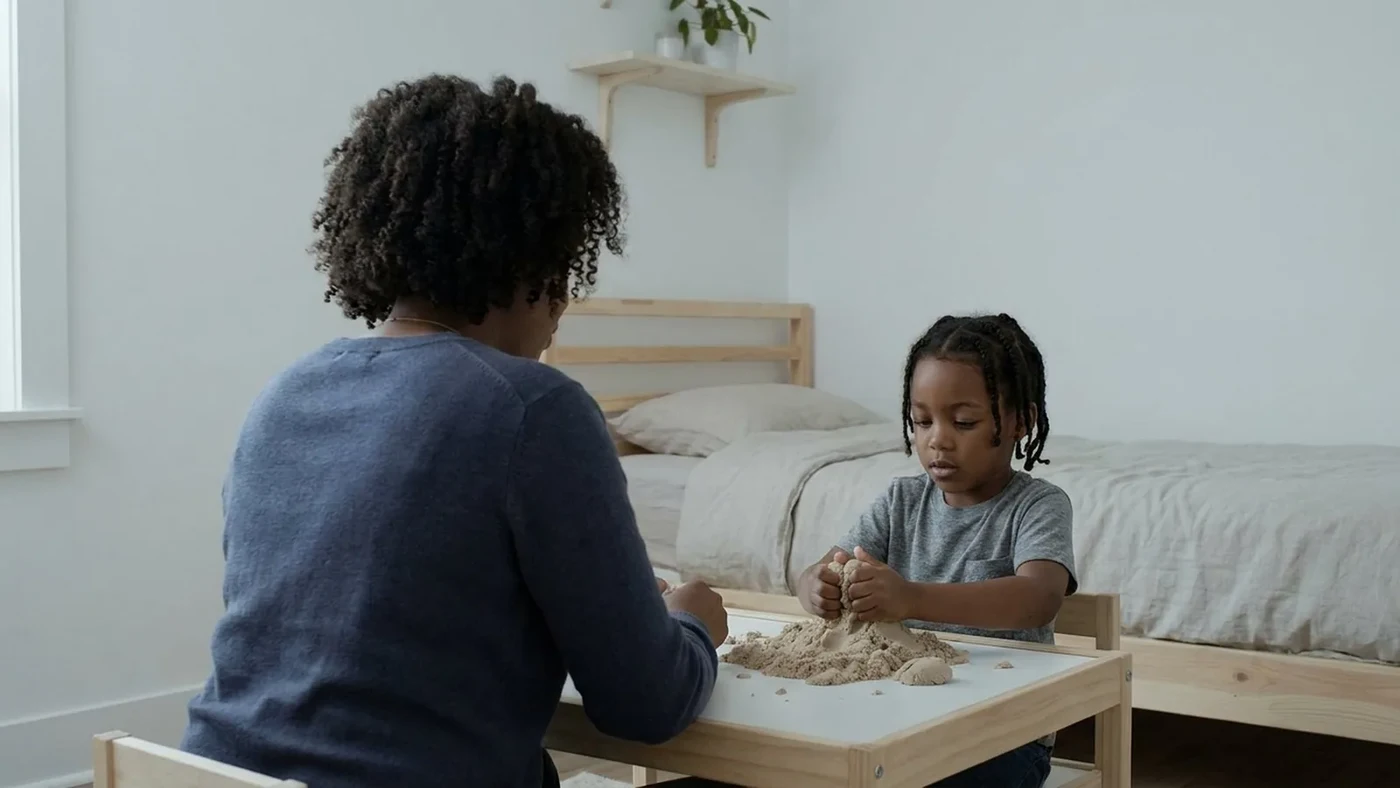
The pediatrician glances at your daughter rocking gently on the exam table and says, very lightly, "we can work on that." Work on what, you want to ask. She is not in distress. She is calmer right now than she has been all morning. But the room has rearranged itself around that one sentence, and you have been turning it over since the appointment ended.
Stimming, the clinical term for the rocking and the hand-flapping and the humming, is one of the most misunderstood pieces of autism. For some kids, it is a tool, the way another kid might bite their nails or twirl their hair, except louder and more visible. For others, it tips into something that gets in the way of school, friendships, or safety. The right response depends on which one you are looking at, and that distinction is usually missed in a fifteen-minute office visit.
This article walks through what stimming actually does, when it is helpful, when it gets in the way, and what an experienced clinician would, and would not, try to change.
Understanding Stimming in Autism
Stimming, short for self-stimulatory behavior, is the umbrella term for repetitive body movements or sounds that show up frequently in autistic individuals and in people with other developmental differences. The most familiar forms include hand flapping, rocking, spinning, and vocalizations like humming or repeating sounds. Stimming serves multiple purposes at once, often working as a quiet pressure-release valve for sensory or emotional overload.
What gets missed in most clinical conversations is that stimming is not inherently a problem. In our practice, we treat it as data first. Many autistic individuals, including adults who can articulate it directly, report that their stims help them regulate during sensory overload, anxiety, or strong positive emotion. The behavior is doing something useful for the person doing it.
| Common Stimming Behavior | Description |
| Hand flapping | Rapid hand movements, often during excitement, anticipation, or nervousness |
| Body rocking | Repeatedly moving back and forth, which can soothe anxiety or sensory overload |
| Spinning | Twisting or turning in circles for vestibular input |
| Vocalizations | Humming, repeating sounds or phrases as a self-regulating sensory output |
Triggers and Emotions
Autistic individuals tend to stim in response to a wide range of internal states: excitement, happiness, boredom, stress, fear, anxiety, and the specific sensation of being overwhelmed. The same child may rock to calm down after a fire drill and rock again, identically, when she is told her favorite show is back on. Same behavior, different driver.
Understanding the trigger is the whole game. A child who is stimming because the lights in the gym are unbearable needs sensory accommodation. A child who is stimming because she is happy is doing something we have no particular reason to disrupt. In our experience, the first useful question a parent can ask is not "how do I stop this" but "what is this doing right now."
| Common Trigger | Associated Emotion |
| Loud noises | Anxiety, stress |
| Social interaction | Overwhelm, fear |
| Changes in routine | Uncertainty, discomfort |
| Excitement or anticipation | Happiness, joy |
Engaging in stimming behaviors is a natural part of daily life for many autistic individuals. The behavior helps them navigate sensory environments and emotional intensity that the rest of us are not necessarily experiencing the same way.
Types of Stimming in Autism
Stimming in individuals with autism takes many forms, and the easiest way to group them is by the sensory channel involved. Each type plays a role in managing sensory overload or emotional intensity, and most children will have a few signature stims that show up reliably across settings.
Auditory and Tactile Stimming
Auditory stimming involves sound-based behaviors. A child might hum, tap rhythmically on a hard surface, or produce repeated sounds that to an outsider seem random but to the child are a steady, predictable input they can control. These behaviors often serve a self-soothing function, particularly in environments that feel chaotic.
Tactile stimming involves touch. Common examples include rubbing hands together, squeezing objects, running fingers over a specific texture, or seeking out particular fabrics. For many children, the tactile loop is where the body recovers from a hard day.
| Type of Stimming | Examples |
| Auditory | Humming, tapping, repeating sounds |
| Tactile | Rubbing hands, squeezing objects, seeking specific textures |
For many children on the autism spectrum, these behaviors function as everyday coping mechanisms, helping the nervous system manage what would otherwise be overwhelming input.
Visual and Movement Stimming
Visual stimming refers to sight-based behaviors. A child might flap her hands close to her face, spin in circles, gaze at lights, or stare at the way ceiling fans move. These behaviors can serve to organize a visual field that otherwise feels chaotic, or to produce input that the child finds calming.
Movement stimming involves physical motion through space: rocking back and forth, bouncing, spinning, pacing. These behaviors recruit the vestibular system, the inner-ear balance system, which for many autistic children is a primary regulation channel. The bouncing kid on the trampoline at the end of school is not just burning energy; she is often using the input to reorganize.
| Type of Stimming | Examples |
| Visual | Hand flapping near face, spinning, gazing at lights |
| Movement | Rocking, bouncing, spinning, pacing |
Visual and movement stims often look the most striking from the outside, which is exactly why they get pathologized fastest. The function, in most cases, is regulation.
Impact of Stimming in Autism
Understanding the impact of stimming behaviors is essential to recognizing the role they play in daily life. These behaviors act as coping mechanisms, communication signals, and, sometimes, sources of social friction the child has no good way to navigate.
Coping Mechanism
Stimming behaviors are, for many autistic children and adults, a reliable coping strategy. They help manage sensory experiences across environments that the rest of the household is not registering as challenging. Many people use stimming to dial down excessive sensory input, including bright lights, loud noises, and the cumulative weight of a hard day.
Autistic adults who can describe their experience consistently report that stimming helps with overwhelming environments, noisy thoughts, and high-anxiety states. The repetitive, predictable nature of the behavior, such as tapping or humming, is itself the soothing element. In our practice, we often see a child's stim rate climb in the third hour of a difficult school day and drop within ten minutes of getting home, which tells us most of what we need to know about its function.
| Benefit of Stimming | Description |
| Sensory regulation | Manages and modulates sensory overload |
| Self-soothing | Reduces anxiety and frustration during stressful moments |
| Communication | Signals internal states like overwhelm, excitement, or fatigue |
Social and Emotional Effects
Stimming behaviors can also carry social and emotional weight. They function, often unintentionally, as a form of communication. Hand-flapping might signal heightened emotion, either excitement or anxiety. Rocking or pacing might signal a need for comfort or a need to move. Once you can read your child's stim vocabulary, you have a faster early-warning system than any clinical checklist.
Socially, the visibility of stimming sometimes leads to misunderstandings with peers, teachers, or strangers who do not know what they are seeing. That can produce isolation or frustration, particularly as children get older and become aware that their stims look different from their peers'. When stimming is understood and accepted in the environment, however, it tends to enhance emotional regulation rather than detract from it.
| Social Effect | Description |
| Misunderstanding | Can produce social friction when others do not recognize the purpose |
| Emotional comfort | Provides relief in stressful or overstimulating situations |
| Non-verbal communication | Signals internal states the child may not have words for |
Stimming behaviors play a vital role in the lives of many autistic individuals, offering both coping strategies and self-expression. Understanding what the behavior is doing is the foundation for any sensible response to it.
Managing Stimming Behaviors
Understanding and supporting stimming behaviors is essential to improving quality of life. The right approach depends almost entirely on whether the stim is helpful, neutral, or interfering, and the work breaks down across behavioral therapy, occupational therapy, and, in narrow situations, medication.
Behavioral and Occupational Therapies
Behavioral and occupational therapies are the backbone of how clinicians support stimming when support is wanted. Applied Behavior Analysis (ABA) is one of the more common frameworks, particularly when a stim is causing harm (head-banging, skin-picking) or significantly interfering with learning, sleep, or relationships. In our practice, our BCBAs design these plans only after doing a function-based assessment, because trying to reduce a stim without understanding what it is doing usually backfires.
The strategies that tend to work look less like extinction and more like skill substitution:
| Strategy | Description |
| Replacement behavior | Teaching an alternative behavior that meets the same sensory or regulatory need |
| Antecedent change | Adjusting the environment so the original trigger occurs less often |
| Self-regulation skill | Teaching the child to recognize her own state and use a tool of her choice |
Punishment is not used to reduce stimming. Research is clear and our experience is clearer: aversive responses increase distress, drive the behavior underground, and often produce new and worse behaviors in its place.
Occupational therapy can layer sensory integration strategies on top of the behavioral work. Activities like jumping on a trampoline, carrying heavy objects, or working with weighted materials provide the sensory input the body is seeking, often reducing the rate of self-stimulatory behavior simply because the underlying need is being met another way. If you want to dig deeper into how ABA approaches sensory profiles in the home, our team specializes in in-home ABA support for sensory needs, where we design these plans inside the actual environments where the stimming is happening.
Medications and Strategies
Medication is not a first-line approach to stimming. In narrow situations, when a stim is causing physical harm or fully blocking participation in meaningful activities, a developmental pediatrician or psychiatrist may discuss medication with the family. Even then, medication should sit inside a broader plan, not stand in for one.
Beyond therapy and medication, several practical strategies show up consistently in homes where stimming is going well:
| Strategy | Description |
| Sensory diet | A scheduled rotation of sensory inputs (movement, deep pressure, oral, visual) that fits the child's profile |
| Regular movement | Built-in physical activity that meets vestibular and proprioceptive needs before the stim escalates |
| Self-management skills | Teaching the child to recognize her own state and choose her own coping tool |
This last piece, self-management, is where skill development work tends to pay off the longest. A child who can name what her body is asking for at age eight is a teenager who can advocate for herself in classrooms and friendships that her parents are not going to be in.
Stimming in Different Conditions
Stimming behaviors look different across conditions, and parents often want help telling whether what they are seeing is autism-specific, ADHD-specific, or just a typical kid being a kid. The behaviors themselves overlap; the function tends to differ.
Autism vs. ADHD Behaviors
Stimming is common in autism, where it most often serves to regulate sensory input or emotional intensity. Autistic individuals may tap, hum, rock, or flap to soothe during stressful situations, and the same stims can appear during high-positive emotion like excitement or joy. The function is usually regulation.
In ADHD, similar-looking behaviors show up but tend to serve a different purpose. Humming, nail-biting, leg-bouncing, and spinning objects often function as ways to channel excess energy or maintain attention. The behaviors can look identical from across the room; the underlying job is different. In our experience, vocal stims that include words or word fragments, like echolalic phrases, tend to point toward an autism profile rather than an ADHD one, though a careful evaluation is the only way to be sure. (We cover one specific version of this in our piece on understanding echolalia and its role in autism communication.)
| Condition | Common Stims | Typical Purpose |
| Autism | Tapping, humming, rocking, flapping | Sensory regulation, emotion modulation |
| ADHD | Humming, nail-biting, spinning objects | Channeling excess energy, attention maintenance |
Neurotypical vs. Autistic Stimming
Neurotypical people stim too. Fidgeting with a pen during a meeting, tapping a foot, chewing the end of a pencil, or twirling hair are all repetitive self-stimulatory behaviors. The difference is intensity, duration, and how essential the behavior is to the person's ability to function.
For neurotypical individuals, stimming usually serves a low-stakes purpose: relieving boredom, helping concentration. For autistic individuals, stimming is more often a primary tool for emotional regulation and sensory management, and removing it without a substitute can have significant cost.
| Group | Common Stims | Typical Motivation |
| Neurotypical | Fidgeting, tapping a pen, twirling hair | Boredom relief, attention support |
| Autistic | Rocking, hand-flapping, vocal stims | Emotional regulation, sensory regulation |
Understanding the variance across conditions and across individuals is the foundation for any sensible support plan. Stimming is not one thing; it is a category of behaviors that may need wildly different responses depending on what is driving them.
Perspective of Autistic Adults on Stimming
Autistic adults have been leading a steady, decades-long pushback against treatment approaches that aim to eliminate self-stimulatory behavior. Their argument, distilled, is that stimming is functional, identity-relevant, and not the clinician's behavior to eliminate.
In our practice, we take this seriously. The case for non-suppression is strong, particularly for stims that are not causing harm, are not significantly interfering with daily life, and are providing real regulatory value. A study of 31 autistic adults aged 21 to 56 found that participants consistently described stimming as an effective tool for managing intense emotions and overwhelming environments, and pushed back hard against interventions designed to extinguish behaviors they relied on. The same adults supported intervention for harmful stims, like skin-picking or head-banging, but drew a sharp line around the non-harmful ones.
This perspective has reshaped how thoughtful clinicians approach stimming. Rather than treating every repetitive behavior as a target for reduction, the question now is: what is this stim doing, who is it bothering, and is the cost of changing it worth the regulatory function being lost? Many BCBAs (including ours) will tell parents directly that a non-harmful stim is not on the list of things to work on. The growing acceptance of stimming as a legitimate form of emotional regulation is shifting how autistic children are supported across home, school, and clinical settings.
| Key Aspect | Description |
| Function of stimming | A coping mechanism and emotional self-regulation tool |
| Resistance to suppression | Autistic advocates oppose interventions that target non-injurious stims |
| Clinical implication | Distinguish harmful from non-harmful stims before deciding whether to intervene |
The perspective shared by autistic adults reflects a deep belief in the value of stimming, framing it not as a deficit but as part of how the autistic nervous system works. For parents trying to make decisions about their child's behavior, that frame is one of the more useful things to have.
Why Mastermind Behavior
Mastermind Behavior is a BCBA-owned and operated in-home ABA therapy practice serving families across New Jersey, Georgia, and North Carolina. Stimming work, in our experience, is rarely about getting a child to stop. It is about understanding what the stimming is doing for the child, protecting the regulating function, and adding more skills around it so the child has options when the world gets loud. Our BCBAs design these supports after watching what happens in your actual living room, your actual hallway, your actual mornings. Behavior Technicians run the day-to-day sessions where new coping skills get rehearsed in the moments that actually trigger sensory overload. Parent training coaches sit with you on the harder days, the ones where the rocking is louder and you are not sure whether to redirect or just let it ride. Most families on our caseload begin direct services within six weeks of their initial assessment, with no onboarding waitlist.
If you have been wondering how to support your child's stimming without trying to suppress a tool they need, we would be glad to talk it through. Schedule a free consultation at mastermindbehavior.com/contact or call 732.813.7333.