What Is an IEP for Autism? A Parent's Guide
What an IEP is, who qualifies, how the process works in NJ, Georgia, and North Carolina, and what your rights are at every step.


Here is the sentence that surprises almost every parent who starts this process: an autism diagnosis does not entitle your child to an IEP. The developmental pediatrician's report, the hours of ADOS testing, the diagnosis you fought six months of waitlists to get: the school system is legally allowed to look at all of it and still say no. And the reverse is just as true: a school can find your child eligible for special education under the autism category without any medical diagnosis at all.
That single fact explains most of the confusion around IEPs, because it reveals what an IEP actually is: not a medical accommodation, but the output of a separate legal system with its own eligibility test, its own evaluators, and its own deadlines that vary by state. Parents who understand that system get better plans for their children. This guide covers what an IEP contains, how a child with autism qualifies, how the process runs step by step in New Jersey, Georgia, and North Carolina, and where your ABA team fits in.
What Is an IEP?
An IEP, or Individualized Education Program, is a written plan that a public school must create for every eligible student with a disability. It is not a courtesy or a school policy. It is a legal document required by the Individuals with Disabilities Education Act (IDEA), the federal law that guarantees eligible children a free appropriate public education, often shortened to FAPE.
Federal regulations at 34 CFR §300.320 define exactly what every IEP must contain:
- Present levels of academic achievement and functional performance, including how the child's disability affects involvement and progress in the general education curriculum
- Measurable annual goals, both academic and functional
- How progress will be measured and when progress reports will be provided
- The special education, related services, and supplementary aids the school will provide, based on peer-reviewed research to the extent practicable
- An explanation of the extent, if any, to which the child will not participate with nondisabled children in the regular class (the least restrictive environment requirement)
- Accommodations for state and district assessments
- The projected start date, frequency, location, and duration of services
- Transition services, beginning no later than the IEP in effect when the child turns 16 (some states, including New Jersey, begin transition planning for teens with autism earlier, so confirm with your district)
Every one of those bullet points is enforceable. If the IEP says speech therapy twice a week for 30 minutes, the school owes your child speech therapy twice a week for 30 minutes.
Does an Autism Diagnosis Automatically Qualify My Child?
As the opening made clear: no. A medical diagnosis of autism spectrum disorder and educational eligibility under the "autism" category are two different determinations made by two different systems, and it's worth understanding exactly how the school's version works.
The Autism Parent Power Podcast covers why a medical diagnosis does not automatically mean school services.
IDEA lists autism as one of its disability categories. Under 34 CFR §300.8, autism means a developmental disability significantly affecting verbal and nonverbal communication and social interaction, generally evident before age three, that adversely affects a child's educational performance. Associated characteristics named in the regulation include repetitive activities, resistance to changes in routine, and unusual responses to sensory experiences. A child who shows these characteristics after age three can still qualify.
To be eligible for an IEP, the school's evaluation team must answer yes to three questions:
- Does the child have a qualifying disability as defined by IDEA?
- Does that disability adversely affect the child's educational performance?
- Does the child need specially designed instruction because of it?
This is why a child with a hospital-issued ASD diagnosis can be found ineligible if the team concludes school performance is not adversely affected, and why a child with no medical diagnosis at all can qualify under the autism category based on the school's own evaluation. If your child has a diagnosis but is managing academically, the school may propose a 504 plan instead, which provides accommodations without specialized instruction. That comparison deserves its own discussion, and the short version is: an IEP changes what and how your child is taught; a 504 changes the conditions around the teaching.
How the IEP Process Works, Step by Step
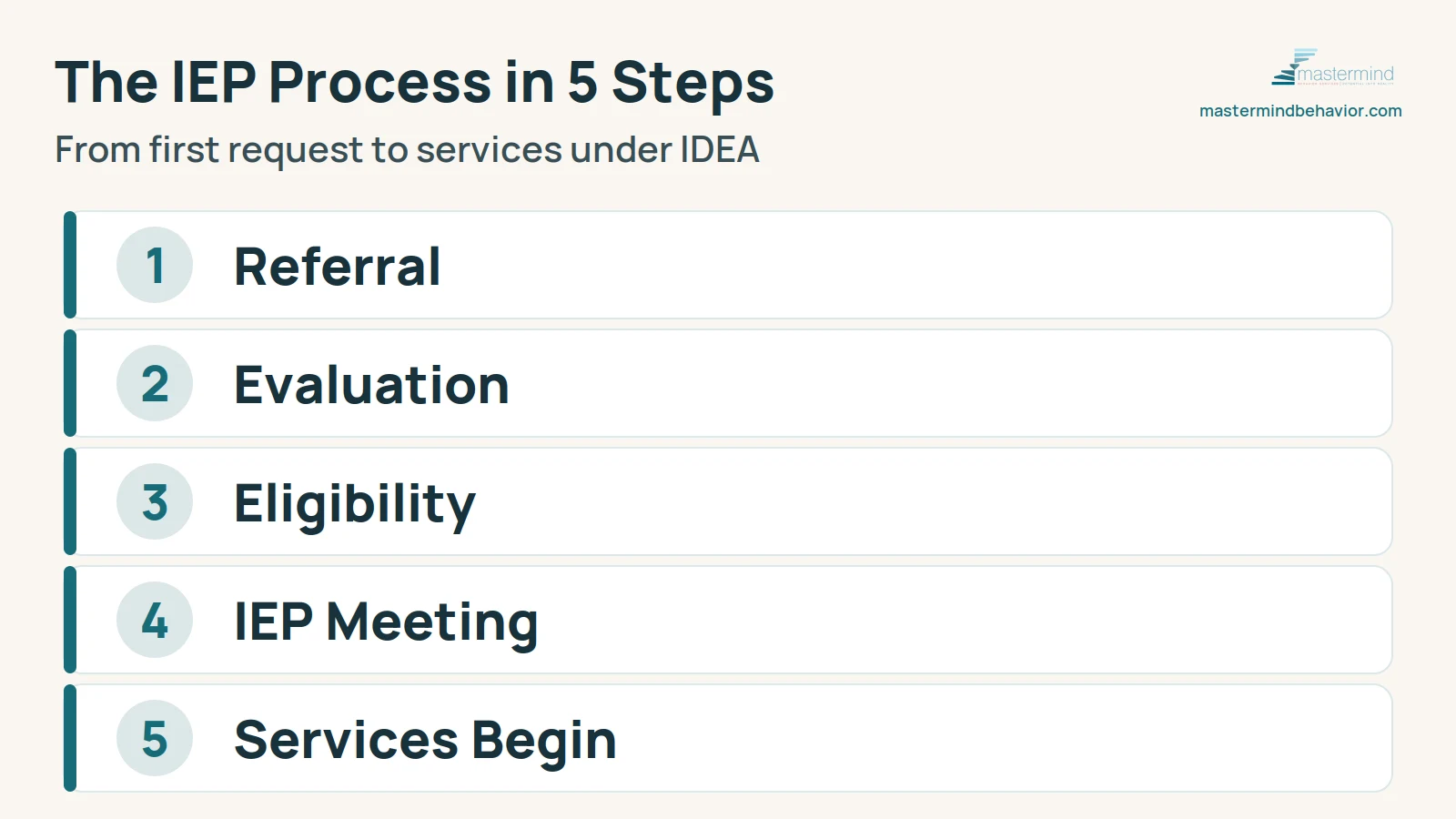
Step 1: Referral
Anyone who suspects a disability can start the process: a teacher, a pediatrician, or you. As a parent, put your request in writing, date it, and address it to the principal or the district's special education office. State explicitly that you are requesting an evaluation for special education under IDEA. The written request matters because in most states it starts a legal clock.
Step 2: Evaluation
If the district agrees to evaluate (and it must respond to your request either way, with written notice if it declines), you'll be asked to sign consent. The evaluation must assess all areas of suspected disability and cannot rely on any single test. For a child with autism, that typically means cognitive and academic testing, speech-language assessment, occupational therapy assessment, behavioral observation, and parent and teacher input.
Federal law gives schools 60 days from parental consent to complete the initial evaluation, unless the state sets its own timeframe, and all three of Mastermind's states handle this differently:
| State | Deadline | Clock starts |
|---|---|---|
| New Jersey | 90 calendar days | Signed parental consent |
| Georgia | 60 calendar days | Signed parental consent |
| North Carolina | 90 calendar days | Your written referral |
New Jersey: the 90 days cover the full arc: evaluation, eligibility determination, and IEP implementation (N.J.A.C. 6A:14-3.4(e)). NJ also requires the child study team to meet within 20 days of a referral to decide whether to evaluate.
Georgia: the 60 days cover completion of the evaluation report (Ga. Rule 160-4-7-.04). If your child is eligible, the IEP meeting must be held within 30 calendar days of the eligibility determination. Summer break pauses the clock.
North Carolina: evaluation, eligibility, and placement must all be completed within 90 days of the written referral itself, which is why putting your request in writing matters most here.
Note the difference in what starts the clock: in North Carolina it's your written referral; in New Jersey and Georgia it's your signed consent. That's a practical reason to respond to consent paperwork quickly.
Step 3: Eligibility Determination
A team that includes you reviews the evaluation results and decides whether your child meets the three-part test above. In New Jersey, you're entitled to copies of evaluation reports at least 10 days before the eligibility meeting. If you disagree with the school's evaluation, you have the right to request an independent educational evaluation (IEE) at public expense.
Step 4: The IEP Meeting
If your child is eligible, the IEP team writes the plan. By regulation, the team includes you, at least one general education teacher, at least one special education teacher, a district representative qualified to commit resources, and someone who can interpret the evaluation results. You may bring anyone with knowledge or special expertise about your child, including, with the district's cooperation, your BCBA. A clinician who works with your child every week in your home often has the most current data in the room about what your child can do and under what conditions.
Step 5: Implementation, Progress Reporting, and Review
Services begin on the date written in the IEP. The school must report progress on IEP goals at least as often as the IEP specifies, the full team must review the IEP at least annually, and the district must reevaluate your child at least every three years unless you and the school agree it's unnecessary. You can request an IEP meeting at any time. You do not have to wait for the annual review.
What Are Your Rights as a Parent?
IDEA builds parents into the process as legal equals, not guests. In practice, that means:
- Consent: The school cannot conduct an initial evaluation or begin initial services without your written consent.
- Participation: You are a required member of the IEP team, and meetings must be scheduled at a mutually agreeable time.
- Prior written notice: Any time the district proposes or refuses to change identification, evaluation, or placement, it must explain why in writing.
- Access to records: You may inspect all of your child's educational records.
- Disagreement paths: Mediation, state complaints, and due process hearings are available if you and the district cannot agree. Every district must give you a procedural safeguards notice explaining these rights; read it once, even though it's dry.
Where ABA Therapy Fits Into the IEP Picture
An IEP and an in-home ABA program are separate systems, one funded through the school under IDEA and one typically funded through insurance, but for a child with autism they work on overlapping skills, and coordination between them is where a lot of progress gets won or lost.
Three practical intersections:
Shared data. The functional behavior assessments, skill assessments, and session data your BCBA collects can inform the school's present-levels statements and goal-setting. Well-written IEP goals and well-written ABA goals follow the same logic: observable behavior, measurable criteria, defined conditions.
Behavior support in the classroom. If behavior impedes your child's learning or others', IDEA requires the IEP team to consider positive behavioral interventions and supports. Many children with autism have a behavior intervention plan (BIP) built into or alongside the IEP, and consistency between the school's BIP and your home behavior support program keeps expectations stable across settings.
Transitions. School entry, grade changes, and the move toward adolescence and adulthood are the moments IEPs matter most and wobble most. Transition planning support can help you prepare for IEP meetings, understand what to ask for, and keep home programming aligned with what the school team is building.
Questions Worth Asking at Your First IEP Meeting
- What data supports each present-level statement, and does it match what we see at home?
- How will each goal be measured, and who is responsible for collecting the data?
- What happens if my child meets a goal in three months instead of twelve?
- How will the school's behavior plan stay consistent with our home program?
- When exactly will services start, and what is the plan if a provider position is unfilled?
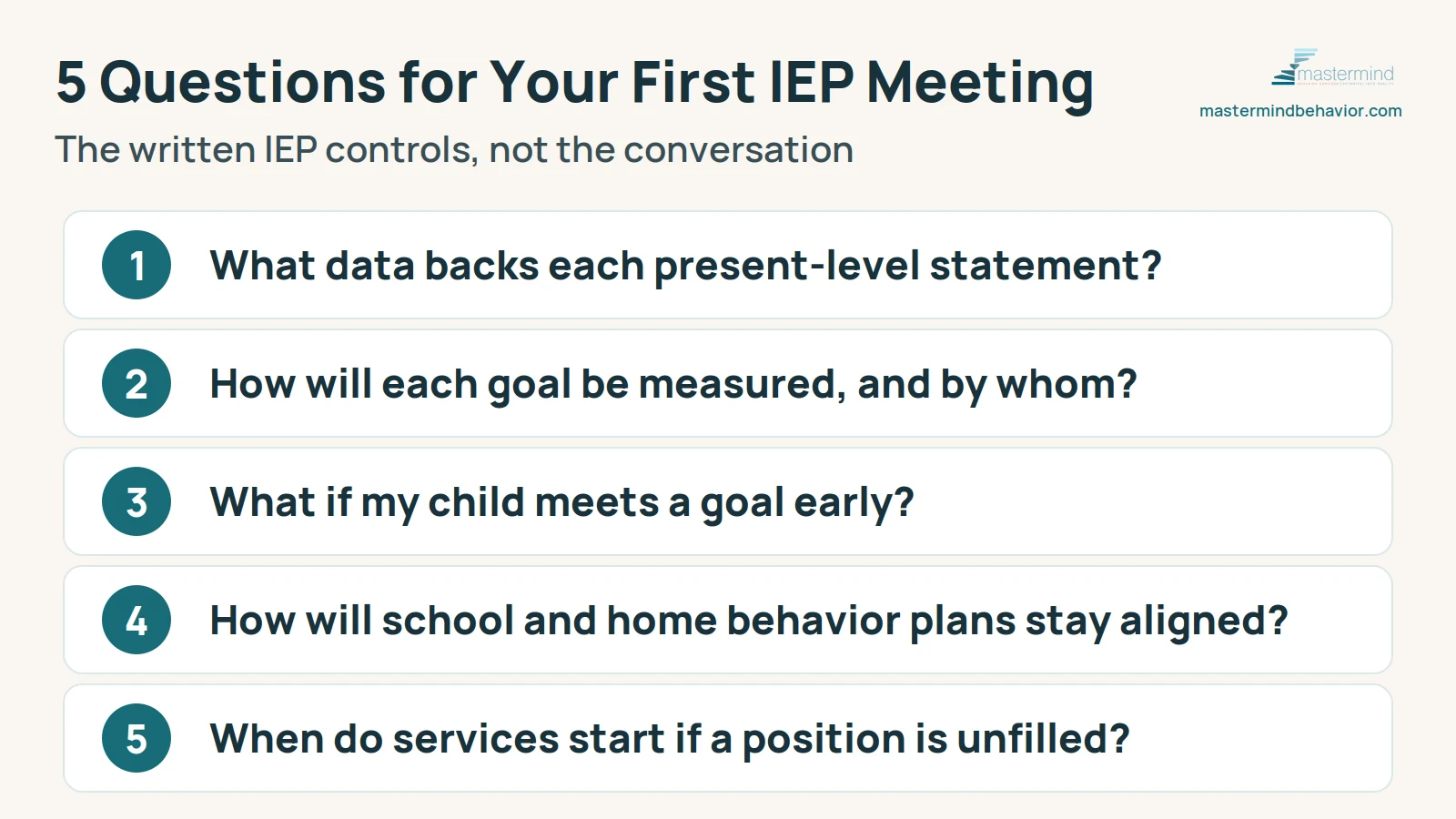
A useful habit: after the meeting, compare the final written IEP against your notes before signing anything. The document controls, not the conversation.
Why Mastermind Behavior
Mastermind Behavior is a BCBA-owned and operated in-home ABA therapy provider serving families across New Jersey, Georgia, and North Carolina. Because our BCBAs work with your child in your home, they walk into IEP meetings with something most of the table doesn't have: current, session-by-session data on what your child can actually do. We help families prepare for evaluations and IEP meetings through ongoing parent training, and we build home programs that stay consistent with what the school team is working on. With a 90%+ staff retention rate and no onboarding waitlist, most families begin direct services within six weeks of their initial assessment.
If you're exploring ABA therapy for your child, schedule a free consultation or call us at 732.813.7333. We'll walk you through what's possible and help you figure out the right next step. No pressure, no commitment.
References
- 34 CFR §300.320, Definition of individualized education program, Electronic Code of Federal Regulations
- 34 CFR §300.8, Child with a disability (autism definition), Electronic Code of Federal Regulations
- 34 CFR §300.301, Initial evaluations, Electronic Code of Federal Regulations
- N.J.A.C. 6A:14, Special Education, New Jersey Department of Education
- Special Education Services and Supports (Rule 160-4-7-.04), Georgia Department of Education
- Exceptional Children Division, North Carolina Department of Public Instruction