Signs of Autism in a 1-Year-Old: Gestures, First Words, and What Matters Most
What most 1-year-olds do per CDC milestones, the differences that matter most (gestures, babbling, name response, joint attention), and how to use the window before the 18-month screening.

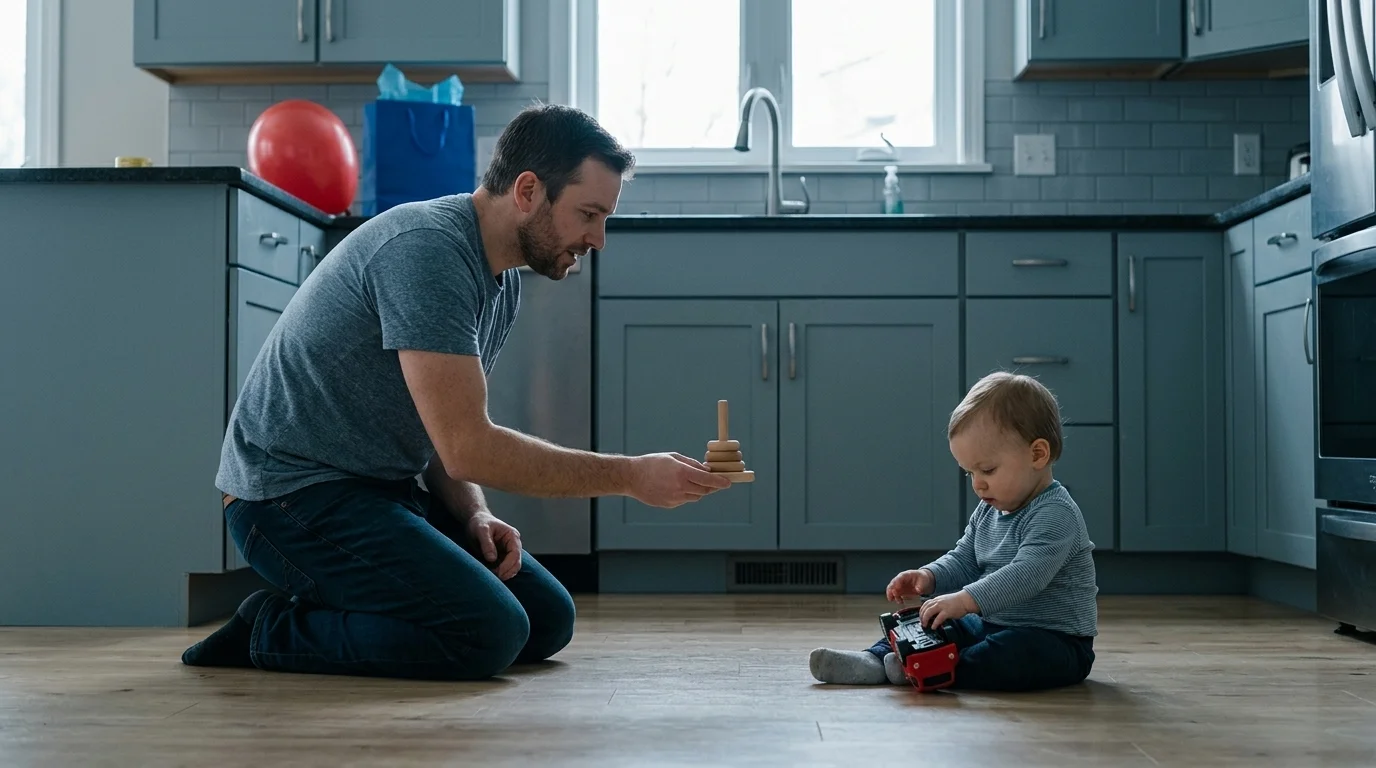
Few dates carry more silent expectation than a first birthday. Somewhere in the back of most parents' minds sits a checklist for this milestone: walking soon, a word or two, waving at the grandparents. The truth about twelve months is that the range of typical is wide, first steps can land anywhere from 9 to 18 months, first words just as broadly, and a quiet first birthday is very often just a quiet first birthday.
But twelve months is also the age where the communication foundations become genuinely readable. Gestures, shared games, name response, and the first stirrings of words are all on the table now, and their broad absence is more informative than it was at six or nine months. This guide covers what most children do by one year according to the CDC's milestone checklists, the differences most worth noting, and how to use the window between now and the 18-month autism screening well.
What Most Children Do by 1 Year
The CDC's Learn the Signs. Act Early. checklists, revised in 2022, define milestones as things most children, 75 percent or more, can do by a given age. By one year:
- Social and emotional: plays games with you, like pat-a-cake
- Language and communication: waves bye-bye; calls a parent "mama" or "dada" or another special name; understands "no" and pauses briefly or stops when you say it
- Cognitive: puts something in a container, like a block in a cup; looks for things he sees you hide, like a toy under a blanket
- Movement: pulls up to stand; walks holding on to furniture; drinks from a cup without a lid as you hold it; picks things up between thumb and pointer finger
Use corrected age if your child was born more than three weeks early.
The Differences That Matter Most at One Year
Every item below is a "may," not an "is," and patterns across weeks matter more than any single moment. With that said, twelve months has a shortlist that clinicians take seriously. In a landmark study, researchers could distinguish one-year-olds later diagnosed with autism just by watching first-birthday-party home videos, largely through looking at others' faces, showing objects, pointing, and responding to their name (Osterling and Dawson, 1994):
- Few or no gestures. Waving, reaching to be picked up, showing you things, and early pointing are how a one-year-old talks before talking. Their broad absence by twelve months is one of the most consistently cited early flags, because gestures are the bridge to spoken language.
- No babbling, and no word-like sounds. Not just quiet, but little of the varied, speech-like babble that usually fills this age, and no "mama" or "dada" used for a specific person.
- Not responding to her name consistently, a signal that carries forward from nine months and grows more meaningful with each month it persists.
- No shared games. Pat-a-cake and peekaboo are formally on the checklist because back-and-forth play is social communication in its purest early form.
- Limited joint attention. Not following your point, not looking back and forth between a toy and your face, not holding things up to share the experience: these are the joint attention skills that this age is built around.
- Unusual, repetitive object use that dominates play: spinning wheels rather than rolling the car, lining things up, or intense fixation on parts of objects.
- Loss of any skill she previously had. Words, sounds, gestures, or social behaviors that fade or disappear deserve prompt attention at any age, and the 12-to-24-month window is when parents most often report it. Skill loss is never a wait-and-see signal.
Why One Behavior Is Never the Whole Answer
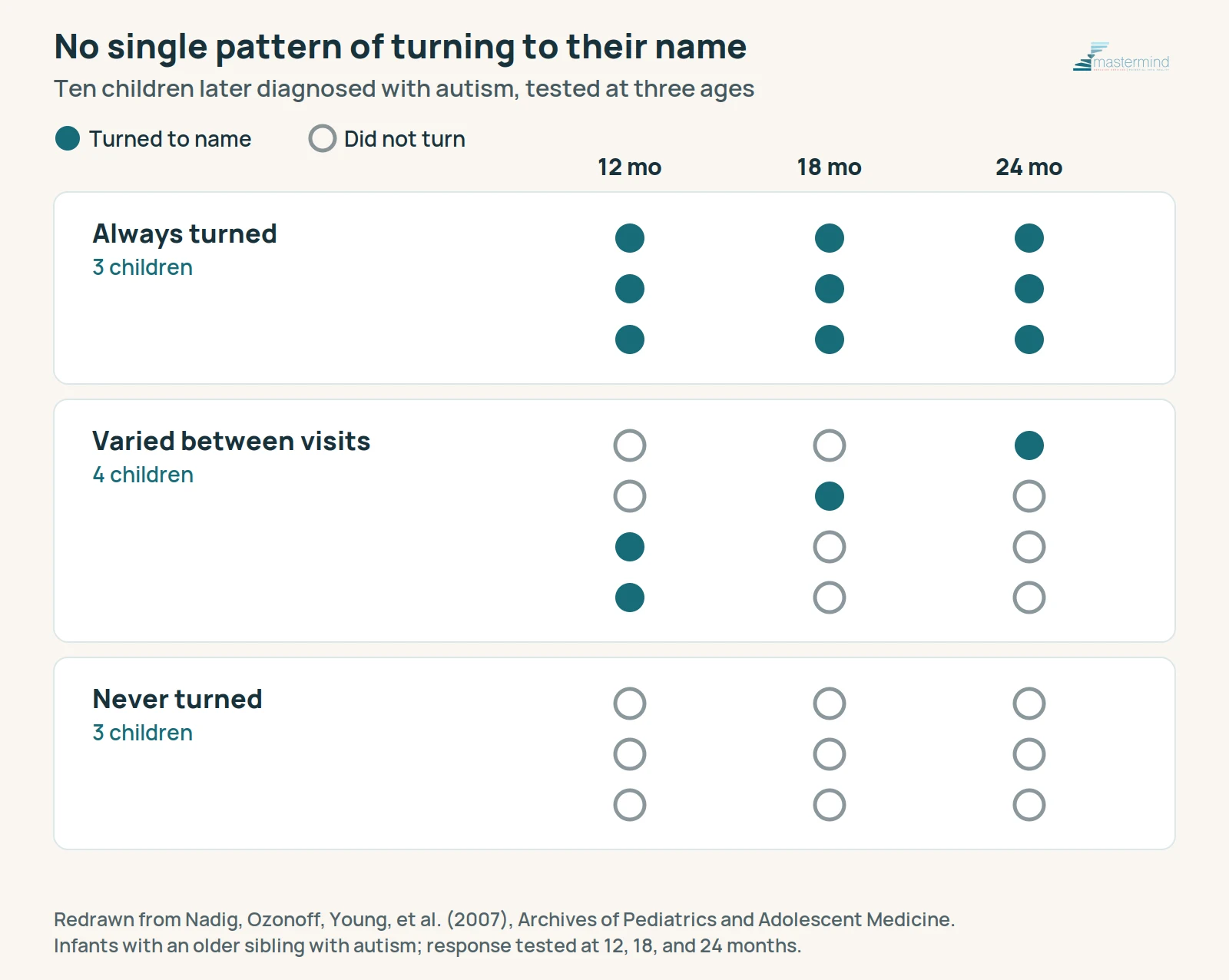
Response to name is the single most studied behavior on the list above, which makes it a useful illustration of how any one behavior should be weighed. In a prospective study that tested the same children repeatedly, researchers followed ten children who were later diagnosed with autism and recorded whether each turned when called at twelve, eighteen, and twenty-four months (Nadig et al., 2007). Three of them turned every time. Three never did. The remaining four moved back and forth between visits.
That is the case for watching patterns rather than moments. Failing to turn at twelve months was meaningful in that study, since none of the low-risk babies failed and three of every four children who did fail had a developmental difference of some kind by age two. But turning reliably ruled nothing out, and a single visit never told the whole story. The same logic applies to every item on this page: it is the combination, sustained across settings and weeks, that is worth acting on.
The Window Between Screenings
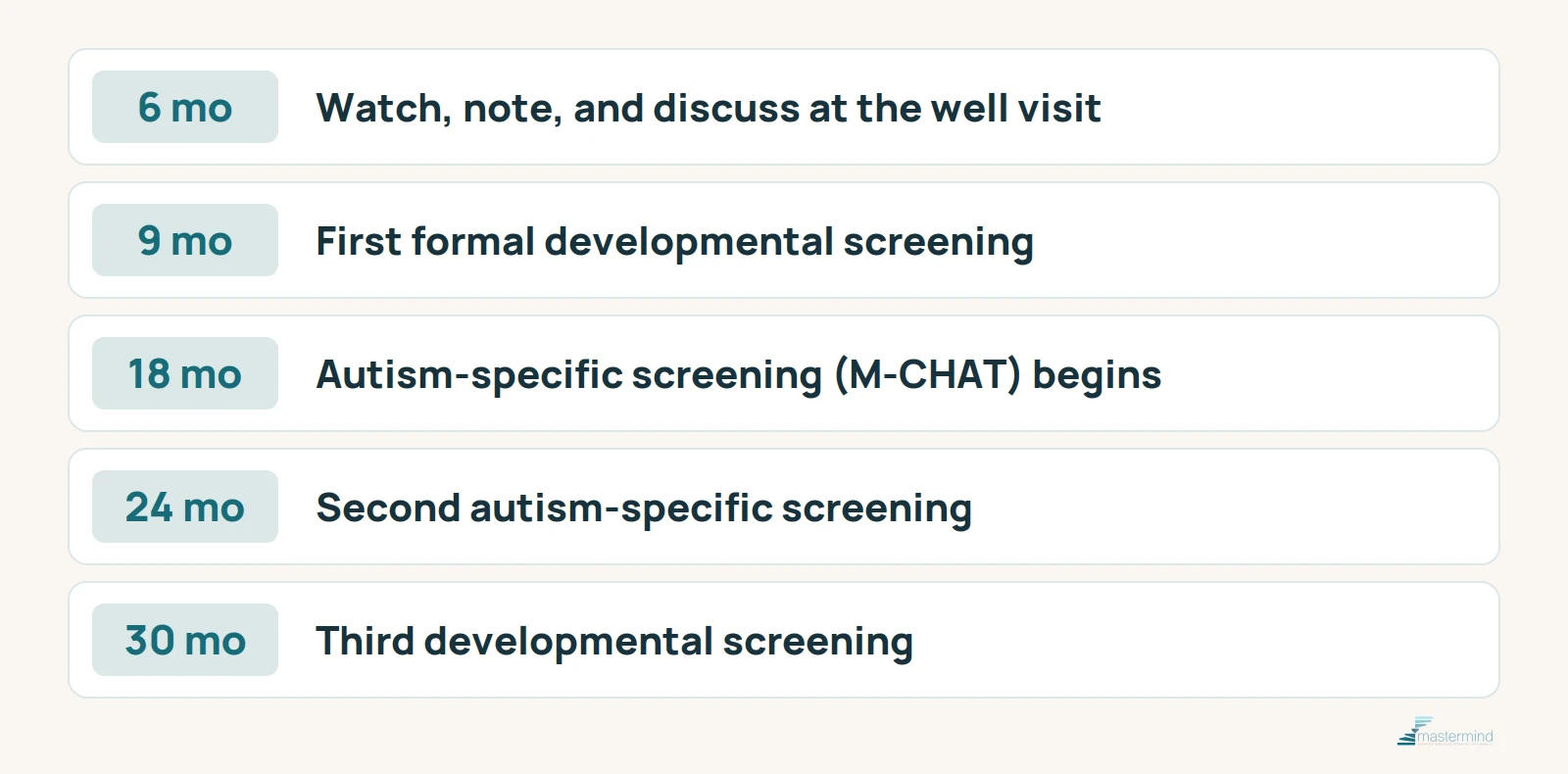
Twelve months sits between the formal checkpoints: the nine-month developmental screening is behind you, and the first autism-specific screening, usually the M-CHAT questionnaire, arrives at 18 months. That gap is not a waiting room. The CDC states the AAP recommendation plainly: screening at 9, 18, and 30 months, autism screening at 18 and 24 months, or whenever a parent or provider has a concern. A documented concern at the 12-month visit is grounds for screening and referral right then, not in six months.
What to Do at One Year if You're Concerned
Film the specific things. A week of short videos targeting the shortlist above, name response, gesture attempts, shared play, gives your pediatrician evidence instead of adjectives. We laid out this playbook at six months and nine months; at twelve, the behaviors to film are simply better defined.
Ask for the screen now, not at 18 months. If your observations match several items on the shortlist, ask your pediatrician to administer an autism-specific screening at this visit under the concern clause, or to refer directly for evaluation.
Call early intervention yourself. Part C early intervention evaluates children under three for free, based on delay rather than diagnosis, on a parent's own referral. At twelve months with persistent concerns, running this in parallel with the pediatrician conversation loses nothing and can save months, and months matter.
Watch the trend, on a schedule. If the decision is to watch, make it active: a defined list, a four-to-six-week window, and a booked follow-up.
Questions for the 12-Month Well Visit
- Here are videos of her name response and play from this week. What's your read?
- Given these observations, is there a reason to wait for 18 months rather than screen now?
- What would a referral for a developmental evaluation involve, and how long are local waitlists?
- Should we start an early intervention evaluation in parallel? How does that work in our state?
- Exactly which changes between now and 15 months would raise or lower your concern?
Why Mastermind Behavior
Mastermind Behavior is a BCBA-owned and operated in-home ABA therapy provider serving families across New Jersey, Georgia, and North Carolina. The year between a first birthday and a diagnosis is where families most often lose time to waitlists and wait-and-see, and we help parents use it instead: reading what they're seeing, preparing for screenings, and navigating early intervention. When a child begins services, our parent training makes you a working part of the team from the first week. With a 90%+ staff retention rate and no onboarding waitlist, most families begin direct services within six weeks of their initial assessment.
If your one-year-old's development is raising questions, schedule a free consultation or call us at 732.813.7333. We'll walk you through what's possible and help you figure out the right next step. No pressure, no commitment.
References
- Important Milestones: Your Baby by One Year, CDC, Learn the Signs. Act Early.
- CDC's Developmental Milestones, Centers for Disease Control and Prevention
- Recommendations for Preventive Pediatric Health Care (Periodicity Schedule), American Academy of Pediatrics
- Osterling J, Dawson G. Early recognition of children with autism: a study of first birthday home videotapes. Journal of Autism and Developmental Disorders, 1994
- Nadig AS, Ozonoff S, Young GS, et al. A prospective study of response to name in infants at risk for autism. Archives of Pediatrics and Adolescent Medicine, 2007