Signs of Autism in a 6-Month-Old: What Parents Can Actually Watch For
Autism can't be diagnosed at 6 months, but development is observable now. CDC milestones, the differences worth noting, the screening timeline, and what to do next.


No one can diagnose autism at six months. That sentence is true, and it is also not the end of the conversation, because six months is not too early to pay attention. The earliest reliable autism diagnoses happen between 18 and 24 months, but development is observable long before it is diagnosable, and the things worth watching at six months are specific, describable, and worth writing down.
This guide covers what most babies do by six months according to the CDC's milestone checklists, the early differences researchers and parents notice, what the screening timeline looks like from here, and exactly what to do at this age if something feels off. One ground rule up front: no single behavior on this page is diagnostic, and many babies who show one or two of these differences develop typically. The goal at six months is observation, not conclusion.
What Six Months Is, and Is Not, for Autism
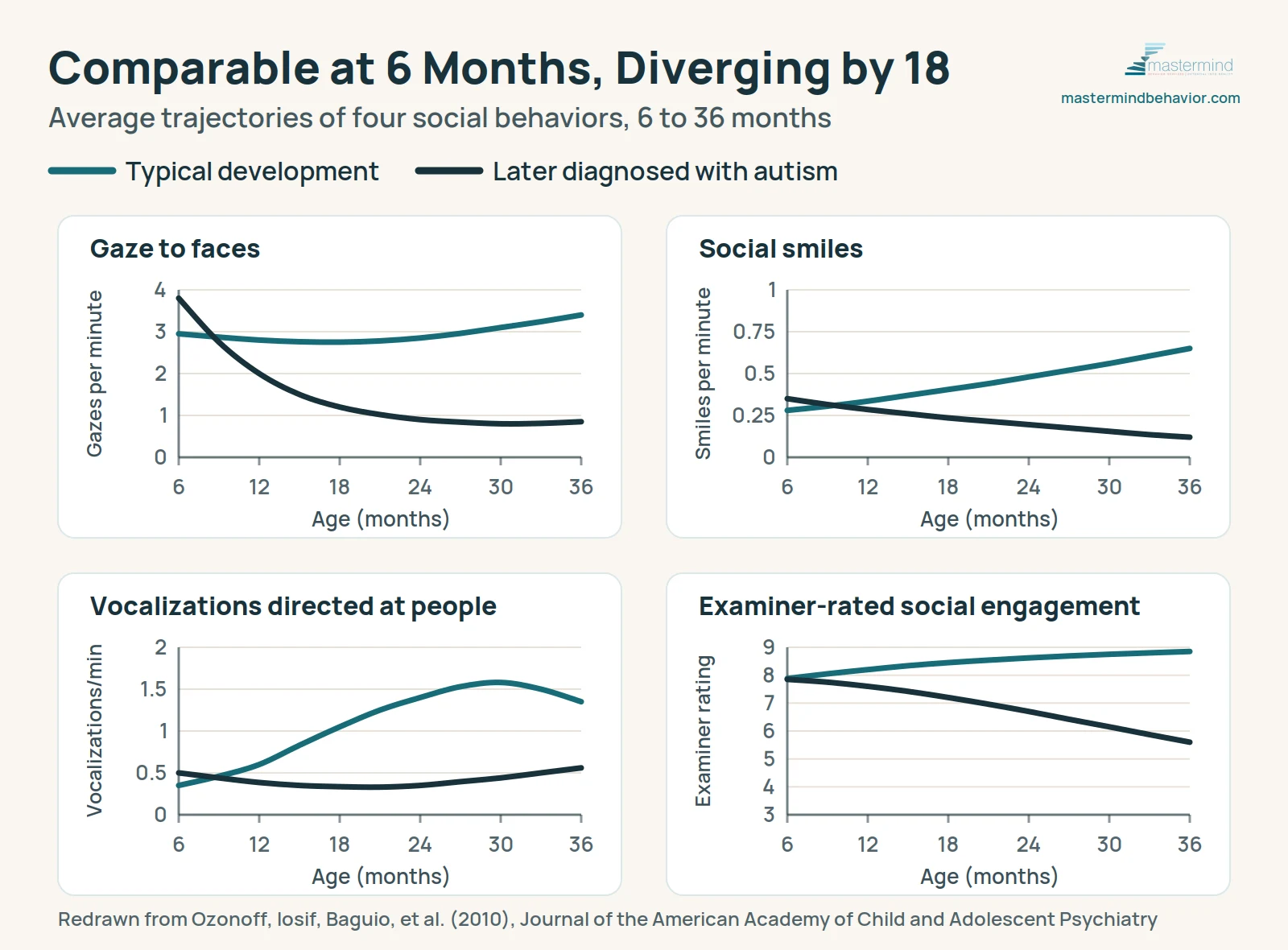
Autism is diagnosed through behavioral observation, and many of the behaviors clinicians evaluate, like pointing, pretend play, and spoken words, have not developed yet in any six-month-old. That is why formal autism screening does not start at this age. What exists at six months is the foundation underneath those later skills: shared attention, social enjoyment, back-and-forth communication in sounds and expressions. In one prospective study that followed infants from six months of age, social behaviors like gaze to faces, shared smiles, and vocalizations directed at people were comparable at six months and then declined between six and eighteen months in the children later diagnosed with autism (Ozonoff et al., 2010). That is exactly the window a six-month-old is entering. Watching is reasonable. Concluding is premature.
What Most Babies Do by 6 Months
The CDC's Learn the Signs. Act Early. milestone checklists define milestones as things most children, 75 percent or more, can do by a given age. By six months, that list includes:
- Social and emotional: knows familiar people, likes to look at herself in a mirror, laughs
- Language and communication: takes turns making sounds with you, blows raspberries, makes squealing noises
- Cognitive: puts things in her mouth to explore them, reaches to grab a toy she wants, closes lips to show she doesn't want more food
- Movement: rolls from tummy to back, pushes up with straight arms on tummy, leans on hands to support herself when sitting
One practical note from the CDC's own guidance: if your baby was born more than three weeks early, use corrected age when reading any milestone list.
Differences Parents and Researchers Notice at This Age
Against that backdrop, these are the patterns that make pediatricians want to watch more closely when they persist. Each one is a "may," not an "is":
- Limited eye contact during feeding, play, and face-to-face moments, or eye contact that has decreased since earlier months
- Little social smiling or shared enjoyment: the baby smiles at objects or alone but rarely in response to your smile or voice
- Not laughing or squealing in playful back-and-forth moments
- Limited vocal turn-taking: you make a sound, pause, and get little back, consistently
- Low response to faces and voices compared to strong interest in objects, lights, or patterns
- Limited shared attention foundations, such as rarely following your gaze or checking your face during play, precursors to the joint attention skills that develop over the next several months
- Unusually intense fixation on specific objects or visual patterns for long stretches
The pattern that matters most is not any single item but the combination and the trend: multiple differences, across settings, that persist or increase over weeks rather than fade. And one signal always deserves prompt attention at any age: a baby who loses skills she previously had, such as sounds or social responses that disappear.
The Screening Timeline From Here
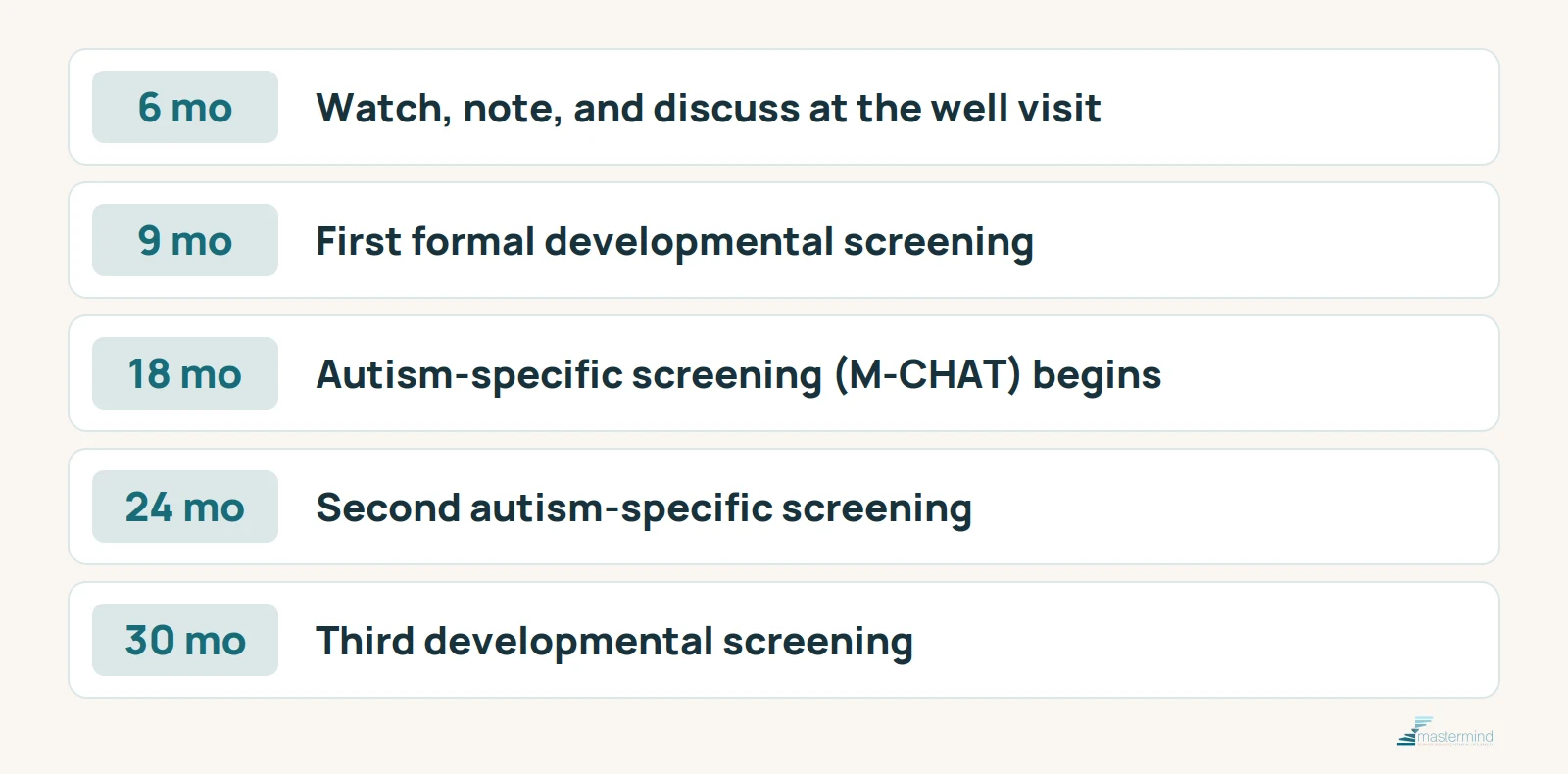
The American Academy of Pediatrics builds screening into the well-visit schedule: general developmental screening at 9, 18, and 30 months, and autism-specific screening (most commonly the M-CHAT questionnaire) at 18 and 24 months. The six-month well visit sits just before that machinery starts, which makes it the right moment to put observations on the record. Nothing about that schedule prevents earlier attention: developmental surveillance, meaning your pediatrician asking about and responding to concerns, is supposed to happen at every single visit.
What to Do at Six Months if You're Concerned
Write it down and film it. Short phone videos of the moments that concern you, taken across a week or two, are worth more to a clinician than any description from memory.
Raise it explicitly at the well visit. Not "is this normal?" but "I've noticed limited eye contact and little back-and-forth sound play, and I'd like to track it with you." Specific observations get specific responses.
Know that early intervention does not require a diagnosis. Every state runs a Part C early intervention program for children under three, and eligibility is based on developmental delay, not an autism diagnosis. A free evaluation can be requested by a parent directly, without a doctor's referral. If concerns persist at nine or twelve months, this is the door that opens earliest, and acting early is the single most evidence-backed move available to parents.
Do not wait silently. The wait-and-see instinct is understandable and often fine, but it works best when it is active: a defined observation window, notes, and a scheduled follow-up, rather than an open-ended hope that it resolves.
Questions for the 6-Month Well Visit
- Here is what I've observed and filmed. What would you want to see change by the 9-month visit?
- How is my baby doing on the CDC 6-month milestones, using corrected age if premature?
- What developmental screening will happen at 9 months, and what does it involve?
- At what point would you refer us for a specialist or early intervention evaluation?
- What should I try at home over the next three months, and what would improvement look like?
Why Mastermind Behavior
Mastermind Behavior is a BCBA-owned and operated in-home ABA therapy provider serving families across New Jersey, Georgia, and North Carolina. Families often first talk to us long before a diagnosis, while they are still in the watching-and-wondering stage this article describes, and we help them understand what they are seeing, prepare for pediatrician conversations, and navigate early intervention referrals. When a child does begin services, our parent training makes you a working part of the team from day one. With a 90%+ staff retention rate and no onboarding waitlist, most families begin direct services within six weeks of their initial assessment.
If you're watching your baby's development and want to talk it through, schedule a free consultation or call us at 732.813.7333. We'll walk you through what's possible and help you figure out the right next step. No pressure, no commitment.
References
- Important Milestones: Your Baby by Six Months, CDC, Learn the Signs. Act Early.
- Learn the Signs. Act Early., Centers for Disease Control and Prevention
- Recommendations for Preventive Pediatric Health Care (Periodicity Schedule), American Academy of Pediatrics
- Ozonoff S, Iosif AM, Baguio F, et al. A prospective study of the emergence of early behavioral signs of autism. Journal of the American Academy of Child and Adolescent Psychiatry, 2010