Signs of Autism in a 9-Month-Old: The First Screening Age
Nine months is the first formal screening age. CDC milestones, the differences that matter most at this age, what the screening involves, and what to do with the result.


Nine months is the age when watching becomes measuring. It is the first well visit where the American Academy of Pediatrics recommends a formal developmental screening, a standardized questionnaire rather than a casual conversation, which makes this the checkup where a parent's private observations meet a validated tool for the first time. If you have been quietly wondering about your baby's development, nine months is when the system is built to hear you.
This guide covers what most babies do by nine months according to the CDC's milestone checklists, the differences worth noting at this specific age, what the nine-month screening actually involves, and what to do with a result in either direction. The same ground rule as every age applies: no single behavior here is diagnostic, autism is not reliably diagnosed until 18 to 24 months, and many babies who show one or two of these differences develop typically. Nine months is for measuring and documenting, not concluding.
What Most Babies Do by 9 Months
The CDC's Learn the Signs. Act Early. checklists define milestones as things most children, 75 percent or more, can do by a given age. By nine months:
- Social and emotional: is shy, clingy, or fearful around strangers; shows several facial expressions like happy, sad, angry, and surprised; looks when you call her name; reacts when you leave, by looking, reaching, or crying; smiles or laughs when you play peekaboo
- Language and communication: makes different sounds like "mamamama" and "bababababa"; lifts arms up to be picked up
- Cognitive: looks for objects when dropped out of sight; bangs two things together
- Movement: gets to a sitting position by herself; moves things from one hand to the other; uses fingers to rake food toward himself; sits without support
As with every milestone list, use corrected age if your baby was born more than three weeks early.
Differences Worth Noting at Nine Months
Three of the nine-month milestones sit at the center of what clinicians watch for autism specifically, which makes this age more informative than six months. Each item below is a "may," not an "is":
- Not responding to her name consistently. Name response is a formal nine-month milestone, and reduced response to name is one of the most studied early differences in infants later diagnosed with autism, with the clearest evidence by 12 months (Nadig et al., 2007). The key word is consistently: across days, settings, and speakers, when she is not absorbed in something else.
- Little or no consonant babbling. The repeated "mamama" and "bababa" strings matter because they are the raw material of speech and of vocal back-and-forth.
- Limited shared games. No smiling or laughing at peekaboo, and little of the anticipation that goes with it, touches the shared-enjoyment foundation that later becomes joint attention.
- A narrow range of facial expressions, or expressions that rarely occur in response to yours.
- Not reacting when you leave, and little stranger awareness. The nine-month social milestones are largely about relationships registering; their broad absence is worth noting.
- Few communicative gestures emerging, such as lifting arms to be picked up, and little of the reaching-toward-you communication that precedes pointing.
- Stronger interest in objects than in people, sustained across settings.
The pattern rules from every age still apply: combinations matter more than single items, trends matter more than snapshots, and one signal always warrants prompt attention: losing sounds, gestures, or social behaviors she previously had.
How Much Weight the Name Test Actually Carries
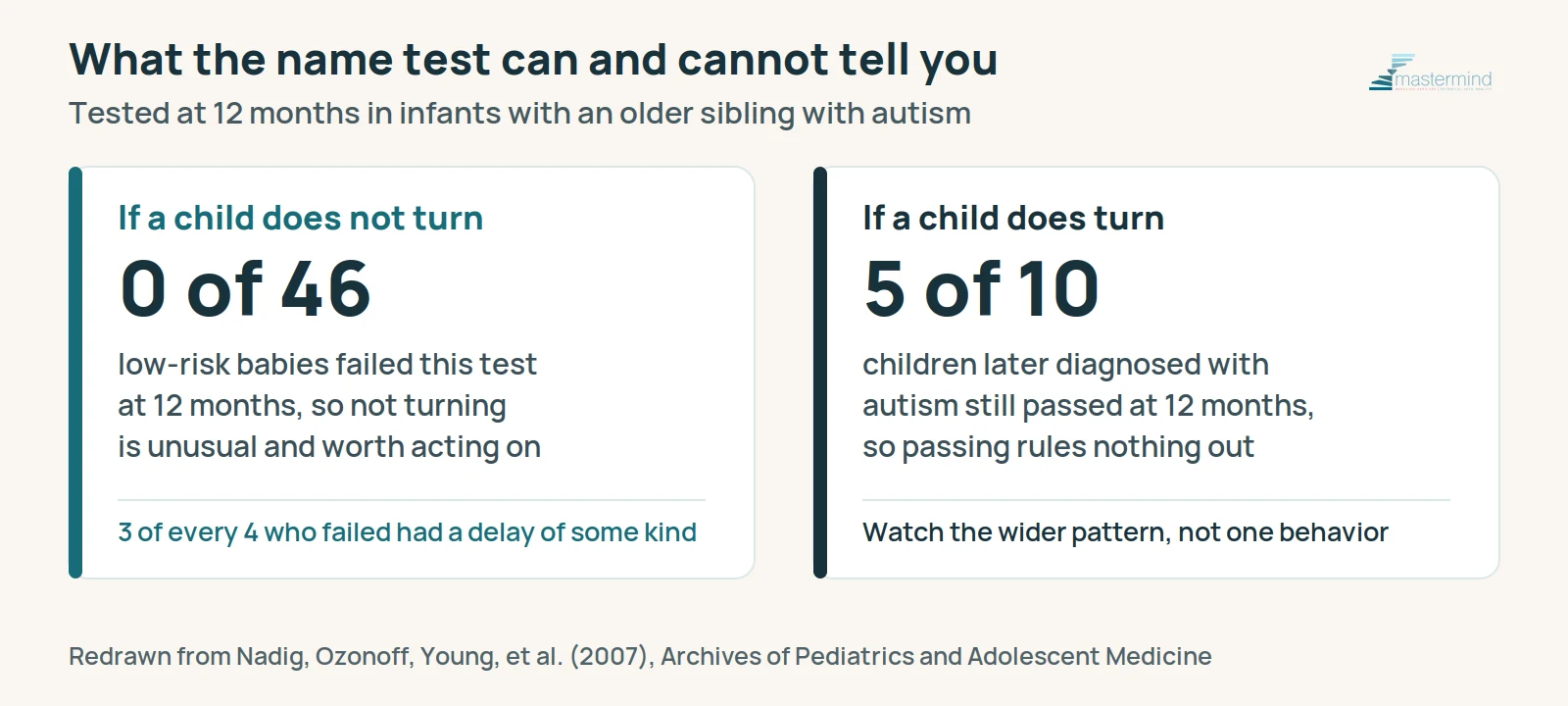
Because name response comes up so often, it is worth knowing exactly how much it proves. Researchers tested it directly, calling each child's name up to three times while the child played, first at six months and again at twelve (Nadig et al., 2007). At six months, the difference between groups was small enough that it did not reach statistical significance, which is part of why nine months is a watching age rather than a testing one. By twelve months the picture sharpened: every one of the low-risk babies turned by the second call, while some of the infants at elevated likelihood did not, and three of every four children who failed at twelve months turned out to have a developmental difference of some kind by age two.
The other half of that finding matters just as much. Of the ten children in the study later diagnosed with autism, five had passed the name test at twelve months, three of them passed at every single visit through age two, and several moved back and forth between passing and failing. A baby who turns every time is not ruled out, and a baby who is slow to turn is not diagnosed. This is the clearest evidence there is for the rule this guide keeps repeating: watch the pattern across many behaviors and many weeks, not one behavior on one day.
What the 9-Month Screening Involves
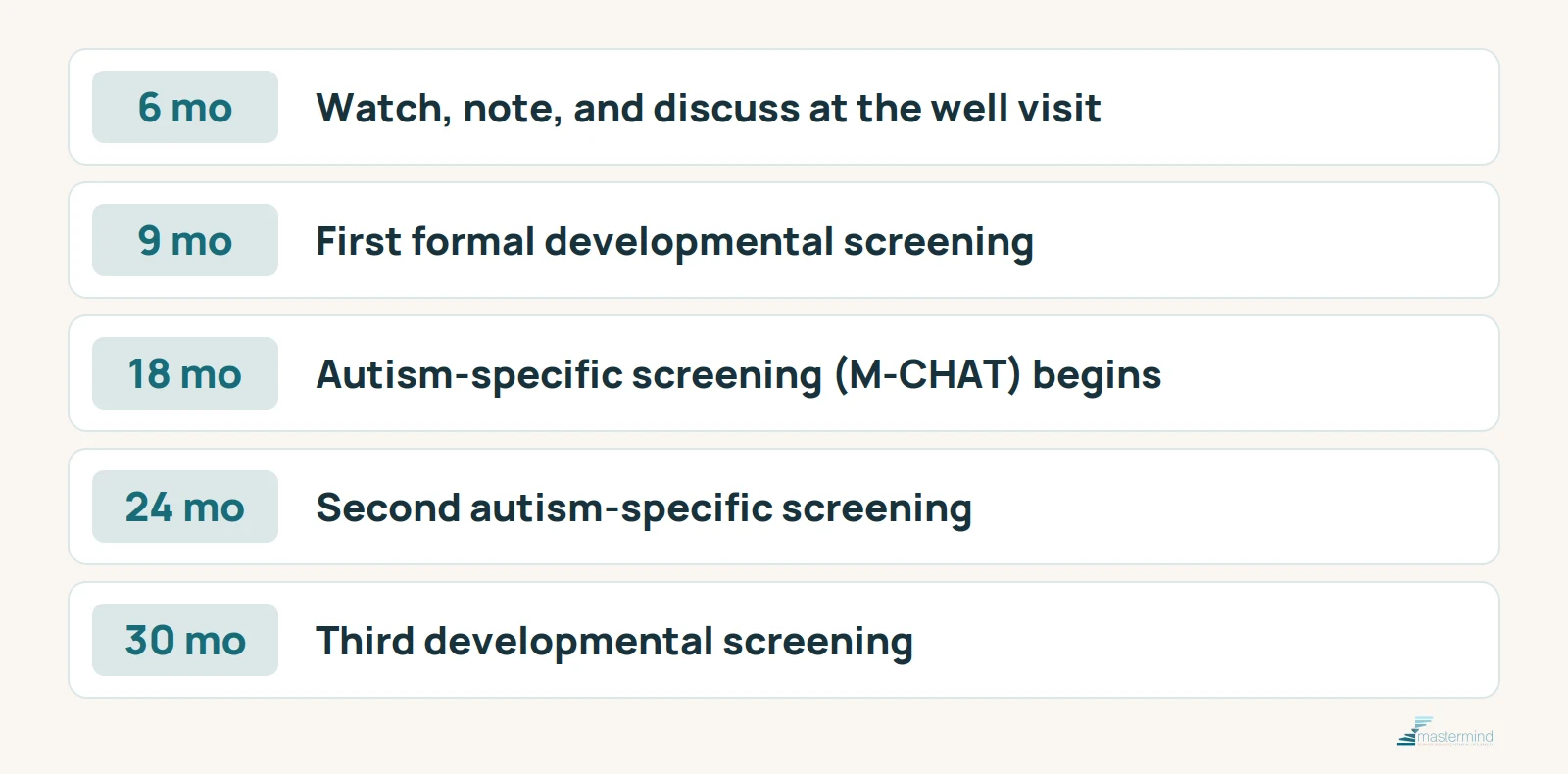
The nine-month screening is a general developmental screening, not an autism-specific one; autism-specific questionnaires enter at 18 and 24 months. In practice, most pediatricians use a standardized parent questionnaire covering communication, motor, problem-solving, and social skills, and the CDC notes the AAP recommendation directly: screening with validated tools at 9, 18, and 30 months, and for autism at 18 and 24 months, or whenever a parent or provider has a concern. That last clause matters more than the schedule: a documented parental concern is grounds for screening and referral at any visit, at any age.
Two outcomes are possible, and both have a next step. A passing screen with ongoing parental concern should still produce a plan: what to watch, and a defined follow-up. A flagged screen typically leads to a referral for further evaluation and, in parallel, to your state's early intervention program.
What to Do at Nine Months if You're Concerned
Bring evidence, not just worry. A week of short phone videos, especially of name-response attempts and play interactions, gives the screening conversation something concrete to work with.
Make the concern part of the record. Ask that your specific observations be documented in the visit notes. Documented concerns trigger the "whenever a parent has a concern" clause and make the follow-up traceable.
Use the early intervention door directly. Part C early intervention serves children under three based on developmental delay, no autism diagnosis required, and a parent can request a free evaluation without a physician referral. At nine months, with a flagged screen or persistent concerns, this is the fastest route to support, and acting early is the most evidence-backed choice available.
Set the next checkpoint. Whatever the screen shows, leave the visit with a date: what you and the pediatrician expect to see by twelve months, and what happens if it is not there. We covered the six-month version of this playbook in our 6-month guide, and the 1-year guide picks it up at the next visit; the discipline is the same at each age, with better tools each time.
Questions for the 9-Month Well Visit
- Which developmental screening tool are you using today, and what does my baby's result mean?
- Her name response looks like this on video. Is this within the range you'd expect?
- If we're still seeing these differences at 12 months, what is the referral path?
- Should we contact early intervention now, and how does that work in our state?
- What specifically should I watch for between now and the 12-month visit?
Why Mastermind Behavior
Mastermind Behavior is a BCBA-owned and operated in-home ABA therapy provider serving families across New Jersey, Georgia, and North Carolina. Many families first reach out to us in exactly this window, after a nine-month screen raised questions or a pediatrician said "let's watch it," and we help them read the results, prepare for follow-ups, and navigate early intervention referrals. When a child begins services, our parent training makes you a working part of the team from the first week. With a 90%+ staff retention rate and no onboarding waitlist, most families begin direct services within six weeks of their initial assessment.
If your baby's screening raised questions, schedule a free consultation or call us at 732.813.7333. We'll walk you through what's possible and help you figure out the right next step. No pressure, no commitment.
References
- Important Milestones: Your Baby by Nine Months, CDC, Learn the Signs. Act Early.
- CDC's Developmental Milestones, Centers for Disease Control and Prevention
- Recommendations for Preventive Pediatric Health Care (Periodicity Schedule), American Academy of Pediatrics
- Nadig AS, Ozonoff S, Young GS, et al. A prospective study of response to name in infants at risk for autism. Archives of Pediatrics and Adolescent Medicine, 2007