IEP vs 504 Plan for Autism: Which Does Your Child Need?
An IEP changes how your child is taught; a 504 plan changes the conditions around the teaching. How to tell which one your child needs and how to request each.

Two laws stand behind every accommodation a public school gives a child with autism, and they are not versions of the same thing. One is an education law that changes what and how your child is taught. The other is a civil rights law that changes the conditions around the teaching. Which one applies to your child determines what the school owes you, what paperwork exists, what deadlines bind the district, and what happens when you disagree.
Most parents meet these two systems at the exact moment the school proposes one of them, usually with a sentence like "we think a 504 would be a better fit." This guide explains what each plan actually is, where they differ in ways that matter, which one fits which child, and how to request each in New Jersey, Georgia, and North Carolina.
The Two Laws in Plain Terms
An IEP (Individualized Education Program) comes from IDEA, the Individuals with Disabilities Education Act. It provides specialized instruction: the teaching itself changes, with measurable annual goals, related services like speech or occupational therapy, progress reporting, and a detailed written plan that federal regulations at 34 CFR §300.320 spell out line by line.
For the advocacy side of this, listen to Kate Swenson on stepping into the advocacy role on the Autism Parent Power Podcast.
A 504 plan comes from Section 504 of the Rehabilitation Act of 1973, a civil rights law that prohibits disability discrimination in any program receiving federal funds, including every public school. A 504 plan provides accommodations and access: extended time, sensory breaks, preferential seating, modified homework loads, a behavior support protocol. The regular curriculum stays the same; the barriers around it come down. Under 34 CFR §104.33, the school must provide an education that meets the needs of a student with a disability as adequately as it meets the needs of students without disabilities.
The Differences That Actually Matter
| Question | IEP | 504 Plan |
|---|---|---|
| Governing law | IDEA | Rehabilitation Act |
| What changes | The instruction | The conditions |
| Written plan | Required, detailed | Not federally required |
| Annual review | Required | Not required |
| Evaluation deadline | Set by law | No federal deadline |
The written document. An IEP must be a detailed written plan with present levels, measurable goals, service minutes, and dates. Section 504 does not federally require a written plan at all, though nearly all districts write one. This is why 504 plans vary so much in quality: the federal floor is lower.
Review and accountability. An IEP must be reviewed at least annually, with progress reported on a schedule the IEP itself sets. Section 504 requires only periodic reevaluation (34 CFR §104.35(d)), with no federal annual-review mandate. In practice, a weak 504 plan can sit untouched for years unless a parent pushes.
Deadlines. IDEA evaluations run on legal clocks: 90 days in New Jersey, 60 in Georgia, 90 from referral in North Carolina, as covered in our IEP guide. Section 504 evaluations have no federal deadline; OCR expects them within a reasonable period, and some states or districts set their own timelines.
Who enforces it. IDEA disputes run through state education agencies with mediation and due process hearings. Section 504 is enforced by the U.S. Department of Education's Office for Civil Rights, and 34 CFR §104.36 guarantees notice, access to records, and an impartial hearing.
Which One Fits Your Child?
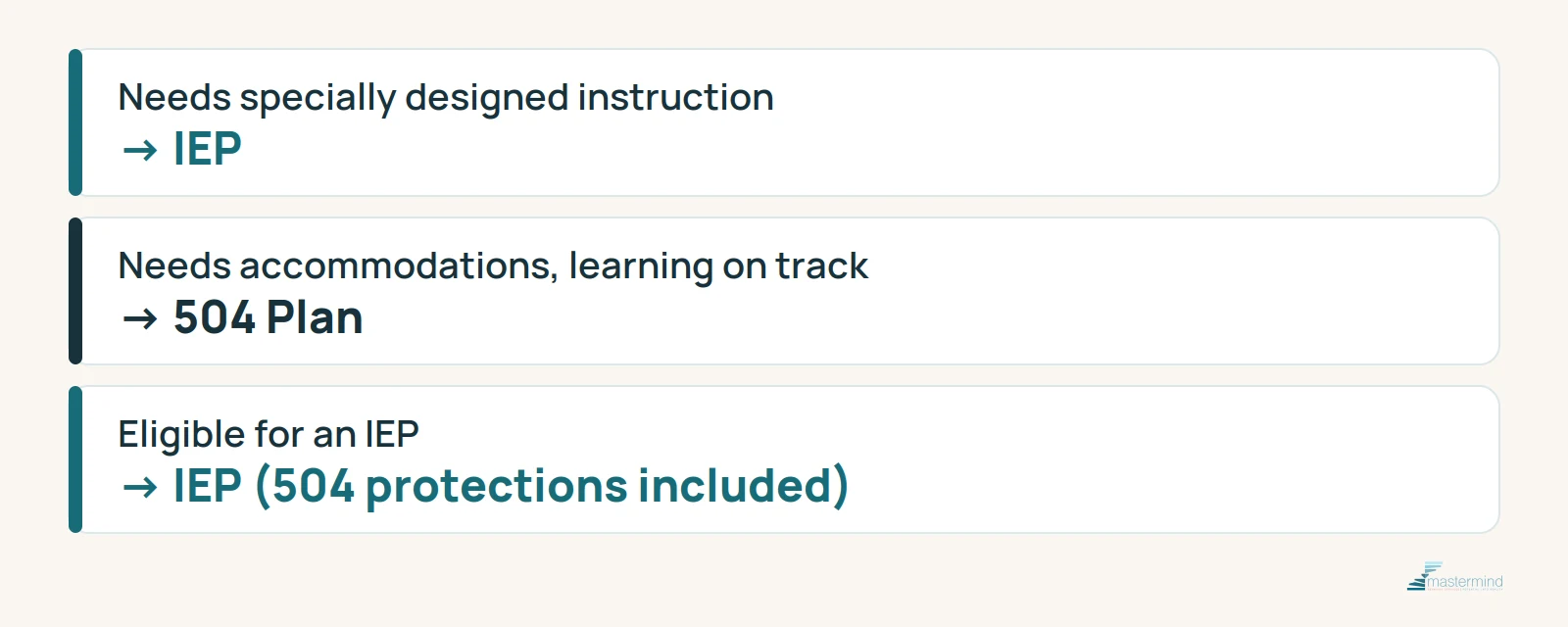
The deciding question is not how significant the diagnosis is. It is what your child needs.
An IEP fits when your child needs specially designed instruction. Under IDEA, eligibility requires a qualifying disability that adversely affects educational performance and creates a need for special education. If your child's autism means the teaching itself must change (different methods, different goals, direct skill instruction, related services), the IEP is the right tool, and the school is obligated to consider it.
A 504 fits when your child needs access, not different instruction. Section 504 eligibility is broader: a physical or mental impairment that substantially limits one or more major life activities (34 CFR §104.3), which include learning, concentrating, communicating, and social interaction. A child with autism who is on grade level academically but needs sensory accommodations, transition warnings, or a consistent behavior protocol may qualify under 504 without qualifying under IDEA. Since the ADA Amendments Act of 2008, "substantially limits" is read broadly, and mitigating measures generally cannot be held against the child.
The overlap runs one direction. Every child who qualifies for an IEP is also protected by Section 504. The reverse is not true. This is why a child found ineligible for an IEP should almost always be evaluated for a 504 plan next: ineligibility under IDEA's narrower test says nothing about eligibility under 504's broader one.
Can You Switch? Can You Have Both?
A child with an IEP does not need a separate 504 plan; the IEP already carries the stronger protections. The switching question usually arises in two situations. First, when a school proposes "dropping down" from an IEP to a 504 as a child progresses. That can be appropriate, but it requires a reevaluation, and parents should understand exactly which services disappear in the move, because everything instructional does. Second, when an IEP referral is denied: request the 504 evaluation in writing the same week. The denial letter for one is the starting gun for the other.
How to Request Each
The mechanics are nearly identical, and both start with a dated, written request:
- For an IEP: write to the principal or special education office requesting an evaluation for special education under IDEA. The legal clock starts, and the district must respond with written notice either way. The full process is covered step by step in our IEP guide.
- For a 504 plan: write to the principal or the district's 504 coordinator (every district must designate one) requesting an evaluation under Section 504. The evaluation must draw on multiple sources (34 CFR §104.35), never a single test or a single doctor's note, and the eligibility decision must be made by a group of people knowledgeable about your child, the data, and the placement options.
In New Jersey, Georgia, and North Carolina specifically: the 504 process runs on the federal framework in all three states; none of the three adds a state-level 504 evaluation deadline the way they do for IDEA. Your district's 504 coordinator is listed on the district website, usually under special services or student support. The IDEA clocks, by contrast, differ meaningfully across the three states, and those timelines are broken down in our IEP guide.
For either plan, attach what you have: diagnostic reports, therapy evaluations, teacher emails, and data from your child's ABA program. A private diagnosis does not automatically qualify a child for either plan, but it is evidence the team must consider.
Where ABA Fits Into Both
An in-home ABA program runs alongside either plan, and the session data your BCBA collects strengthens both. For an IEP, that data feeds present levels and measurable goals. For a 504 plan, it does something parents often overlook: it turns vague accommodations into specific ones. "Behavior support as needed" is a weak 504 line. "Staff will use the attached de-escalation protocol, consistent with the child's home behavior support plan" is an enforceable one, and your BCBA can help write it. The same applies at every school change, where transition planning keeps home and school programs aligned while plans get rewritten.
Questions Worth Asking Before You Decide
- Does my child need different instruction, or access to the same instruction?
- If the school proposes a 504, what IEP-level services is it declining to provide, and why?
- Who monitors this plan, and how often will we review it?
- How will accommodations be communicated to every teacher, including substitutes?
- If this doesn't work, what does escalation look like?
Whichever plan your child ends up with, the same habit applies: the written document controls, not the conversation in the meeting. Get every accommodation and service in writing, with names and frequencies attached.
Why Mastermind Behavior
Mastermind Behavior is a BCBA-owned and operated in-home ABA therapy provider serving families across New Jersey, Georgia, and North Carolina, with parent training for Georgia families to help you prepare for these meetings. Because our BCBAs work with your child at home, they bring session-by-session data to IEP and 504 meetings, and they help families translate home behavior programs into accommodations schools can actually implement. Through ongoing parent training, we prepare you for these meetings so the plan on paper matches what your child needs. With a 90%+ staff retention rate and no onboarding waitlist, most families begin direct services within six weeks of their initial assessment.
If you're exploring ABA therapy for your child, schedule a free consultation or call us at 732.813.7333. We'll walk you through what's possible and help you figure out the right next step. No pressure, no commitment.
References
- 34 CFR §104.33, Free appropriate public education, Electronic Code of Federal Regulations
- 34 CFR §104.35, Evaluation and placement, Electronic Code of Federal Regulations
- 34 CFR §104.36, Procedural safeguards, Electronic Code of Federal Regulations
- 34 CFR §104.3, Definitions (physical or mental impairment, major life activities), Electronic Code of Federal Regulations
- 34 CFR §300.320, Definition of individualized education program, Electronic Code of Federal Regulations
- Section 504 of the Rehabilitation Act, U.S. Department of Education, Office for Civil Rights