Georgia asks parents to do something most coverage documents never mention: the state Medicaid manual makes active parent and caregiver participation a condition of ABA, not a suggestion. Families sometimes read that as one more obligation. We see it differently: it is the state recognizing what we have always believed. The person who is there at bedtime, in the car, and at the grocery store is the person who can change what happens there, and coaching that person is where therapy hours turn into a different week.
Mastermind Behavior provides in-home ABA therapy, with parent training built into every program, for families across Georgia from our Middle Georgia offices.
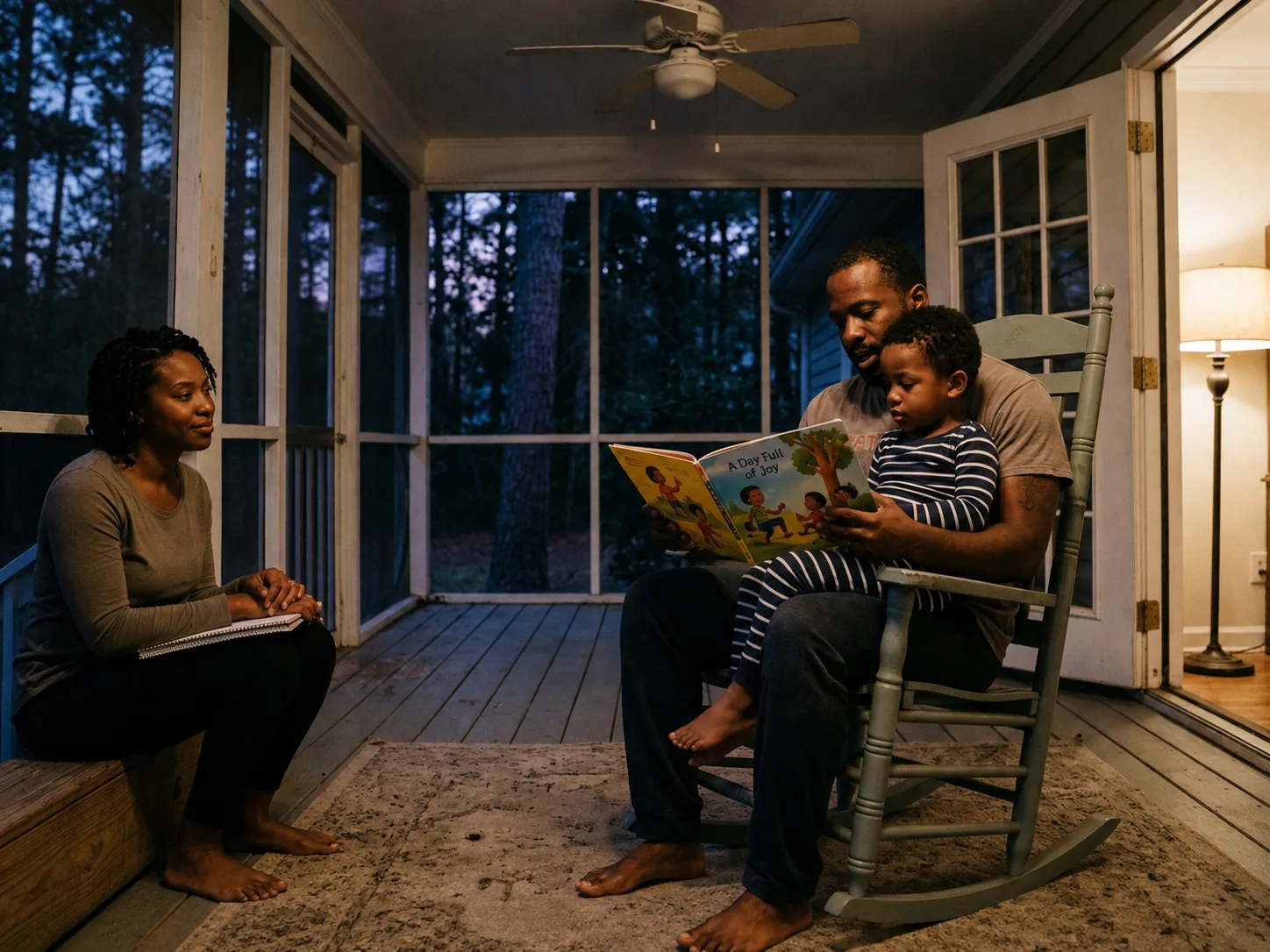
Parent training in ABA is hands-on coaching in your own home. It teaches you the same strategies your child's BCBA uses, inside the routines where you need them, so what works in a session keeps working after the technician leaves.
In Georgia that matters for a practical reason as well as a clinical one. Since SB 118 took effect, the insurer decides whether ABA is medically necessary, and it may ask for that to be shown again every year. Parent training is part of what shows it: session data plus a record of what the adults at home are doing between sessions is a stronger case than session data alone. For Medicaid families the same record supports each six-month reauthorization through the care management organization.
There is also a lot of Georgia to cover. Babies Can't Wait before three, the school district and its PBIS framework after, a CMO if Medicaid is involved, and the Katie Beckett pathway for families whose income sits above the usual Medicaid limits. Every one of those systems has its own staff and its own calendar. You are the one constant in all of them, and parent training is how that constancy becomes skill rather than exhaustion.
Parent training rarely appears as its own line in a policy. It travels inside ABA coverage, so the question that matters is whether ABA is covered, and in Georgia the answer is usually yes. The full detail lives on our Georgia ABA therapy page.
| Coverage element | Georgia detail |
| State mandate | Ava's Law (HB 429, effective July 1, 2015), amended by SB 118 (signed 2018, effective January 1, 2019), codified at O.C.G.A. § 33-24-59.10 |
| Coverage | Diagnostic assessments and ABA therapy, plus speech, OT, PT, and counseling for autism spectrum disorder |
| Plans covered | Individual grandfathered plans; fully insured large group plans; fully insured small group grandfathered plans |
| Medicaid | GA Medicaid (DCH) covers ABA for individuals under 21 since January 1, 2018, via EPSDT. The manual describes therapy ranging from 10 to 30 hours a week, or more if medically necessary, and requires active parent participation. Requires DSM-5 ASD diagnosis from a licensed professional and prior authorization through the assigned Care Management Organization. |
We use Behavioral Skills Training, which is coaching rather than instruction. Your BCBA explains one strategy, shows you what it looks like in the routine where you need it, then steps back while you try it and coaches as you go. The feedback lands at the front door at 7:40 in the morning, not in a summary the following week.
The strategies are pulled from your child's own program rather than a generic list: the reinforcement that actually motivates your child, the antecedent changes that stop a hard moment before it starts, prompting and fading, visual schedules, and a simple way to track whether the week is getting better. Because Georgia's coverage runs on an annual redetermination, we also show you how to keep the kind of notes that make the next review straightforward.
Coaching comes from the BCBA who designed the program and reads the data, and it happens in your real routines, not a staged version. Georgia families usually pair it with early intervention in the youngest years, behavior support when a specific behavior is running the house, and transition planning as the teen years arrive. Our Georgia team works from the Macon office at 4658 Presidential Pkwy, serving families across the state.