In much of Georgia the nearest autism clinic is an hour away, and the drive is only part of the problem. The behavior that needs help does not happen in a clinic waiting room. It happens at the kitchen table, in the car seat, at the door when it is time to leave. If you are here, you have probably tried the advice already, and you are looking for someone who will come and see it for themselves.
Mastermind Behavior provides in-home ABA therapy, including behavior support, for children and young people with autism through age 21, from our Middle Georgia offices out to communities across the state.
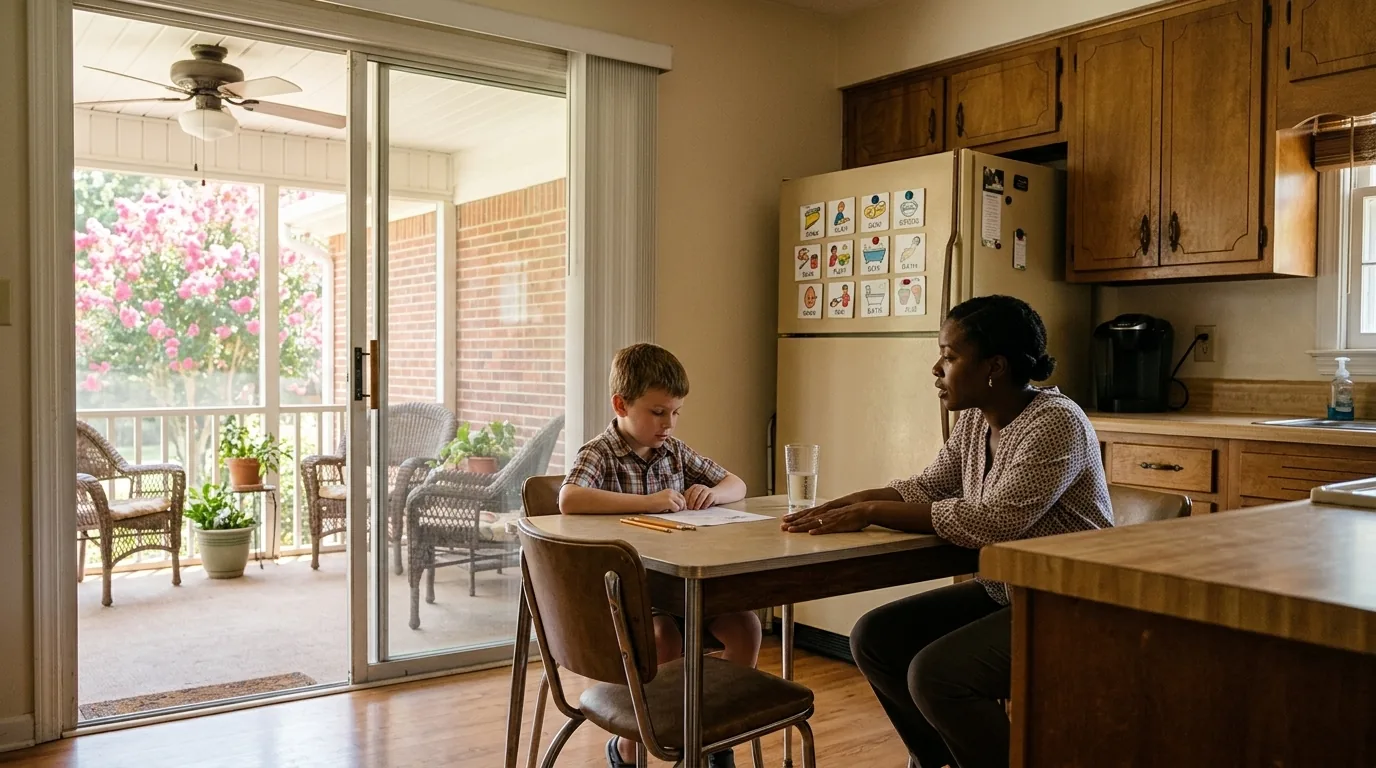
Three people usually have a stake in a child's behavior in Georgia: the family, the school, and, if the child is on Medicaid, the care management organization that authorizes services. Behavior support in ABA starts with the family, because behavior is communication and the people it is communicating with are at home. We observe, we collect data, and we work out what the behavior is doing for your child before anyone tries to change it.
The school runs its own version of that process. Federal law requires the IEP team to consider positive behavioral supports when behavior gets in the way of learning, and in Georgia that usually happens inside the state's PBIS framework, with a functional behavior assessment and a behavior intervention plan for the school day. It is a good plan for school. It does not come home on the bus. The hours between the end of the school day and bedtime are usually the hardest, and that is the half we cover: an assessment done in your home, a plan written for your routines, and coaching so every adult in the house responds the same way.
Georgia licenses the people who do this. Behavior analysts practicing here must hold a state license through the Georgia Behavior Analyst Licensing Board, and our BCBAs serving Georgia families hold both that license and BACB certification. When the behavior has grown past what a home plan can carry, the Department of Behavioral Health and Developmental Disabilities is the state's door to more intensive supports, and the Georgia Crisis and Access Line is its front desk. We are not that system. We do share our data with it when a family asks us to.
Behavior support is ABA therapy, and Georgia treats it that way for coverage purposes. The rows below are the parts of the state's picture families ask about most. The full detail lives on our Georgia ABA therapy page.
| Coverage element | Georgia detail |
| State mandate | Ava's Law (HB 429, effective July 1, 2015), amended by SB 118 (signed 2018, effective January 1, 2019), codified at O.C.G.A. § 33-24-59.10 |
| Annual dollar cap | $35,000 a year for ABA services. Federal MHPAEA parity may make this unenforceable on plans subject to parity; ask the carrier in writing. |
| Medicaid | GA Medicaid (DCH) covers ABA for individuals under 21 since January 1, 2018, via EPSDT. The manual describes therapy ranging from 10 to 30 hours a week, or more if medically necessary. Requires DSM-5 ASD diagnosis from a licensed professional and prior authorization through the assigned Care Management Organization. |
| BCBA licensure | Georgia Behavior Analyst Licensing Board operational; behavior analysts are required to be state-licensed. Our BCBAs serving GA families hold both BACB certification and a current GA license. |
Weeks one to four: the assessment. A BCBA comes to your home and watches. Not once, but across the times of day when the behavior tends to happen, taking data on what comes right before it and what comes right after. Parents sometimes expect a diagnosis of the behavior at the first visit. What they get instead is a record, and the record is what makes the plan honest.
The plan. Built from that record, using the least restrictive strategies that will work. Most of it is teaching, not stopping: if the behavior gets your child out of a demand, we teach a faster way to ask for a break; if it gets attention, we teach a safer way to get attention. Functional communication training and replacement skills carry most of the weight.
The sessions. Behavior Technicians run the plan in your home, with the same technician each time rather than a rotation, and a BCBA supervising and adjusting as the data comes in. You are in every session that involves you, because the plan only works if the response to the behavior is the same whether we are there or not.
Timing. The assessment takes about four weeks, and there is no onboarding waitlist. For Georgia Medicaid families, the prior authorization is issued in six-month blocks and we start each renewal early, so the plan does not lapse between authorizations.
Behavior support often runs alongside our other Georgia services: parent training deepens the coaching side, early intervention serves the youngest children, and transition planning picks up the teen years. Our Georgia team works from the Macon office at 4658 Presidential Pkwy, serving families across the state.