Teaching Appropriate Boundaries and Personal Space to Children with Autism
Strategies for Teaching Personal Space and Boundaries to Children with Autism

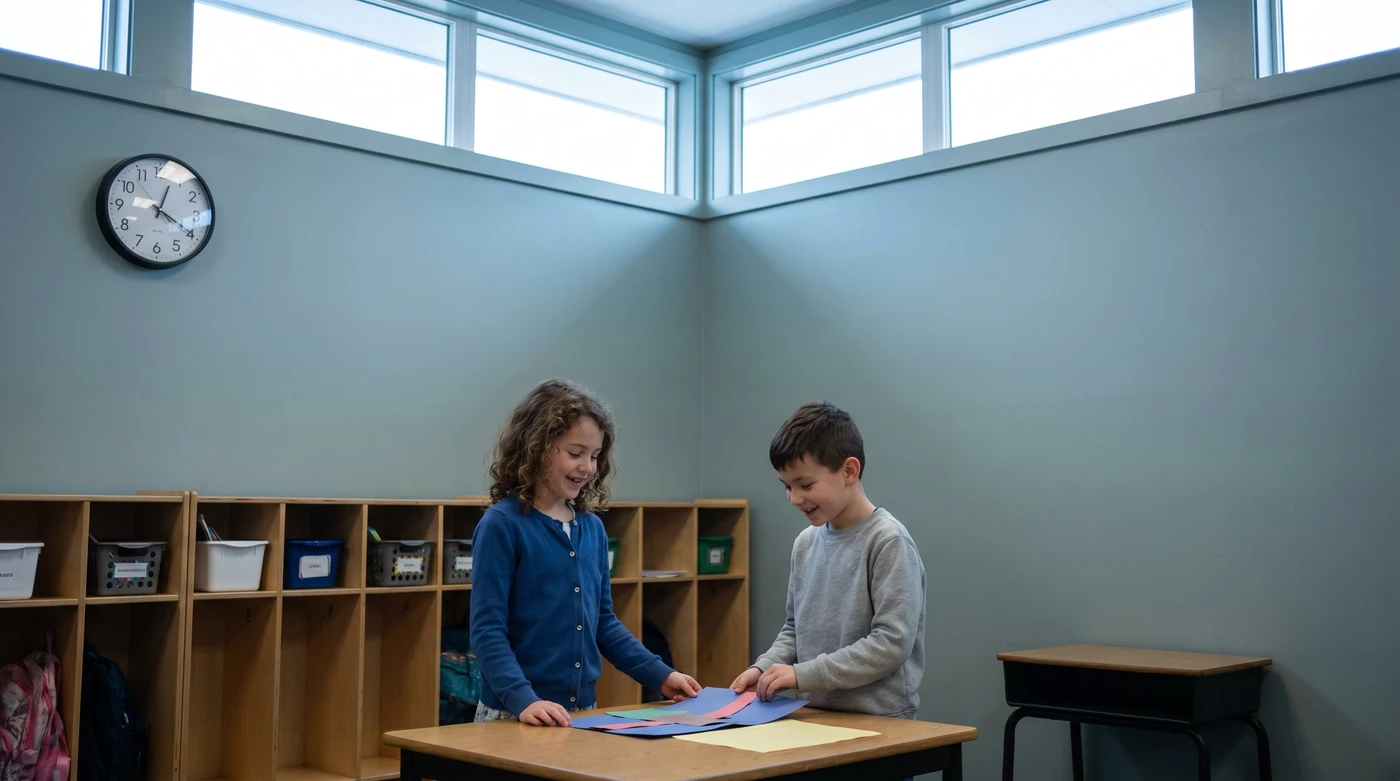
It is the first day of school drop-off, and your seven-year-old has just walked up to a kid he has never met and wrapped him in a full hug. The other boy freezes. The other boy's mom looks at you. You know the look. You have been getting it since your child was four. You also know that the hug came from a real place, he is genuinely happy to see another kid. None of that helps you in the moment.
If you are a parent of a child with autism, personal space is one of those skills that is easy to talk about and hard to teach. You don't want to make your child afraid of people. You don't want to extinguish the affection. You also don't want him touching strangers or standing two inches from a teacher's face. Here is how good in-home ABA therapy approaches this without losing the parts of your child you love.
Most neurotypical children pick up the rules of personal space implicitly, somewhere between ages four and six, by watching other people. They notice when someone leans away. They notice when a friend stiffens. They adjust without anyone teaching them.
Children with autism often miss those same signals, not because they don't care about other people, but because the signals themselves are subtle and unspoken. The American Academy of Pediatrics describes social communication and reciprocity differences, including difficulty reading nonverbal cues like body language and facial expression, as a defining feature of autism spectrum disorder.1 Add in sensory differences (some kids on the spectrum love deep pressure, which makes hugs feel regulating) and you can end up with a child who genuinely loves the people around him and has no idea his version of love is making them uncomfortable.
This is the reframe we offer parents in the first BCBA visit. Personal space is a teaching gap, not a behavior problem. Your child is not being defiant. He has not yet built a skill that other kids built without instruction.
Before we get to what works, it is worth naming what does not. We do not want to teach a child to never hug, never touch, never get close to anyone. That kind of blanket rule erases the warmth your family relies on, and it backfires anyway, because kids learn the rule but not the reason, and the rule eventually breaks down.
The goal is more nuanced. We want a child who can read the room, ask before initiating contact, accept a no, and find a different way to connect when the answer is no. That goal sounds harder than "stop hugging strangers," and in some ways it is, but it produces a child who can actually function socially, not one who has been quietly trained out of his own warmth.
We had a six-year-old we will call Mateo who wanted to hug everyone he met, sometimes mid-stride. Classmates at drop-off, teachers at pickup, the cashier at the grocery store. His parents had tried "use your words" and "personal space, please" for over a year. Nothing was sticking, and Mateo was starting to look confused and a little sad. He could tell something was wrong but not what.
His BT spent the first two weeks not on hugging at all, but on a three-step micro-script. Ask first. Wait for the answer. Read the response. We rehearsed it at home with both parents and his older sister before the school environment ever got involved, because the same script with three different humans is what makes the skill generalize. By the end of the school year, Mateo was leading with a high five about three times out of four. He still hugged the people who were okay with it. He had learned to ask the people who weren't.
The connection didn't disappear. The form it took just got safer for everyone. That is what most of our skill development work looks like up close. We are not removing your child's social drive. We are giving it a more durable shape, one that travels well from the home where we taught it to the school cafeteria where it has to actually hold up.
Once a child can ask first and wait for an answer, the work moves to calibration. How close is "close enough" when you're greeting a friend? When you're talking to a teacher? When a stranger is standing in line at the store?
The trouble with the words "personal space" is that they are pure abstraction. There is no edge. There is no shape. A child looking at another person and trying to figure out how close is too close has nothing to measure against. So we give them something to measure against. Visual and physical props turn an invisible rule into a visible one, and visible rules are something a child can actually use under stress. Visual supports are one of the most-recommended evidence-based strategies for autism spectrum disorder, and the Autism Speaks Autism Treatment Network has built whole tool kits around them.2
A few that consistently earn their keep in the homes we work in:
A plastic hula hoop or pool inner tube, held around the child's waist, gives them a literal felt-sense of "this much space belongs to me, and the same amount belongs to everyone else." We will sometimes start with the child wearing the hoop while a sibling or BT walks around them. The child can see when the hoop bumps into someone, and they learn to adjust without anyone having to say a word.
Bright-colored floor tape (painter's tape works well) marks out "personal spaces" on the floor for circle time, table work, or sitting on the couch. The child sits in their square. The sibling sits in theirs. The rule becomes the room, instead of a phrase a parent has to repeat. Pillows on the couch can do the same work, marking out who sits where so two cousins watching a movie are not constantly negotiating elbow room.
The arm-circle rule gives a child a body-based reference they can take anywhere. Hold both arms out in a wide circle in front of your body, like you are holding a beach ball. The space inside that circle, between you and another person's chest, is roughly the right distance for talking to a friend or classmate. Unlike a hula hoop, the arm circle goes with the child to school. It is a rule they can check by themselves, without anyone having to remind them.
The classic "arm's length" rule is a tighter version of the same idea. Hold one arm straight out. Fingertip to chest is the right distance for most conversations. We use this with older kids who are past the hula hoop stage but still need a quick body check.
Concentric circles drawn on paper (or with chalk in the driveway) help a child see who belongs in which "zone." Family is closest. Friends and teachers are next. Acquaintances and strangers are furthest out. The visual makes the rule that "you can hug grandma but not the cashier" finally make sense.
All of these props are scaffolding. We design them to fade. Within a few months, most kids on our caseload no longer need the prop in their hands or on the floor. The internal version, the one in their head, is the one that sticks.
Social stories and role-play, two evidence-based teaching strategies the Child Mind Institute highlights for boundary instruction, are how we rehearse these scripts before the child has to use them in real situations.3 We write a short story about Mateo's day, read it before each session, then act it out with stuffed animals before we try it with humans.
Not every child with autism stands too close. Some stand too far. Some flinch from contact, refuse to sit at a crowded table, or struggle to tolerate the touch involved in a haircut, a dental cleaning, or a hug from a relative they actually love. The Kennedy Krieger Institute, through its Interactive Autism Network research, has documented how widely personal-space preferences vary across the spectrum, with some children seeking proximity and pressure and others avoiding it entirely.4
That side of the conversation is just as real, and the work looks different. We are not teaching distance, we are building tolerance for proximity, slowly and with consent. The child gets to set the pace. We pair small steps with reinforcement, and we build a vocabulary the child can use to advocate for himself when the proximity is too much. "I need a minute" or "not right now, please" is a real personal-space skill, and for some kids, it is the first one we teach. This is part of the behavior support work that makes the difference between a child who shuts down at family dinners and one who can stay at the table.
Progress on personal space is rarely a single moment. It is usually a slow accumulation of choices that look small from the outside. Your child pauses before stepping forward. Your child lifts a hand to ask, even before the words come out. Your child takes a half-step back when a peer leans away.
Parents tend to miss these because they are looking for the big win, the moment a child stops doing the thing that has been embarrassing them for years. The big win does come, but it is preceded by weeks of small ones that are easy to overlook in real time. This is part of why our BCBAs take so much data: parents are the first to spot real progress, and also the first to miss it, because it is happening every day right in front of them.
If personal space issues are creating real social consequences (kids avoiding your child at school, family members starting to pull back, a teacher flagging it in a parent-teacher conference), that is the signal that a structured plan would help. The same applies if you have been working at this for months and the strategies you have read about online aren't translating into actual change at home. The Centers for Disease Control identifies behavioral approaches, focused on understanding what happens before and after a behavior, as a primary evidence-supported framework for autism intervention.5
In-home ABA therapy is built for this kind of work. The lessons happen in the rooms where the issue actually shows up: at the dinner table when a sibling is too close, on the couch when a cousin sits down uninvited, in the doorway when grandma comes over. We teach the skill where it has to live.
Why Mastermind Behavior
Mastermind Behavior is a BCBA-owned and operated in-home ABA therapy provider serving families across New Jersey, Georgia, and North Carolina. Personal space and boundary skills click best in the rooms where children actually have to use them, so our BCBAs design the program around your child's specific triggers, our BTs run trials in the rooms where those triggers live, and our parent training coaches teach you and your partner the same prompts so the skill holds when therapy is not there. With a 90%+ staff retention rate and no onboarding waitlist, most families begin direct services within six weeks of their initial assessment.
If you are exploring ABA therapy for your child, schedule a free consultation or call us at 732.813.7333. We will talk through the specific moments where personal space breaks down, walk you through what a program would look like for your child, and help you figure out the right next step. No pressure, no commitment.
References
- Hyman SL, Levy SE, Myers SM, et al. Identification, Evaluation, and Management of Children With Autism Spectrum Disorder.Pediatrics. 2020;145(1):e20193447. American Academy of Pediatrics.
- Autism Speaks. Visual Supports and Autism Spectrum Disorder (ATN/AIR-P Tool Kit).
- Child Mind Institute. Teaching Kids About Boundaries.
- Kennedy Krieger Institute, Interactive Autism Network. Personal Space and Autism.
- Centers for Disease Control and Prevention. Treatment and Intervention for Autism Spectrum Disorder.