Types of ABA Assessments: A Parent's Guide
VB-MAPP, ABLLS-R, Vineland, FBA: what each ABA assessment measures, how the intake process works, and how results become your child's treatment plan.


VB-MAPP. ABLLS-R. Vineland. FBA. Somewhere between the diagnosis and the first therapy session, the acronyms start arriving, in intake packets, in insurance paperwork, in a BCBA's explanation of what happens next. Each one is an assessment, and together they answer the two questions everything else depends on: what can your child do today, and what should therapy work on first.
This guide translates the acronym wall. It covers the assessments parents of children with autism actually encounter, what each one measures, how they are administered, and how the results turn into a treatment plan with hours attached.
Why Assessment Comes Before Everything
No ethical ABA program starts with therapy. It starts with measurement, for three reasons.
First, an individualized treatment plan can only be built on a precise picture of your child's current skills.
Second, insurers require documented assessment results to establish medical necessity before they authorize hours, and again at every reauthorization.
Third, the assessment creates the baseline that progress gets measured against; without it, nobody can honestly tell you whether therapy is working.
Professional practice guidelines from the Council of Autism Service Providers (CASP) build the entire treatment cycle around this assess-treat-reassess loop, and the American Academy of Pediatrics' clinical report on autism takes the same position: identification, evaluation, and ongoing reassessment are the framework everything else hangs on (Hyman et al., 2020).
The Two Families of Assessment
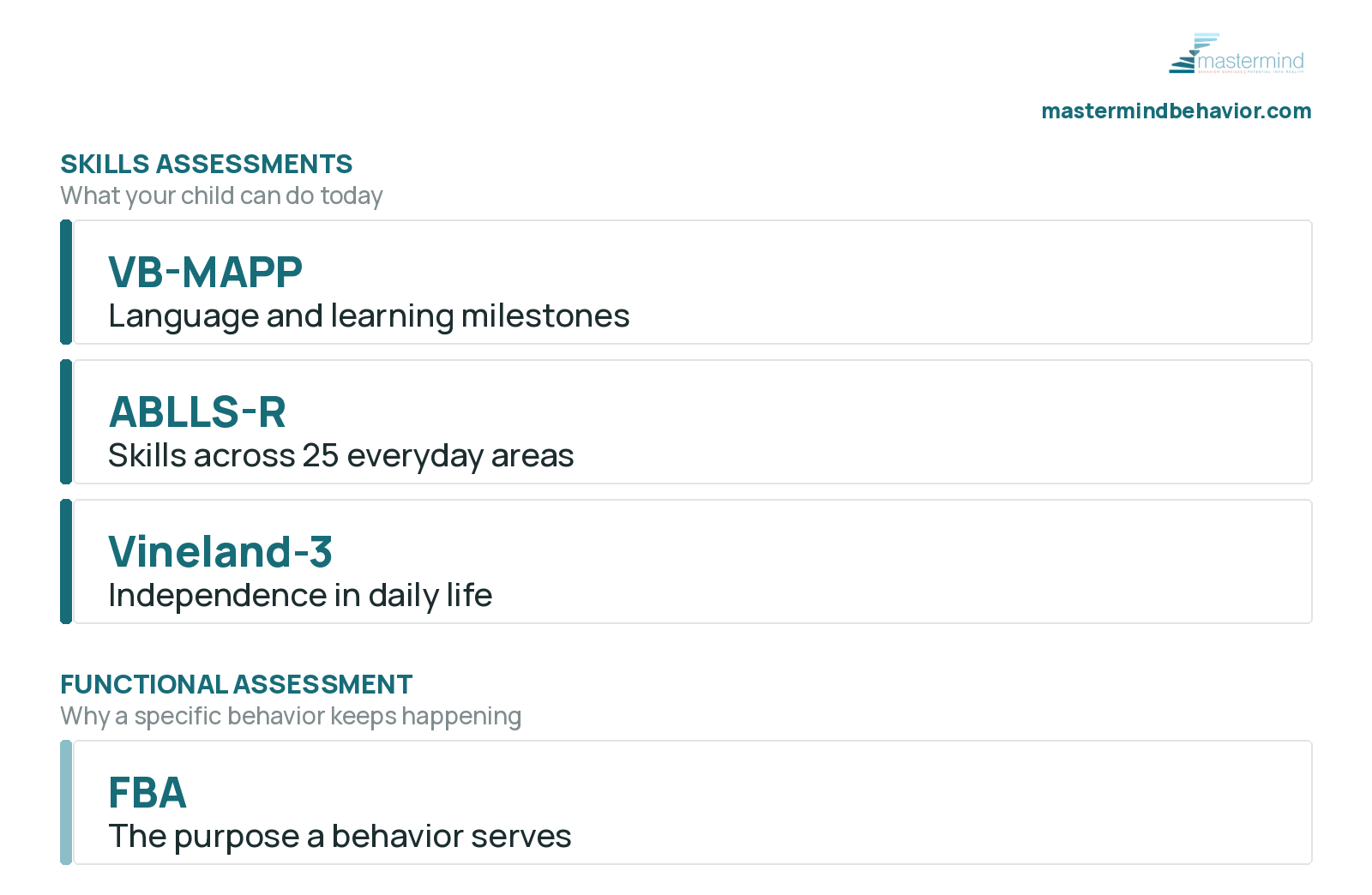
Almost everything your BCBA administers falls into one of these two families, and most children get at least one from each.
VB-MAPP: Language and Learning Milestones
The Verbal Behavior Milestones Assessment and Placement Program, developed by Dr. Mark Sundberg, is the most common starting assessment for young children. It measures 170 language and learning milestones across three developmental levels covering roughly the skills of a typically developing child from birth to 48 months: requesting, labeling, imitation, play, social behavior, and early academics. It also includes a barriers assessment that identifies what is getting in the way of learning, such as prompt dependence or difficulty with transitions. For a young child starting early intervention, VB-MAPP results usually shape the first treatment plan directly.
Its psychometric backing is still developing. A national panel of 13 experts rated the content validity of the VB-MAPP Milestones, Early Echoic Skills, and Barriers assessments as moderate to strong overall, while noting that a few domains are not fully represented by their items (Padilla et al., 2021). That is worth knowing as a parent: the VB-MAPP is a useful map of what to teach next, not a diagnostic test, and a good BCBA will treat it that way.
ABLLS-R: A Broad Skills Inventory
The Assessment of Basic Language and Learning Skills, Revised, developed by Dr. James Partington, inventories 544 skills across 25 areas, from language and social interaction through self-help, motor, and early academic skills. Where the VB-MAPP is organized around developmental milestones, the ABLLS-R reads more like a comprehensive checklist of teachable skills, which makes it especially useful for building curriculum and tracking granular progress over time. Many programs use one or the other; some use both at different stages.
Vineland-3: Independence in Everyday Life
The Vineland Adaptive Behavior Scales, Third Edition, is different from the first two in an important way: it is norm-referenced, meaning your child's everyday independence (communication, daily living skills, socialization, motor skills) is compared against national age norms. It is completed through structured parent interviews and questionnaires rather than direct testing. Because it produces standardized scores, insurers frequently require the Vineland to establish and re-establish medical necessity, so expect to sit for this interview at intake and again at reassessment points.
The two kinds of assessment do overlap. In a study of 235 children with autism, VB-MAPP Milestones scores showed moderate to strong positive correlations with the Vineland's Communication, Socialization, and Daily Living Skills subdomains, and a strong positive correlation with the Vineland overall raw score (Lotfizadeh et al., 2025). They are measuring related territory from different angles, which is part of why a BCBA may run both rather than choosing between them.
The FBA: Understanding Why a Behavior Happens
A Functional Behavior Assessment answers a different question entirely: not what your child can do, but why a challenging behavior keeps happening. The BCBA combines caregiver and teacher interviews, direct observation of what happens before and after the behavior, and sometimes a structured functional analysis, to identify the behavior's function: getting attention, escaping a demand, getting access to something, or the sensory experience itself. The FBA's conclusions drive the behavior intervention plan, and in the school context, IDEA regulations (34 CFR §300.324) require the IEP team to consider behavioral interventions whenever behavior impedes learning, which is where a well-done FBA becomes a bridge between home therapy and the classroom, as covered in our IEP guide.
This step is not a formality. A meta-analysis of 19 studies that compared FBA-based and non-FBA-based interventions within the same participants found that interventions built on a prior functional assessment had clearly superior effects on problem behavior, while interventions not based on function had negligible effects on it (Hurl et al., 2016). Understanding why the behavior happens is what makes the plan work.
Preference Assessments: Small but Constant
Not every assessment is a formal battery. Preference assessments are quick, structured checks of what currently motivates your child, and they happen constantly, often within single sessions, because motivation shifts and reinforcement only works when it is actually reinforcing.
What the Intake Assessment Actually Looks Like
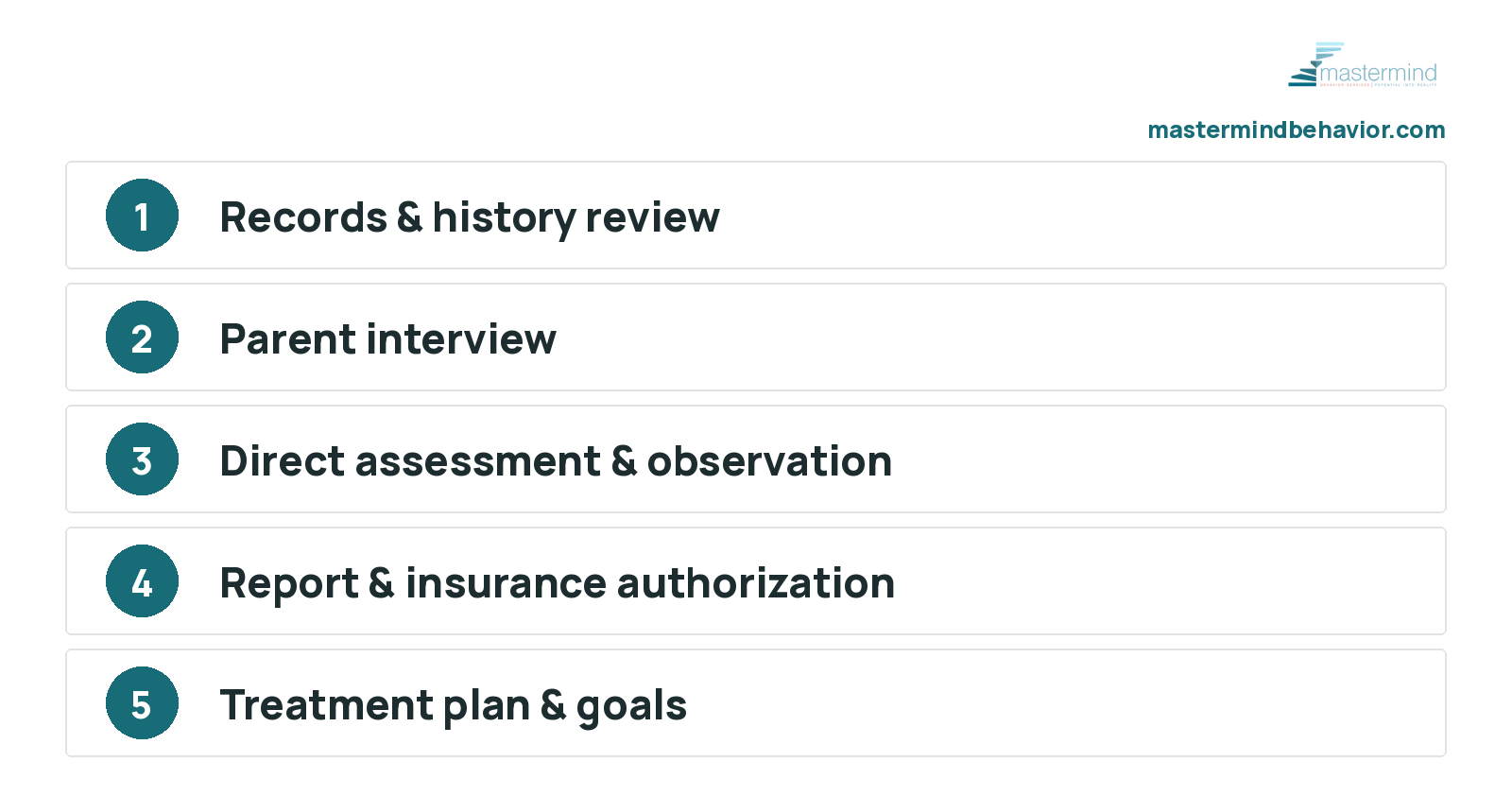
Providers vary, but the shape is consistent:
Records and history review. The BCBA reads the diagnostic report, prior evaluations, school documents, and any earlier therapy records before meeting your child.
Parent interview. You are a primary data source. Expect detailed questions about communication, daily routines, sleep, eating, safety concerns, and what a better six months would look like for your family. The Vineland interview often happens here.
Direct assessment and observation. The BCBA works with your child directly, usually in your home for an in-home program, running selected assessment items and observing play, communication, and responses to demands in the environment where therapy will actually happen.
Report and insurance authorization. The results become a written report with baseline scores, recommended goals, and a recommended number of weekly hours, which goes to your insurer for authorization.
Treatment plan and goals. Once authorized, the assessment translates into the treatment plan: specific, measurable goals with data collection behind each one. From here forward, reassessment typically happens on your insurer's reauthorization cycle, commonly every six months, which is how the plan stays honest about progress.
Questions Worth Asking About Your Child's Assessment
- Which assessments will you use, and why those for my child?
- What did the results show as strengths, not just deficits?
- How do these specific results connect to each goal in the treatment plan?
- How were the recommended weekly hours determined?
- When is the next reassessment, and how will you show me progress against today's baseline?
The hours question in particular has research behind it. A 2025 meta-analysis of 25 controlled studies of ABA-based interventions found through meta-regression that greater treatment dose and longer treatment duration were associated with larger gains in adaptive behavior (Mutschler Collins et al., 2025). Dose is not the only factor, and more hours is not automatically better for every child, but it is a fair thing to ask your BCBA to explain in terms of your child's specific goals.
A good BCBA will welcome every one of these questions. The assessment is not paperwork standing between you and therapy; it is the map the therapy follows, and you are entitled to understand it.
Why Mastermind Behavior
Mastermind Behavior is a BCBA-owned and operated in-home ABA therapy provider serving families across New Jersey, Georgia, and North Carolina. Our BCBAs conduct assessments in your home, where your child is most comfortable and where the results reflect real life instead of a clinic room, and we walk you through every score in plain language through ongoing parent training. With a 90%+ staff retention rate and no onboarding waitlist, most families begin direct services within six weeks of their initial assessment.
If you're exploring ABA therapy for your child, schedule a free consultation or call us at 732.813.7333. We'll walk you through what's possible and help you figure out the right next step. No pressure, no commitment.
References
- VB-MAPP: Verbal Behavior Milestones Assessment and Placement Program, AVB Press (Dr. Mark Sundberg)
- Vineland Adaptive Behavior Scales, Third Edition, Pearson Assessments
- Applied Behavior Analysis Practice Guidelines for the Treatment of Autism Spectrum Disorder, Council of Autism Service Providers
- 34 CFR §300.324, Development, review, and revision of IEP (behavioral interventions), Electronic Code of Federal Regulations
- Hyman SL, Levy SE, Myers SM. Identification, Evaluation, and Management of Children With Autism Spectrum Disorder. Pediatrics, 2020
- Padilla KL, et al. Content Validity Evidence for the Verbal Behavior Milestones Assessment and Placement Program. Journal of Autism and Developmental Disorders, 2021;51(11):4054-4066
- Lotfizadeh AD, Gard B, Rico C, Poling A, Choi KR. Convergent and Discriminant Validity of the VB-MAPP and the Vineland Adaptive Behavior Scales. Journal of Autism and Developmental Disorders, 2025;55(3):803-811
- Hurl K, Wightman J, Haynes SN, Virues-Ortega J. Does a pre-intervention functional assessment increase intervention effectiveness? A meta-analysis of within-subject interrupted time-series studies. Clinical Psychology Review, 2016;47:71-84
- Mutschler Collins I, Halter F, Schächinger Tenés LT, Lieb R, Meyer AH. A Meta-Analysis of Applied Behavior Analysis-Based Interventions to Improve Communication, Adaptive, and Cognitive Skills in Children on the Autism Spectrum. Review Journal of Autism and Developmental Disorders, 2025