The Importance of Teaching Turn-Taking Skills in Autism
Mastering Turn-Taking: A Key to Unlocking Social Success for Children with Autism

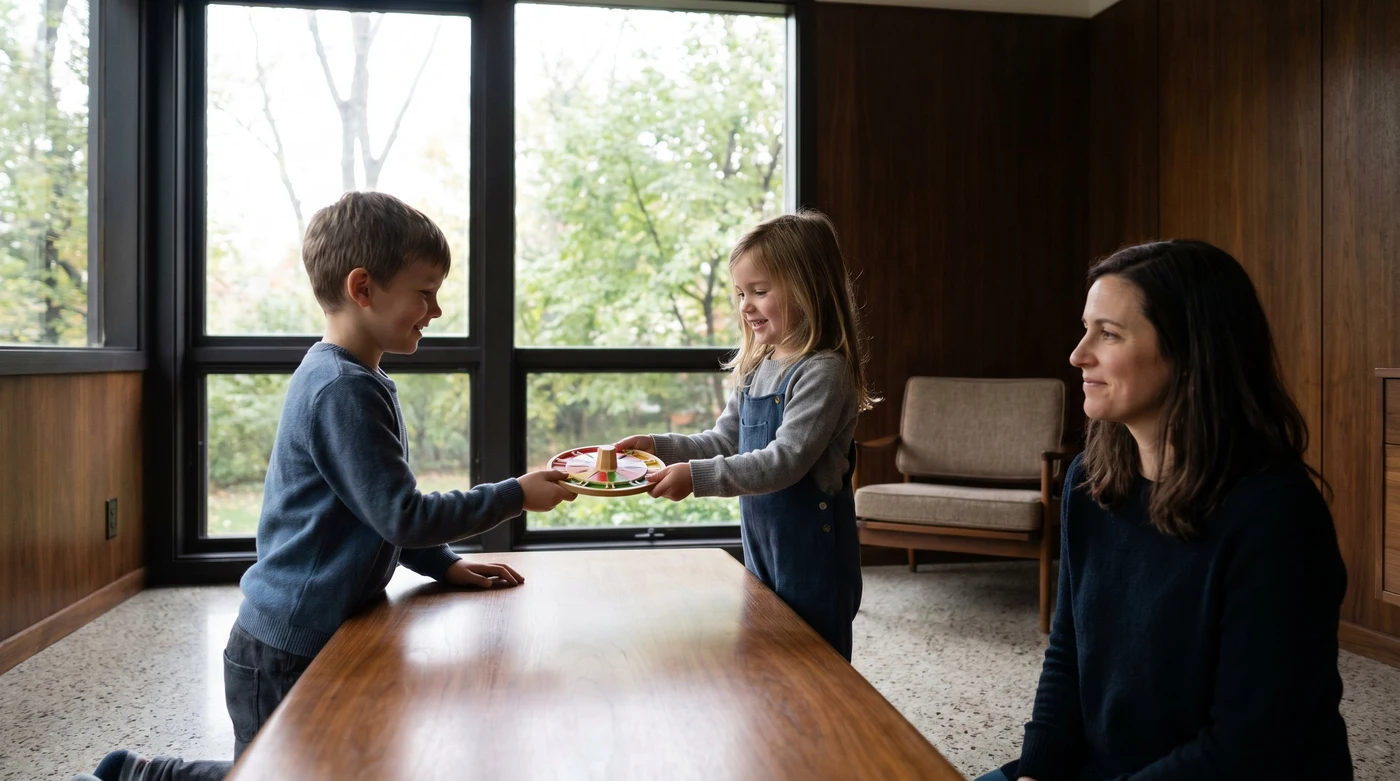
You are sitting on the living room floor with your four-year-old. There is a small wooden ball run between you. You drop a ball in. He watches it spin down. You hand him a ball, and before he can put it in, he grabs another from your pile and another and another, and now all the balls are in his lap and the run is empty. He is not being defiant. He just does not know yet that this game has two people in it.
This is where turn-taking starts for a lot of the kids on our caseload. Not at Candy Land. Not at Uno. Right here, on the floor, with one ball at a time and a parent who is about to get really good at saying "my turn, your turn" in the same patient voice over and over again.
Turn-taking is one of the earliest building blocks of social communication. It is the back-and-forth structure that conversation, play, and friendship eventually rest on. The DSM-5, which is what clinicians use to diagnose autism, lists "deficits in social-emotional reciprocity" (the failure of normal back-and-forth) as one of the core features of autism spectrum disorder.1 So when a child on the spectrum struggles with turn-taking, you are not seeing a behavior problem. You are seeing the diagnostic criteria, in motion, on your living room floor.
Most kids pick up turn-taking by absorbing it. They watch it happen at the dinner table. They get scolded by an older sibling. The neurotypical brain just sort of files it away. For children with autism, that absorption pathway is not as available, so the skill has to be taught directly, in small and concrete pieces.
In our practice, that is what most of the early sessions look like. Not games. Pieces of games.
When parents ask us to "work on turn-taking," they often picture us pulling out Connect Four. We do not start there.
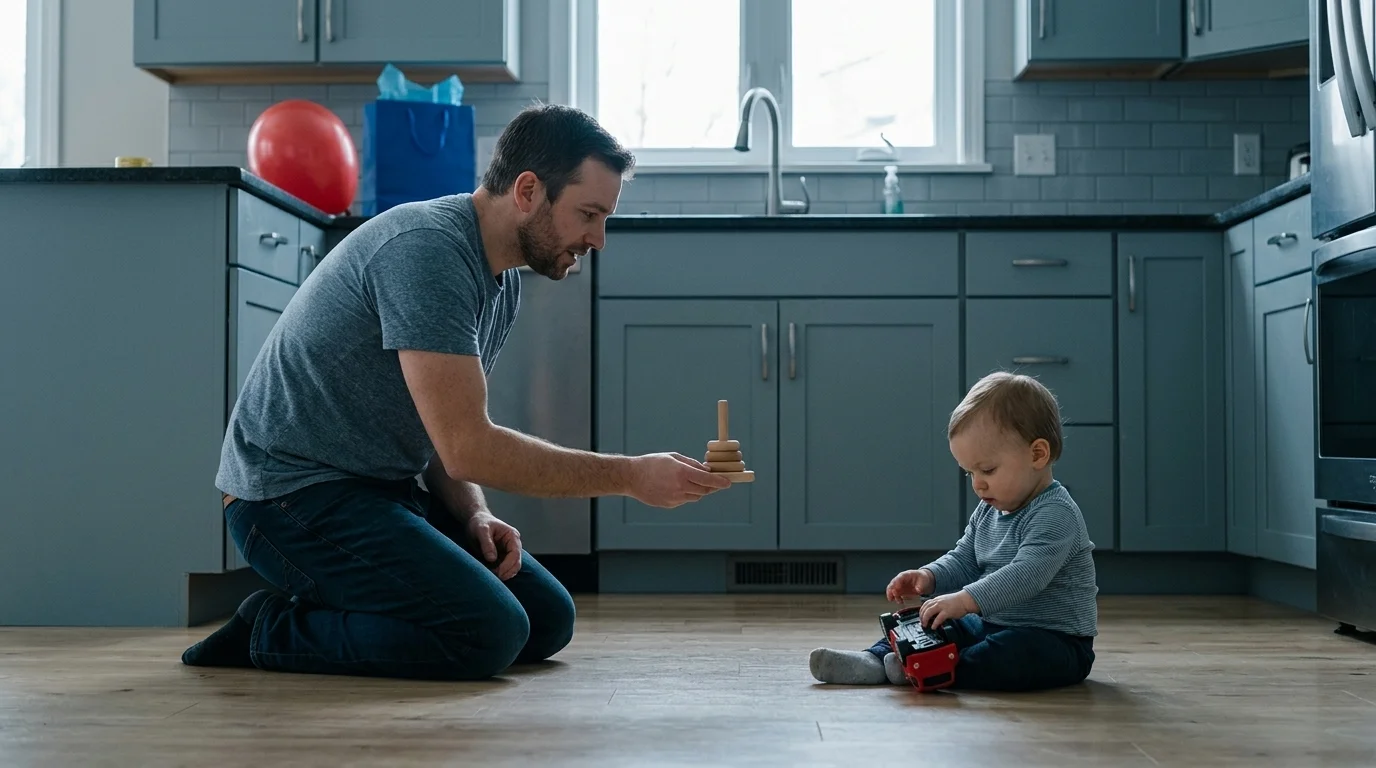
The very first goal is accepting an item from another person. That is it. Before a child can take turns, they have to be able to receive something from someone else's hand without grabbing, without throwing, without melting down. A BT sits across from your child and offers a small preferred toy. The child takes it. The BT smiles, marks the response, and the toy stays with the child for a few seconds before the next round.
The second goal is giving an item back. The same toy, offered back to the BT. The child hands it over. Brief separation, immediate return, lots of reinforcement. This is the building block. Until a child can comfortably take and give a single item, no game in the world is going to work, because every game is just that pattern, repeated.
Our BCBAs design the next stage of the program around what one of our team calls "the 1–2 second exchange." The child gives up a preferred item briefly. They wait one or two seconds. They get the item back. The reinforcement is not a sticker. The reinforcement is the toy coming back.
If your child cannot tolerate handing over the iPad for two seconds, your child is not ready to share the iPad for ten minutes. That is information, and it tells the BCBA where to start.
Once tolerating brief separation is solid, we add length. Two seconds becomes five. Five becomes ten. Eventually we add a second person. Eventually we add language. The progression looks slow on paper. In real homes it usually moves faster than parents expect, because the foundation is doing the heavy lifting.
Here is the part that surprises a lot of families. We use turn-taking with physical objects to teach the structure of verbal conversation, before the child has the language to hold a verbal one.
A typical scene: a BT (a Behavior Technician, the team member running daily sessions in your home) sits across from your child and rolls a ball. As they roll it, they say "hi." The child rolls it back. The BT models "how are you?" and rolls. The child receives the ball, says or signs "good," and rolls again. The ball is doing the work that conversation will eventually do on its own. The child is learning that something gets sent, something comes back, and there is a rhythm to it.
Most parents have never seen anyone teach conversation this way. It works because it is concrete. The ball is the turn. You can see the turn move. You can see when it gets stuck.
Research from the National Institutes of Health backs up why this matters. Joint attention (the shared focus on an object that turn-taking creates) is one of the strongest early predictors of expressive language development in autistic children.2 Turn-taking is one of the most reliable ways to build joint attention into a session, which is why we put it so early in most programs.
Once a child can accept and give, the natural next step is structured turn games. The goal here is not to play for fun, although fun usually shows up on its own. The goal is repetition. A good turn-taking game gives a child fifteen or twenty turns in a single sitting, with a built-in pause between each one, which is more practice than most parents can squeeze out of a whole afternoon of "share with your brother."
A few that earn their keep with the kids on our caseload:
Rolling a ball back and forth on the floor. This is the simplest version. Two people, one ball, no rules. The "turn" is built into the physics of the game; you cannot roll a ball you do not have. We will sometimes do this for ten or fifteen minutes with no other instructions, just so the rhythm of "you go, I go" becomes automatic.
Kicking a soccer ball back and forth in the yard or hallway. Same structure, different muscles. Useful for kids who get more dysregulated sitting still than they do moving.
Tic-Tac-Toe. The first board game most kids can hold the structure of. The turns are visible (X, then O, then X), the game ends quickly, and there is a built-in opportunity to practice both winning and losing, which is its own program later in the sequence.
Connect Four. A step up from Tic-Tac-Toe. Slightly longer attention span, slightly more strategy, same visible turn structure. The pieces are satisfying to drop, which sneaks in extra reinforcement.
We do not introduce all of these at once. We pick one, run it until the child has the rhythm down, and then add the next. The variety matters because it teaches the child that "turn-taking" is a thing that happens across many games rather than one specific game. That is what generalization looks like in practice.
Across most of the kids on our caseload, the sequence looks something like this. We are flexible, but the order rarely changes.
- Accepting an item from another person.
- Giving an item to another person.
- Tolerating brief separation from a preferred item. One to two seconds. Full prompts. Immediate return.
- Brief physical exchanges with high-interest items. Ball, marble run, button toy that makes a sound the child likes. Turn passes back and forth quickly because the reinforcement is built into the toy itself.
- Adding "my turn / your turn" language. Spoken, signed, or pointed to on a visual. Whatever the child's communication mode is.
- Generalizing to a peer. A sibling, a cousin, a kid from down the block. This is where the program leaves the therapy session and moves into real life.
- Tolerating losing. This is its own program. Most parents underestimate how much explicit teaching goes into "losing without a meltdown."
In a clinic, you can drill the first six steps and pretend the last two will follow. In a home, the BT is already in the rooms where the last two steps actually happen, which is most of why we work in homes.
Here is a pattern we see often enough to mention. The neurotypical sibling becomes the unofficial turn-taking coach. A six-year-old gets very good at saying "no, it is my turn" to her four-year-old brother with autism, because she has been doing it five times a day since he was a toddler.
This is not bad. Siblings teaching siblings is one of the more powerful learning channels we know of. But two things tend to need attention when we walk into a home where this pattern is set up.
First, the sibling sometimes runs out of patience and stops creating turn-taking opportunities. She just hands her brother the toy and walks away. The intervention then quietly disappears from the home before anyone notices.
Second, the sibling sometimes becomes the family translator and stops being the sister. Parent training (one of our core service areas) often involves helping the sibling step back so the BT can build the skill more directly, without the sibling feeling like she has to be the one who fixes it. The goal is for her to be a sister again, not a teacher.
The reasons turn-taking is hard for autistic kids are concrete, not mysterious. The CDC describes the social-communication piece of autism as including difficulty reading nonverbal cues like facial expressions, eye contact, and body language.3 Those cues are exactly what tells a neurotypical kid "okay, my turn now." When the cues are not landing, the rhythm breaks.
A few specific patterns our BCBAs see in homes:
The waiting feels wrong. For some kids, the gap between turns is genuinely uncomfortable. Not impatient in the everyday sense. Uncomfortable like a sound they cannot tune out. We sometimes shorten the wait dramatically (back to one second) and rebuild from there, instead of pushing through.
Solitary play has been the safest setting for years. If a child has spent most of their play time alone because group play was too dysregulating, "two-person play" is a category they have never really had to navigate. Turn-taking will feel like a brand new world, not a brand new game.
The meltdown is from the loss, not the wait. Many kids can tolerate waiting fine, until the moment they realize they might not get the toy back. Reinforcement design (making absolutely sure the toy does come back, every time, fast) is what fixes this. We see this go wrong when a parent pushes "share" too early and the child learns that "share" means "lose."
Game rules feel arbitrary. "You go around the board this way and try to land on a ladder" is not intuitive when you struggle with social inference. Cooperative games, where everyone is on the same team, often work better in the early stages than competitive ones, because the rules feel more honest.
Most of the kids we work with respond strongly to visuals. For turn-taking, a simple red-and-green card system (red means wait, green means go) reduces the cognitive load of figuring out whose turn it is. The child can see the turn instead of having to infer it.
Visuals are scaffolding. Most kids fade them naturally as the rhythm of turn-taking becomes internal. Our BTs design them to be temporary and easy to fade, which is part of why we build them into your actual home routines instead of handing you a generic printable.
If you are reading this and your kid struggles with turn-taking, you do not have to wait for a session to start.
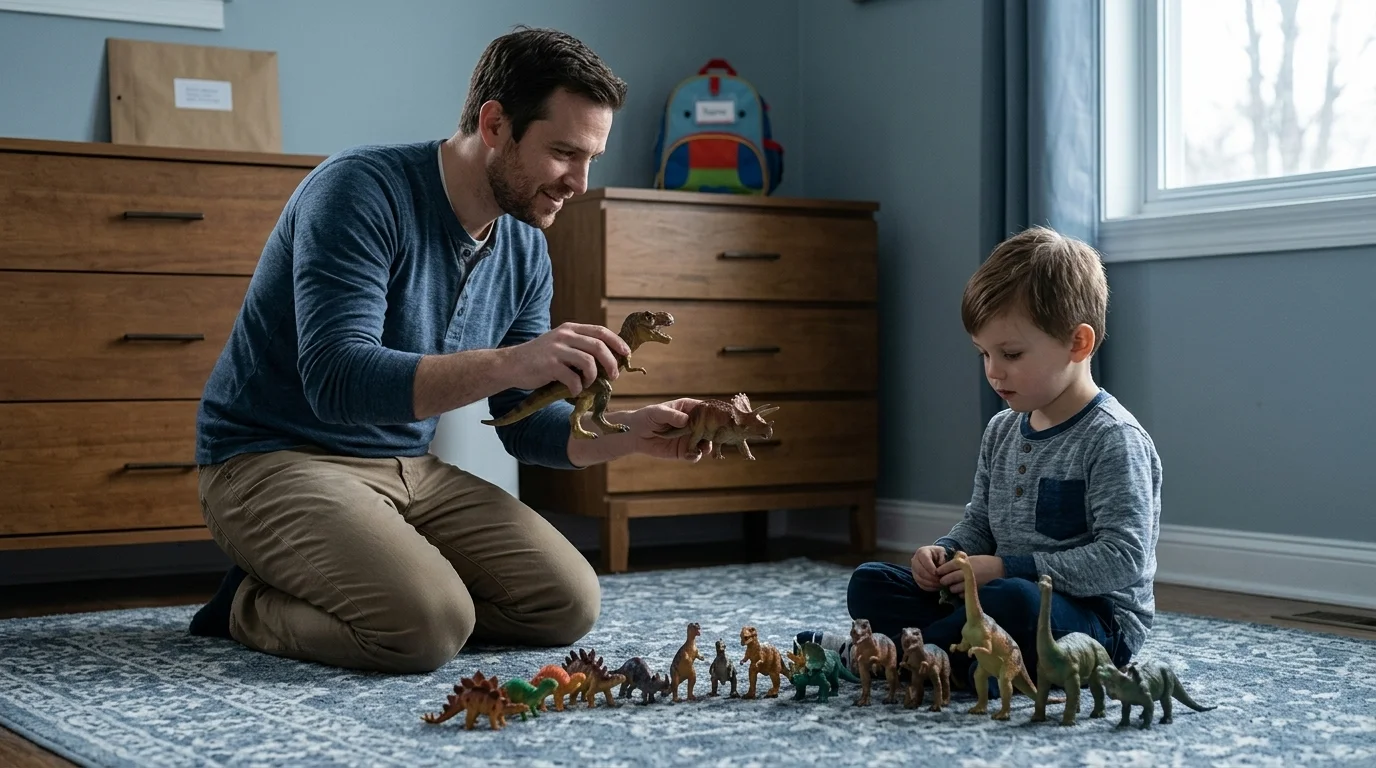
Sit on the floor across from your child. Pick a small preferred item. Offer it to them. When they take it, say a clear "thank you for taking it" and let them hold it for a few seconds. Then hold out your hand and say "my turn." Take it for one second. Say "your turn" and give it back. Repeat.
That is the whole starter program. Five minutes a day, with the most highly preferred item your child will tolerate sharing. If your child melts down on the first try, the item was too preferred. Pick something one notch less special. If your child stares at you blankly, the language was too abstract. Use a hand gesture only. Once that round trip is going smoothly, roll a ball back and forth a few times. That is your first real game.
You are not training a behavior. You are showing your child that letting go of something for a second is safe, because it always comes back. Once that is true in their bones, every other turn-taking goal stops being a fight.
Why Mastermind Behavior
Mastermind Behavior is a BCBA-owned and operated in-home ABA therapy provider serving families across New Jersey, Georgia, and North Carolina. Skill development work like turn-taking lands best when it is taught in the rooms where it actually has to live, which is your living room floor with your child's actual toys, not a clinic across town with someone else's toys. Our BCBAs design the program. Our BTs run the daily sessions in your home. Our parent training coaches show you how to keep it going during the hours we are not there. With a 90%+ staff retention rate and no onboarding waitlist, most families begin direct services within six weeks of their initial assessment.
If you are exploring ABA therapy for your child, schedule a free consultation or call us at 732.813.7333. We will listen to where your child is right now (the brief exchanges that work, the meltdowns over giving things up, the moments where turn-taking falls apart with a sibling), walk you through what a program would look like, and help you figure out the right next step. No pressure, no commitment.
References
- American Psychiatric Association. Autism diagnostic criteria: DSM-5. Reproduced by Autism Speaks. 2013 (TR 2022).
- Toth K, Munson J, Meltzoff AN, Dawson G. Early Predictors of Communication Development in Young Children with Autism Spectrum Disorder: Joint Attention, Imitation, and Toy Play. Journal of Autism and Developmental Disorders | NIH PMC. 2006.
- Centers for Disease Control and Prevention. Clinical Testing and Diagnosis for Autism Spectrum Disorder. CDC. 2025.