The Connection Between Language Skills and Cognitive Development in ASD
Exploring the Interplay of Language and Cognition in Autism

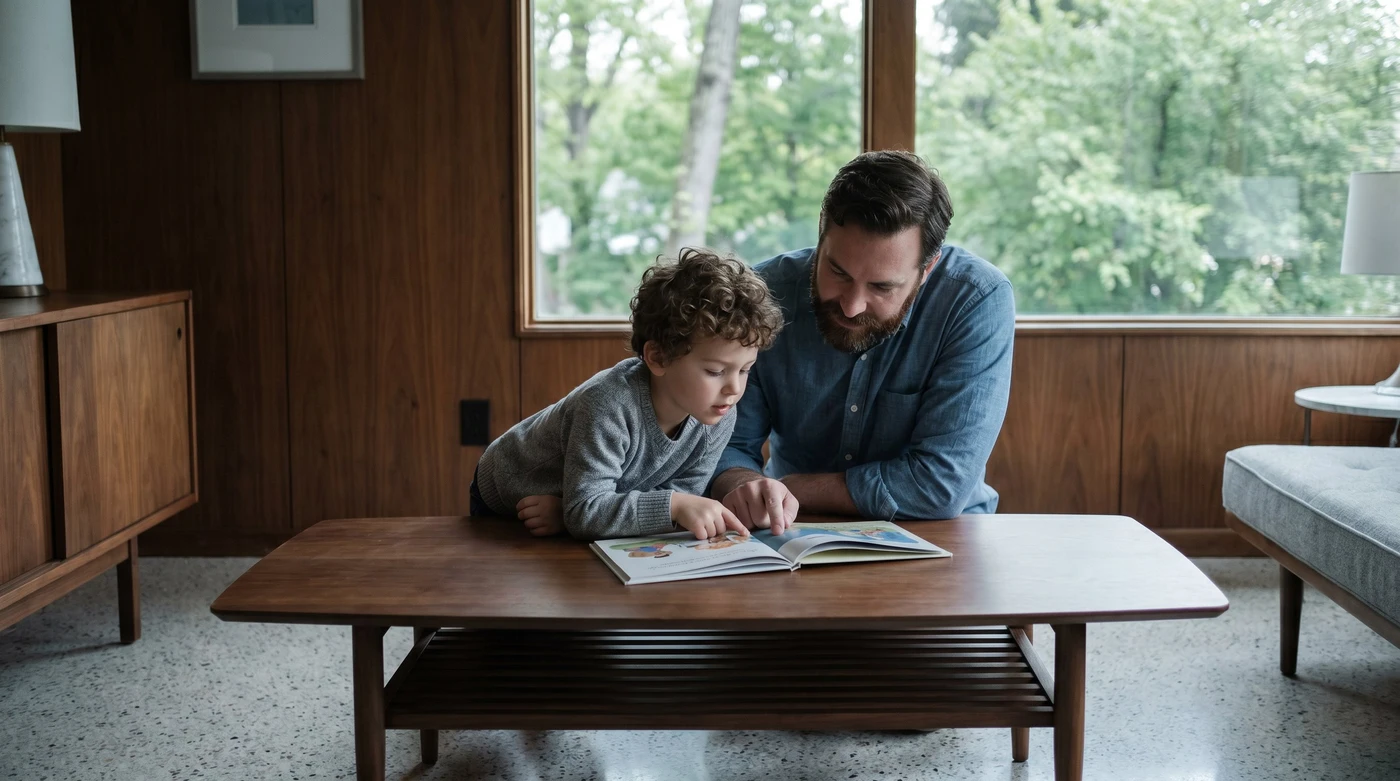
You are at the pediatrician's office on a Wednesday morning. Your three-year-old has said maybe four words this year, and the doctor is asking the questions you have been bracing for. Does he respond to his name. Does he point. Does he look when you call him from across the room. You are answering yes, no, sometimes. The doctor writes things down. You leave with a referral and a worry that has now grown teeth: if he is not talking, what does he understand. If he is not understanding, what does he know. If he is not learning, what happens next.
This is one of the most common worries we walk into when families call us. The link between language and thinking feels obvious, and it is, but the relationship is more interesting than parents are usually told. A child can understand a lot more than they can say. A child can know things they cannot yet show. And when language eventually starts to come, what happens next is rarely what parents expect. We want this article to give you the real picture, not the textbook one.
Receptive Language and Expressive Language Are Not the Same Thing
Most language conversations parents have with pediatricians focus on expressive language: how many words is he saying, is he putting two words together, can she answer a question. That is the visible piece. But there is a second piece, less visible and often underestimated, called receptive language: what the child understands when other people talk to them.
On the Autism Parent Power Podcast, an early intervention therapist explains why expressive language is usually the first thing parents notice.
The two are different skills, and they do not always grow at the same rate. In children with autism, the gap between them can be unusually wide. Some children show a relative advantage in receptive language (they understand more than they say). Others show the reverse. Studies of preschoolers with autism have actually shown receptive language can lag behind expressive language in this population, the opposite of typical development.1 In one study of minimally verbal autistic children and adolescents, receptive language was lower than expressive language overall, and only about a quarter of the children showed a clear receptive advantage.2
What does this mean for your kid. It means the question "does he understand" cannot be answered by counting words. We have to test it directly, and we have to keep testing it as the child grows.
The Kid Who Was Listening the Whole Time
We had a young client a while back, around age four, with very little expressive language. Maybe ten words, mostly single labels for things he wanted. The family had been told by more than one person that he probably did not understand much beyond simple commands. Their assumption (and several professionals' assumption) was that the limited speech reflected limited comprehension.
The first time our BT ran a structured receptive language probe with him, the results were striking. Asked to follow multi-step directions, he could. Asked to point to less obvious things in a picture (the elbow, the spoon under the table, the dog's tail), he could. Asked to identify category items ("show me three things you can eat"), he could. He was watching every adult in the room. He was imitating his older sister at home. He was exploring rooms in detail, examining items, listening to conversations he was not part of. The expressive language was minimal. The receptive language was several years past where everyone assumed it was.
In our practice, this is more common than parents realize. A pattern we see often: the child is responding through gestures, eye gaze, behavior changes, leaving the room when something is being discussed they do not like. Parents miss it because the child is not answering with words. The child is answering. They are using a different channel.
What changed for that little guy's program: we shifted away from just trying to build expressive vocabulary, and built the augmentative communication side simultaneously. By the time spoken language did start to expand, he had a way to demonstrate what he had already known for months. The expressive language followed the channel that was available, not the other way around.
What "Cognitive Development" Actually Means at This Age
When researchers talk about cognitive development in young children, they are usually talking about a cluster of skills: attention, memory, problem-solving, sorting and categorization, cause-and-effect understanding, imitation, and the ability to apply something learned in one context to a new context.
Language and these skills are tied together, but they are not the same thing. A child can have a clear cognitive profile, with intact problem-solving and good memory, while their expressive language is significantly delayed. A child can have strong vocabulary while their attention and flexibility are weak. The combinations are real, and they matter for how a program is designed.
In our practice, our BCBAs typically run a developmental assessment that looks at language, social, motor, and cognitive milestones separately, instead of relying on a single overall age. A four-year-old who scores at three years for expressive language, four years for receptive language, two years for social, and four years for motor is a different child than a four-year-old whose profile is flat. The interventions are different. The priorities are different.
The "Be Careful What You Wish For" Moment Most Parents Are Not Warned About
Now the harder thing to talk about, the thing most parenting books and intervention guides quietly skip: when expressive language starts to come in, parents are usually unprepared for what it brings with it.
For years, the family has been hoping for words. The first big communication explosion is the moment the household has been waiting for. Then, sometimes within weeks, the child starts using those words to express opinions ("no"), to refuse things ("don't want this"), to negotiate ("two cookies first"), to argue ("not yet"), and to push back on things they used to accept passively. Parents tell us they expected the words and did not expect the will. Or, more honestly: they expected the will to look like a typical four-year-old's tantrums and instead it looks like something more complex, because the child has years of pent-up communication trying to come out at once.
The clinical phrase we sometimes use is "the second wave of work." When language explodes, social skills and emotional regulation skills do not automatically follow. They have to be taught, and the teaching often has to happen in parallel with the language gains, not after them. Coping with disappointment, taking turns in conversation, accepting "no," waiting, repairing after a conflict, all of those are separate skill domains. They were on hold during the language-delay years because the child did not have the words. Now the words are here, and the rest of the work begins.
What Parent Training Looks Like at This Stage
Most of our parent training time during a language explosion is spent on the same handful of things, in roughly this order.
First, recognizing the difference between intentional refusal (a real opinion, expressed correctly) and a problem behavior. A four-year-old saying "no, I don't want broccoli" with a flat tone is using language correctly. The instinct of many parents in the moment is to treat the refusal as defiance. We teach parents to honor the language even when the answer is still no broccoli. The child made a request; the parent responds to the request and then enforces the rule. The order matters.
Second, building the parent's tolerance for the new mess. Households that have been quiet for years are now loud. The child is correcting siblings. The child is asking the same question fifteen times. The child is announcing every observation. This is good. It is also exhausting. Parent training in this stage often involves naming what is happening so the parent can hear it as progress instead of as a step backward.
Third, scaffolding the social skills that have to come now. Conversation turn-taking. Asking before grabbing. Waiting for an answer. Greeting people they know. None of these are automatic. Each of them is a teaching target with goals and data.
Our parent training coaches see this stage often, and the families that come through it best are usually the ones who got a heads-up before it arrived.
How Cognition Is Built When Spoken Language Is Slow to Come
Here is where parents tend to relax, because the news is better than they expect: cognitive development does not have to wait for spoken language. In our experience and in the research, children with limited expressive language can absolutely build strong cognitive skills (attention, problem-solving, categorization, memory, flexibility) through other channels.
Augmentative communication systems (a speech-generating device, a picture-exchange system, sign language, or some combination) give the child a way to participate in the cognitive work without first solving the speech problem. A child using a device to label "red," "blue," "yellow," and then to combine "I want red car," is doing the categorization work that drives cognitive growth, regardless of whether the words come out of their own mouth.
Naturalistic teaching (sometimes called Natural Environment Teaching, or NET) is one of the more evidence-supported approaches in autism early intervention. Naturalistic developmental behavioral interventions (NDBIs) have been shown across multiple meta-analyses to produce gains in language and broader developmental skills.3 In NET, the cognitive targets get embedded in the child's natural play and routines: matching shapes during a puzzle game, sorting cars by color during play, problem-solving how to get the toy out of the bin. The cognitive work is happening. The language is one of several channels for it.
For more on how this fits the broader picture of language and cognitive development, skill development programming includes both pieces from the start.
The Imitation Piece
A specific cognitive skill that often shows up early on goal sheets, and that is worth naming, is imitation. Children with autism sometimes show delayed motor and verbal imitation, and that delay can slow other developmental areas because so much typical learning happens through imitating others.
Our BCBAs typically build motor imitation first ("do this," with a clap or a tap), then object imitation (banging a drum, pushing a car), then vocal imitation. Once imitation is reliable across all three, we use it as a teaching channel for almost everything else: actions, sounds, words, simple sequences. The child who can imitate has a built-in way to learn from anyone in the room.
The reason this matters for the language-and-cognition picture: imitation is one of the bridges between cognition and language. The child who watches you crack an egg and then tries to do it themselves is doing cognitive work (sequencing, motor planning, prediction) and language work (labeling, requesting help) at the same time. Building imitation strengthens both sides.
What to Watch For Over the Next Six to Twelve Months
If your child is in the language-delay stage right now, three things to track.
The first is what the receptive language data is showing. Ask your team. If they are not running structured receptive probes, request that they start. The receptive picture is the more accurate predictor of where the cognitive baseline actually is. When the receptive scores are climbing, the cognitive engine is running, even if the expressive output is slow.
The second is whether augmentative communication is on the table. If the child is past age three with very limited spoken language, and an augmentative communication system has not been discussed, that is a flag. Augmentative communication does not slow speech development. Multiple decades of research have shown the opposite, that it tends to support spoken language emergence rather than replace it. If the team is hesitant, ask why.
The third is whether the program has goals for the post-language-explosion phase, even if the child is not there yet. Coping skills, social pragmatics, conversation turn-taking, accepting "no" and saying "no" appropriately, repair after conflict. These should be on the IEP and on the ABA goal sheet before the language wave hits, not after. The families that come through this phase smoothly are the ones whose teams planned for it.
A Note on Predicting "Outcomes"
Parents sometimes ask whether their three-year-old's language profile predicts long-term outcomes. The honest answer is that early language scores are correlated with later outcomes, but the correlation is not destiny. Children change. Trajectories shift. Late talkers sometimes catch up dramatically. Children with stronger early receptive language sometimes go further than the early data suggested.
What we tell families: the work right now is to build the skills that are buildable right now. The cognitive work is not on hold. The receptive work is not on hold. The communication work, in whatever channel works, is not on hold. The expressive language will come on its own timeline. Most of what determines outcomes is happening in the years between now and elementary school, in the home and in the program. That is where the leverage is.
Why Mastermind Behavior
Mastermind Behavior is a BCBA-owned and operated in-home ABA therapy provider serving families across New Jersey, Georgia, and North Carolina, including parent training across Georgia. Language and cognitive skills are best built where children actually use them, which is why our BTs run sessions with the toys, the books, and the routines that already live in your house. Our BCBAs assess language, cognitive, social, and motor skills separately so the program reflects your child's real profile, not an averaged age, and our parent training coaches walk you through the language-explosion phase before it arrives. With a 90%+ staff retention rate and no onboarding waitlist, most families begin direct services within six weeks of their initial assessment.
If you are exploring ABA therapy for your child, schedule a free consultation or call us at 732.813.7333. We will listen to where your child is right now (the words that have not come yet, the comprehension you suspect is there, the cognitive work you are not sure how to support), walk you through what a program would look like, and help you figure out the right next step. No pressure, no commitment.
References
- Hudry K, Leadbitter K, Temple K, et al. Preschoolers with Autism Show Greater Impairment in Receptive Compared with Expressive Language Abilities. International Journal of Language and Communication Disorders. 2010.
- Chen S, Lee Y, Hampton LH, et al. Receptive Language and Receptive-Expressive Discrepancy in Minimally Verbal Autistic Children and Adolescents. Autism Research. 2024.
- Schreibman L, Dawson G, Stahmer AC, et al. Naturalistic Developmental Behavioral Interventions: Empirically Validated Treatments for Autism Spectrum Disorder. Journal of Autism and Developmental Disorders. 2015.