How to Teach Children with Autism to Recognize Danger
Enhancing Safety Awareness in Autistic Children

You are at the grocery store. You turn your head for three seconds to grab a gallon of milk, and when you turn back your five-year-old has bolted. Down the aisle, around the endcap, gone. Your stomach drops. You find him forty seconds later, two aisles over, very pleased with himself, holding a bag of pretzels. You are shaking, and he can't understand why.
If you are a parent of a child with autism, this scene (or some version of it) is probably already familiar. You are not alone in it. Research published in the journal Pediatrics found that nearly half of children with autism spectrum disorder had attempted to elope from a safe setting at least once after the age of four, with more than half of those who eloped going missing long enough to cause real concern.1 The parking lot. The pool. The front door of the house when the doorbell rings. Your child is not trying to scare you. He is trying to get somewhere or away from something, and his sense of danger has not yet caught up with his ability to move. Here is what good in-home ABA therapy actually does about this, in what order, and why most of the advice you find online has the sequence backwards.
Recognizing danger is not a single skill. It is a stack of skills that have to fire in order. The child has to notice a cue (a car, a stranger, the sound of running water). The child has to interpret the cue as relevant to them. The child has to suppress the impulse they were already acting on. The child has to switch to a different action.
For a lot of kids on the spectrum, the wiring on every step of that stack is different. They may be hyperfocused on a goal (the pretzels, the pool, the toy in the parking lot) and miss the warning cue entirely. They may notice the cue but not connect it to themselves. They may understand the rule in calm moments and lose access to it the second their nervous system spikes. The Autism Society describes wandering and bolting as often serving a communicative function, signaling an unmet need, sensory overload, or the pull of a familiar place, rather than simple defiance.2 None of that means kids with autism are unable to learn safety skills. It means the teaching has to start in a different place than most parents are told.
This is the part that gets skipped in most online safety guides, and it is the part that matters most. Before a child can be taught not to run into a street, the immediate environment has to be safe enough that one mistake will not be the catastrophic one. Teaching is a months-long process. The streets do not wait that long.
For a child who would run into traffic without looking, that means a physical safeguard from day one. Two common options:
Hand-holding is the simplest version. It is also the most invasive, and the most exhausting for both adults and children. Many parents find that the child fights it, the grip gets sweaty within minutes, and supervision is essentially constant for as long as the family is outside.
A child-sized backpack with a leash or harness attachment is the option a lot of the families we work with prefer. The leash gets a bad reputation online, but practically speaking it is the less invasive of the two. The child has both hands free, can walk a few steps ahead or to the side, and gains a small amount of independence while the parent still has a physical tether for the moment when the child's body decides to launch. It is a teaching tool, not a punishment, and the child learns the boundary of staying within range of the adult almost passively, just because the tether is there.
Either way, the rule is the same. Containment buys you the runway to teach. If your child can bolt into a street at any moment, the entire training plan below has nowhere to land, because the first real lapse ends the program. Most families on our caseload use a containment strategy for the first two to four months of safety work, and most are able to fade it as the stop-on-cue program takes hold.
Here is the single most common mistake we see when we walk into a home for the first time. Parents have been working on "look both ways before you cross the street." They have been practicing it for months. The child can recite it. The child cannot do it.
The reason is that "look both ways" is the second skill in the sequence. The first skill is "stop." If a child cannot reliably stop on a cue (their name, the word "stop," a hand signal), the looking step never gets a chance to happen, because the child is already across the street. Most parents skip past stop-on-cue and go straight to looking, and then wonder why the looking part isn't working. Autism Speaks, in its expert guidance on bolting, recommends starting safety practice in low-stakes environments like an empty parking lot or a quiet street, with two adults present for each session, before moving to busier environments.3
In our practice, the first three to four weeks of safety work are spent teaching stop-on-cue away from any actual road. We use games like freeze dance, red light/green light, and musical statues, paired with high reinforcement. Our BTs run dozens of trials a session in the living room before a single trial happens outside. The cue word is consistent. The reinforcement is rich. The child practices stopping while running, while playing, while distracted. By the end of those weeks, many kids on our caseload will pause for a count of three on the cue before the parent has even caught up to them. That pause is the whole game.
Once stop-on-cue is reliable indoors, we generalize it carefully. The order is:
The driveway, with the car parked and turned off. The child practices walking to the car, hearing "stop," and freezing. We do this dozens of times.
The parking lot at quiet times. Saturday mornings, weekday late mornings, anywhere with low traffic. The child practices stopping at painted lines, at the edge of the lot, at curb cutouts. Each new environment usually takes another two to three weeks to lock in.
A quiet store aisle. The child has to stop while distracted, while motivated to keep moving toward something interesting. This is harder than it sounds.
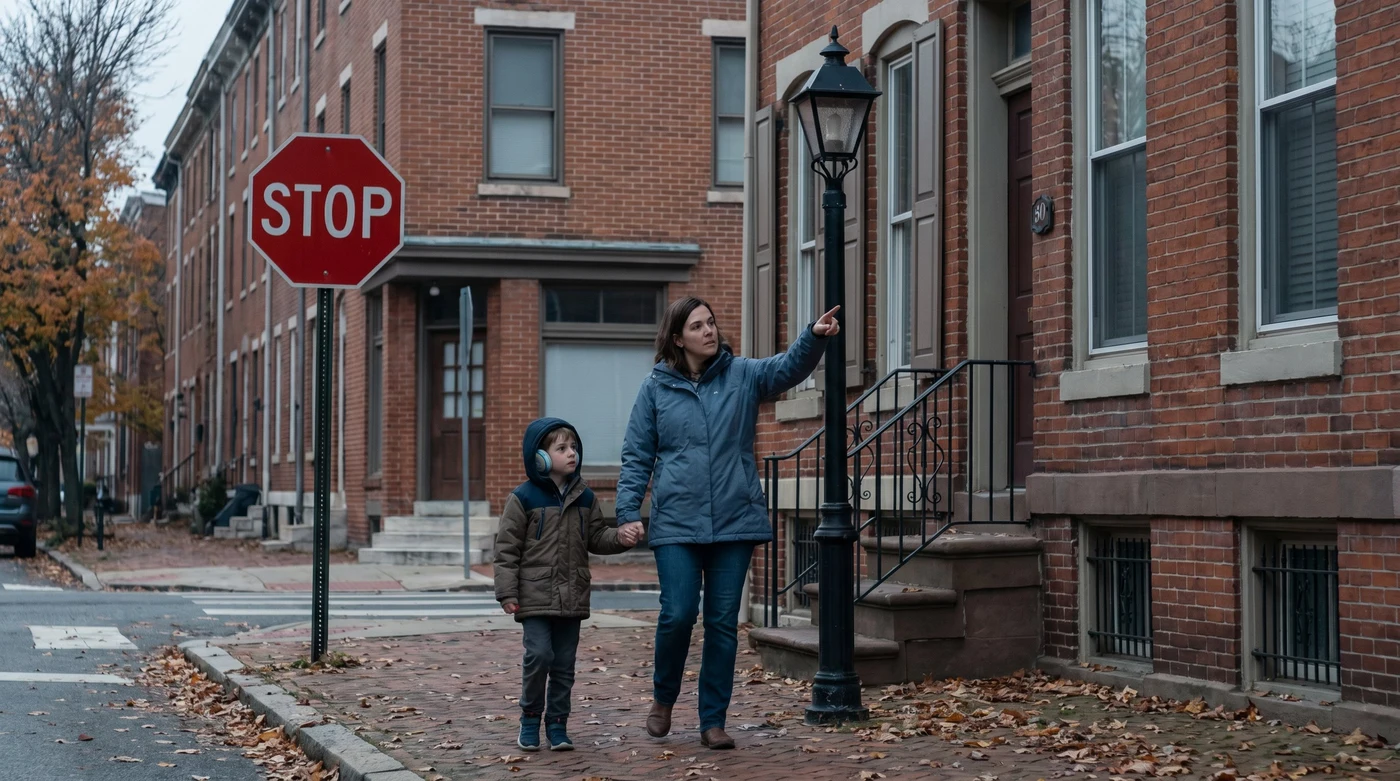
A residential curb. We add the looking step here, because now stopping is automatic and the child has cognitive bandwidth left over to look. Looking is the easy part once stopping is solid.
The reason we sequence it this way comes down to data. Stop-on-cue is the prerequisite that makes every other community safety skill possible. Skipping it is what makes more advanced skills fall apart in the moment that actually matters. This kind of structured generalization is at the heart of transition planning work, where the goal is taking a skill the child can do at home and making it durable enough to hold up everywhere else.
Through all of this, the backpack-and-leash or hand-holding stays in place during real outings, even as it stops being needed in the practice environments. The training environment is controlled. The grocery store on a Saturday is not. We fade the physical safeguard only after the child is reliably stopping in real, distracted environments for several weeks running. That is usually a clinical decision the BCBA makes with the family together, not a milestone the parent has to guess at.
When a child bolts repeatedly, it is almost never random. There is a function, a reason the behavior is happening. Functional Behavior Assessments help us figure out what that reason is, and the reason changes the whole intervention.
An "escape" bolter is running away from something: sensory overload, a demand they cannot meet, a transition they are not ready for. The right intervention is not faster locks; it is lowering the demand, building a "request a break" skill, and identifying the trigger before it spikes.
An "access" bolter is running toward something: water, a specific store, a fixation. The right intervention here is teaching a request skill ("can I go to the pool, please?") and managing access during the teaching window so the bolting itself stops being reinforced.
A "social" bolter is doing it because something happens when they bolt (a parent chase, a chase from a sibling, the return to a familiar spot). The intervention removes the social reinforcement and replaces it with a more functional way to get the same need met.
Same surface behavior, three very different programs. Treating bolting as one undifferentiated problem is a mistake we see often in school-based safety plans, and it is one of the first things our BCBAs untangle when a family transfers in.
The traditional "stranger danger" conversation does not work well for most kids on the spectrum. It is too abstract, it relies on social judgment the child is still building, and it can leave a child either terrified of every adult or unable to identify a safe one in an emergency.
We teach a more concrete version. The child learns to recognize specific safe figures by uniform: police officer, firefighter, store employee with a name tag and apron, school staff with a lanyard. The child learns a script for what to do if they get lost ("find a person with a name tag and tell them I'm lost"). We role-play it in the actual store, the actual park, the actual mall. The skill becomes a recognizable pattern instead of a vague rule, and a recognizable pattern is something a child can use under stress.
One pattern worth flagging from our caseload. Most pool-related emergencies we hear about don't start at the pool. They start at the front door. A child elopes from the house, finds the neighbor's pool, and the family had no idea their child was even outside.
This pattern is borne out in the research. The National Autism Association reports that accidental drowning accounts for 71 percent of lethal outcomes in autism wandering incidents, and that drownings are the leading cause of wandering-related death.4 The Centers for Disease Control's child development resources, citing the Anderson et al. Pediatrics study, note that elopement frequently starts at home and that brief gaps in supervision are when most incidents occur.5
The fix is rarely a swim-only intervention. We layer it. Door alarms and visible locks first, because seconds matter. A clear "ask before going outside" routine, reinforced from week one. Swim instruction in parallel, ideally one-on-one and ideally including swimming with clothes on (because a real water emergency rarely involves a swimsuit). A community plan with neighbors who have water on their property, so they know your child's name, your phone number, and what to do if your child shows up uninvited. Each piece is partial protection on its own. Together, they are a real net.
Progress on safety skills is, in some ways, easier to see than progress on other skills. The child stops at the cue word. The child waits at the curb without a hand on him. The child finds a name tag in the store and asks for help. These are concrete, observable wins.
What is harder to see is the slow build of moments that don't happen. The bolt that didn't happen because the door alarm caught it. The street-crossing that didn't end in a near miss because the child stopped. Those are the wins that matter most, and they are the ones parents are least likely to notice in real time. We track them so you can see them, because confidence about your child's safety is one of the things this work is meant to give you back.
If your child has bolted more than once, if you have started avoiding the parking lot or the pool because of safety fears, or if a school-based safety plan has stopped working, that is the signal that a structured in-home approach would help. Safety skills cannot be drilled into a child in an hour-long session at a clinic. They have to be taught where they will be used, by people the child trusts, with the kind of repetition that only fits into a real day at a real home.
Why Mastermind Behavior
Mastermind Behavior is a BCBA-owned and operated in-home ABA therapy provider serving families across New Jersey, Georgia, and North Carolina. Safety skills like stopping on cue, recognizing strangers, and handling busy parking lots are taught where they actually happen: your driveway when you are getting the kids in the car, your curb at school pickup, the entrance to your local store on a Saturday morning. Stop-on-cue learned on a clinic floor does not transfer to a real parking lot, so we do not pretend it does. With a 90%+ staff retention rate and no onboarding waitlist, most families begin direct services within six weeks of their initial assessment.
If you are exploring ABA therapy for your child, schedule a free consultation or call us at 732.813.7333. We will listen to the specific safety moments that scare you (the bolting incidents, the parking lot near-misses, the pool) and help you figure out the right next step. No pressure, no commitment.
References
- Anderson C, Law JK, Daniels A, et al. Occurrence and Family Impact of Elopement in Children With Autism Spectrum Disorders.Pediatrics. 2012;130(5):870-877.
- Autism Society. Living Safely on the Spectrum: An Introduction to Wandering and Prevention Strategies.
- Autism Speaks. Special Ed Teacher Seeks Advice: Child with Autism Bolts from Safety (Expert Opinion).
- National Autism Association. Wandering: Resources and Statistics.
- Centers for Disease Control and Prevention. Wandering (Elopement), Child Development.