How to Teach a Child with Autism to Accept “No”
Strategies for Helping Autistic Children Embrace 'No'


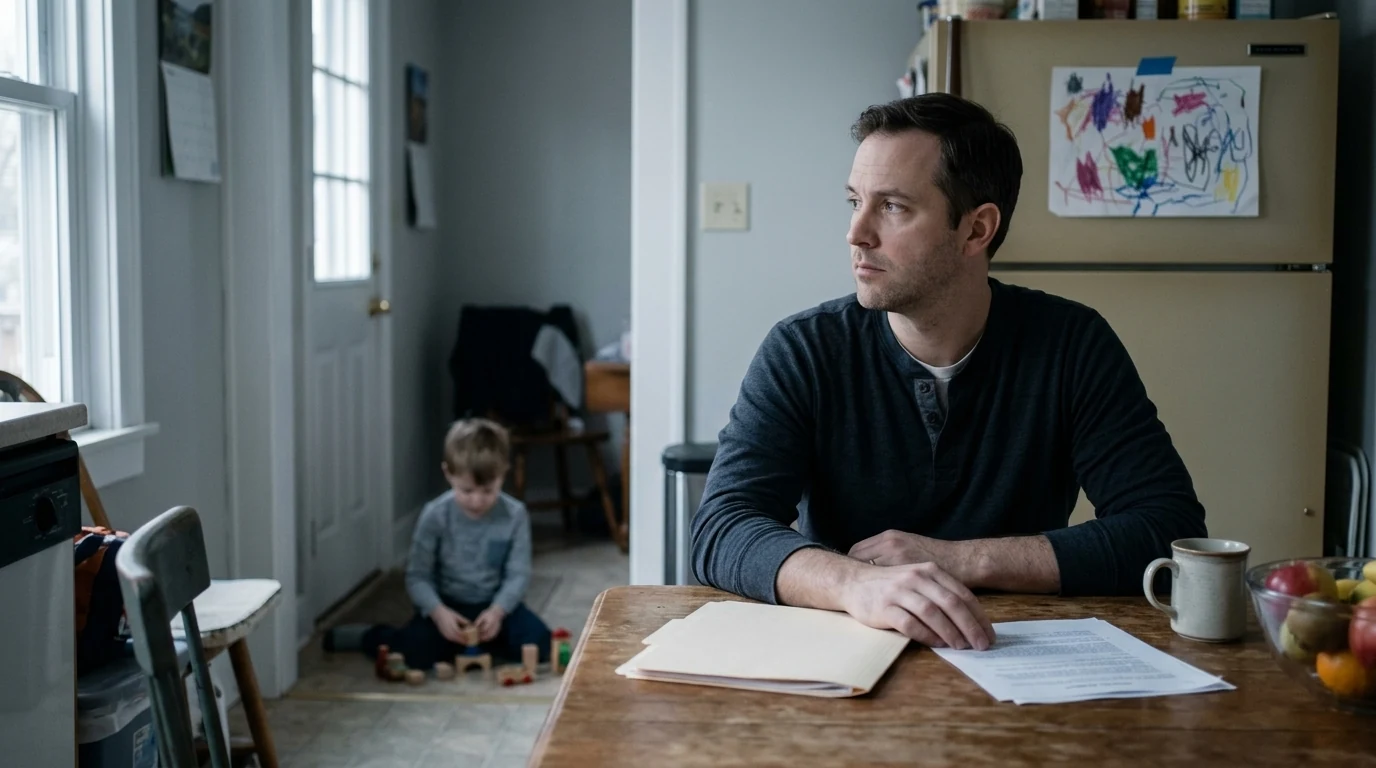
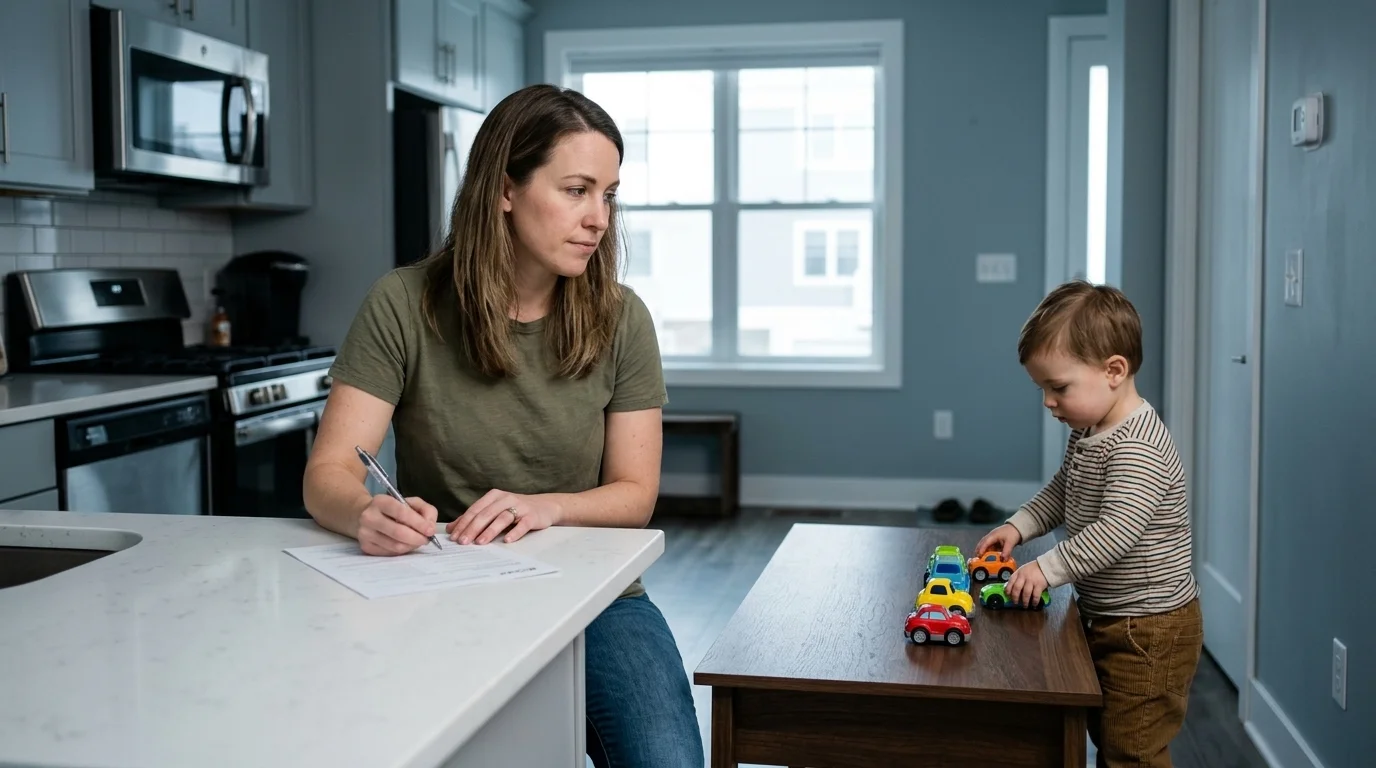
It is 7:42 on a Tuesday night. Your six-year-old is asking for the iPad again, and you have already said yes twice today. This time, you say no. The floor of the living room becomes a place where words don't reach him. There is screaming, a shoe gets thrown, and you are standing there knowing that at some point he has to learn that "no" is a word that exists. Tonight is not the night you are going to win that lesson.
If you are a parent of a child with autism, "accepting no" might be the single hardest skill on the list. It comes up at every meal, every transition, every screen-time conversation. The standard advice to "be consistent and stay calm" rarely tells you what to actually do at 7:42 on a Tuesday. Here is what good in-home ABA therapy does differently.
For a lot of children with autism, the word "no" lands like a door slamming. The American Academy of Pediatrics describes social communication challenges and difficulty with abstract or temporal language as core features of autism spectrum disorder, which means concepts like "later," "tomorrow," or "in five minutes" don't always land cleanly.1 Past meltdowns may also have actually worked, meaning a "no" sometimes turned into a "yes" once the protest got loud enough. None of that makes a child manipulative. It makes them human, and it makes "no" feel like a permanent verdict instead of a temporary one.
There is another piece worth naming. Many kids on the spectrum are intensely focused on a preferred item or routine. Saying no to "iPad now" is not the same as denying a neurotypical child a snack. It is denying access to the thing that helps them regulate. The stakes feel higher to them, so the protest matches the stakes.
The most frequent thing we see well-meaning parents do is avoid the word "no" entirely. They distract, redirect, change the subject, swap one preferred item for another, anything to sidestep the moment. It looks like it is working in the short term, because the meltdown does not happen. But the skill of hearing "no" never gets built.
The first real "no" then arrives somewhere worse than home: at school, at a friend's house, at a doctor's office. It hits a child who has never practiced. The work that should have happened in low-stakes moments at home gets forced into a high-stakes moment in public, and that is usually when families call us.
Here is the move most parents miss. Saying "okay" after a "no" is itself a skill. Like any skill, it has to be worth doing. If the only thing your child gets for accepting "no" is the absence of the thing they wanted, "okay" is a losing trade every time. So we flip it.
In the homes we work in, the first program around accepting "no" usually has nothing to do with the "no" itself. It has to do with what happens the second the child says "okay." A token goes on a chart. A specific, immediate praise statement lands ("That was a great okay. I know that was hard."). Sometimes a small preferred item appears. And when it is possible (which is more often than parents expect), the original request gets granted a beat or two later, after the calm response. The child learns that "okay" is not surrender. "Okay" is a different kind of yes.
We borrow heavily here from Dowd and Tierney's Teaching Social Skills to Youth, a manual our BCBAs use as a starting point because it breaks complex social skills into discrete, role-playable steps. "Accepting 'no'" is one of the named skills in that book, and the structure is simple enough that parents can run it: look at the person, say "okay," stay calm, and if you disagree, ask later in a calm voice. We role-play that sequence with the child before any real "no" moment happens. Stuffed animals, dolls, a parent pretending to ask for cookies and accepting the answer with a big visible "okay." By the time the real moment arrives, the script is muscle memory.
Before any BCBA tries to teach a child to accept "no," there is a step that most parent guides skip. The child has to actually want to interact with the person setting the limit. If a child does not enjoy your company, "no" feels like rejection. If they do, "no" feels like a temporary disappointment.
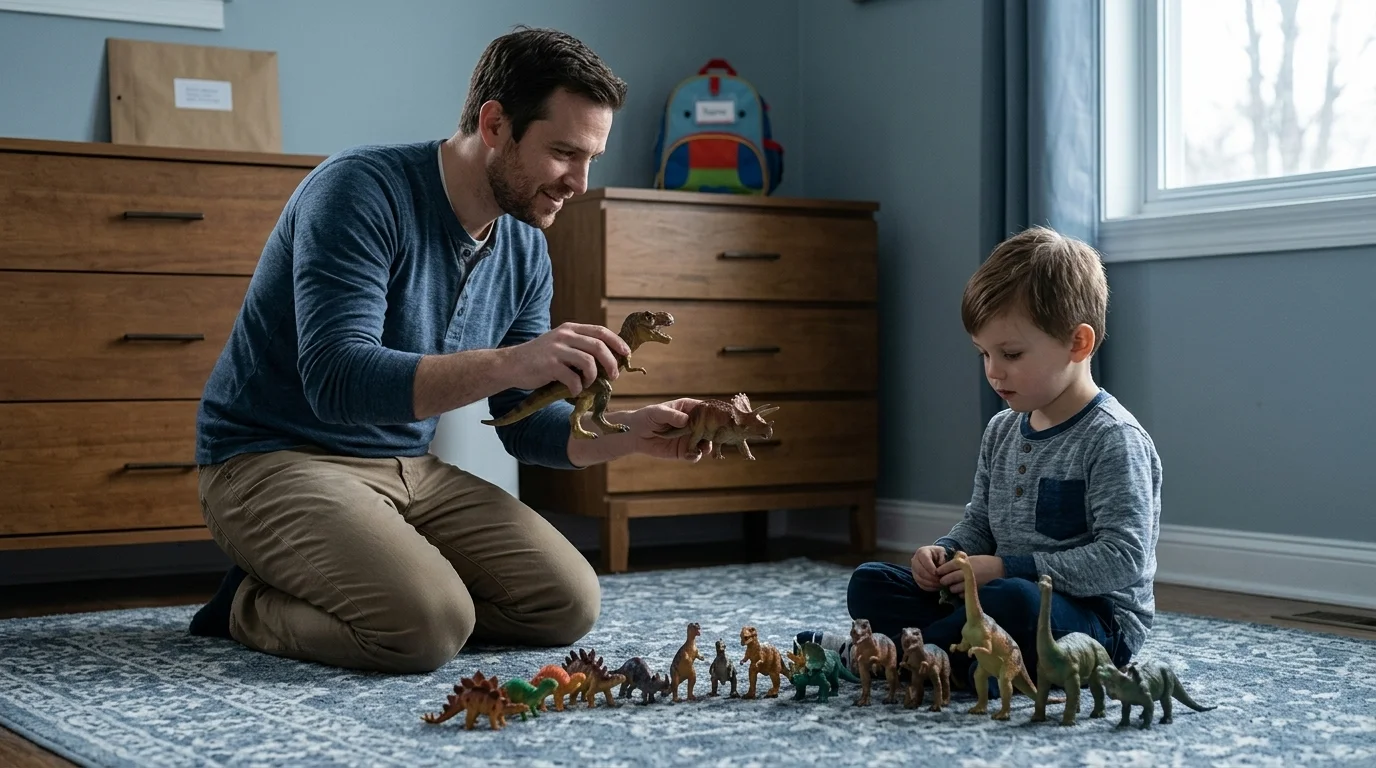
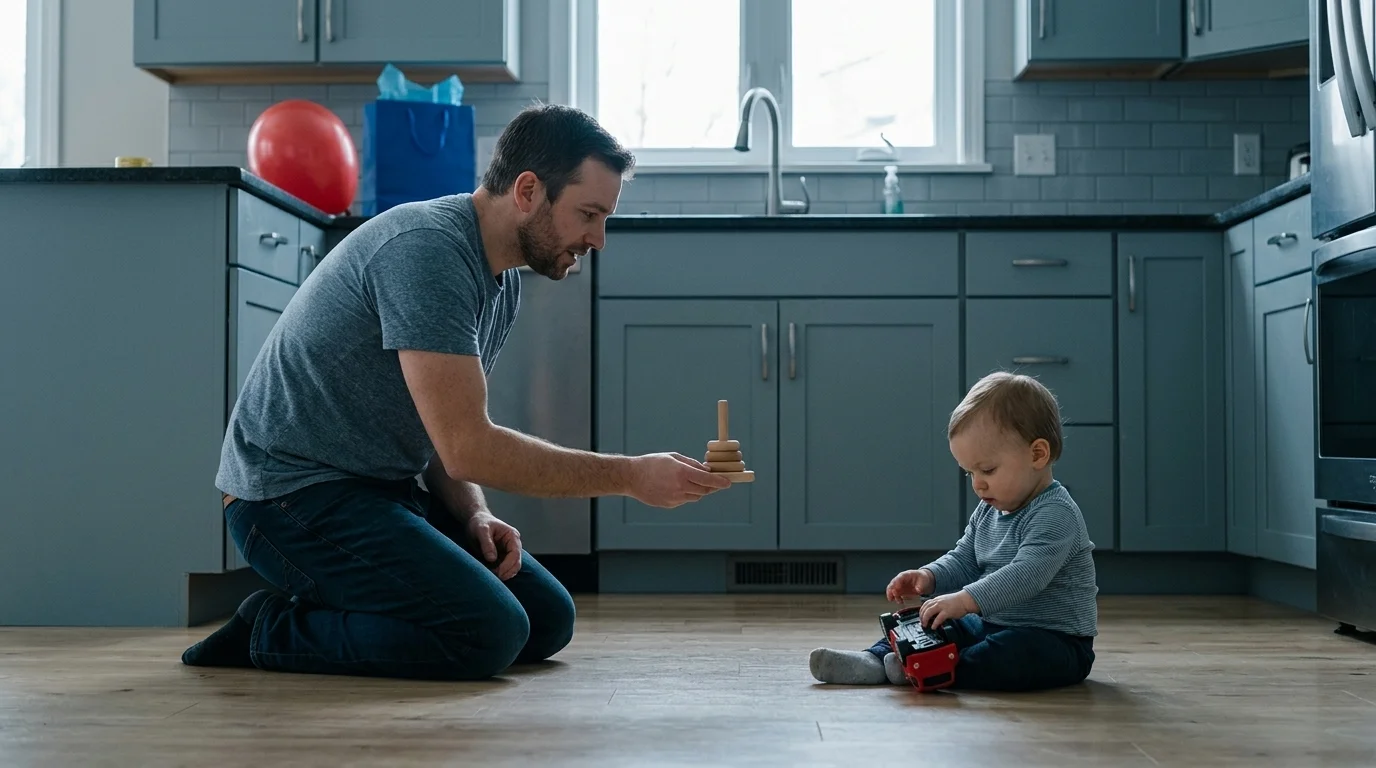
So the very first move, especially with a new Behavior Technician walking into the home, is narration and shared interest. The BT sits on the floor. They narrate what the child is doing ("you're stacking the red one on top, now you're getting the blue one") without demanding anything. They pair themselves with reinforcement, so being near them feels good. Only after that relationship is built do they start working on tolerance.
The sequence is specific. We build the relationship, then we teach the child to tolerate hearing the word "no," then we teach them to tolerate the action of not getting the thing. Skipping a step is what causes the meltdown. This is the part of the program our parent training coaches walk every household through in the first month, because consistency across caregivers (both parents, grandparents, older siblings) is what makes tolerance work stick.
Once a child can hear the word without coming apart, the work moves to small denials. Not the iPad. The iPad is the championship round. We start with low-preference items.
A BCBA might say, "Can I have the green crayon?" The child wants the green crayon. They get to say no, and the BCBA says, "Okay, that's fine, you keep the green one." The child learns that "no" is a word that works in both directions, that it is survivable, and that the world does not end when someone uses it. Then we flip the script. The BCBA holds a less-preferred item and says, "No, you can't have this right now, but you can have this instead." The child practices hearing "no" attached to something they don't desperately want. Calm responses get immediately reinforced, often with the very thing they were just told no about, after a short delay. Research published in the Journal of Applied Behavior Analysis compared three different methods of teaching children to accept denied requests and found that the structure of the "no" itself, paired with brief delay-and-redirect, made a measurable difference in reducing problem behavior.2
This is where parent training becomes the multiplier. Parents who learn to run these tiny practice reps a few times a day, on items the child only mildly cares about, end up with a child who handles real "no" moments in two to four weeks of consistent work. That is often faster than parents expect.
For many of the kids on our caseload, a token board is the bridge between "I said okay" and "I see why okay was worth it." Tokens are visual, immediate, and they accumulate toward something the child actually wants.
A typical setup: a small board with five spots. Every time the child accepts a "no" calmly, a token goes on the board. Five tokens earns a brief preferred activity. The "no" stops being an isolated loss. It becomes a step toward a win the child can see coming. Within a few weeks, most kids start asking, "Did I earn a token?" after a calm response, which is the moment you know the skill is starting to live inside them.
The token board is scaffolding. Most kids fade off of it within a few months, the same way they fade out of training wheels. The internal version (the part of them that knows accepting "no" is something they can do, and something they get credit for) is the one that stays.
Words can feel slippery to a child who is still building receptive language. Visuals do not have that problem. Visual supports are one of the most-recommended evidence-based strategies for autism spectrum disorder, and the Autism Speaks Autism Treatment Network has built whole tool kits around them.3 A few that consistently earn their keep in the homes we work in:
A First/Then board turns "no, not yet" into a picture sequence. First lunch, then iPad. The "no" becomes a "not yet," and "not yet" has a picture next to it that tells the child exactly when. The waiting becomes concrete instead of bottomless.
A choice board lets a denied request turn into a real choice between two available options. Instead of "no, you can't have ice cream," it becomes "ice cream isn't on the board today, would you like apple slices or yogurt?" The child still gets agency, and the denial gets framed as a fork in the road, not a closed door.
A visual timer does the same work for waiting. A timer set for ten minutes makes "ten minutes" a real, watchable thing. The countdown gives a child something to track instead of a vague stretch of time to fight against.
These supports are part of structured skill development work, and most kids stop needing the elaborate version of them within a few months. The internal version, the one that lives in their head, is the one that sticks.
Progress on accepting "no" is rarely a single moment. It is usually a slow drop in the intensity of the protest. Week one, the meltdown is twenty minutes. Week three, it is eight. Week six, the child grumbles, walks away, and finds something else to do.
Parents tend to miss this because they are looking for a clean win. The clean win does come, usually around the moment the child says "okay" instead of screaming. But it is preceded by weeks of slightly-less-bad responses that are easy to overlook in the moment. This is one of the boring reasons BCBAs take so much data: parents are the first to spot real progress, and also the first to miss it, because it is happening every day right in front of them.
If "no" turns into property damage, self-injury, or aggression toward siblings, that is the signal that a structured plan would help. The same applies if you have been working at this for months and your child is still melting down on every refusal. The Autism Speaks Challenging Behaviors Tool Kit recommends a Functional Behavior Assessment for situations where everyday strategies stop being enough, because the FBA identifies what the behavior is actually communicating before any plan gets written.4 That kind of assessment falls under behavior support work, and it is the right starting point when refusal-related behaviors are interfering with daily life.
This is the kind of work in-home ABA therapy is built for. The Centers for Disease Control identifies behavioral approaches that focus on changing behaviors by understanding what happens before and after them as a primary, evidence-supported framework for autism intervention.5 It happens in the rooms where the meltdowns happen. It uses the toys you already own. It teaches the people who are already there with the child every night.
Why Mastermind Behavior
Mastermind Behavior is a BCBA-owned and operated in-home ABA therapy provider serving families across New Jersey, Georgia, and North Carolina. Skills like accepting "no" are best taught in the rooms where they actually have to work, so our BCBAs and Behavior Technicians come to your home, sit on your living room floor, and build the practice into the moments where the real meltdowns happen. With a 90%+ staff retention rate and no onboarding waitlist, most families begin direct services within six weeks of their initial assessment.
If you are exploring ABA therapy for your child, schedule a free consultation or call us at 732.813.7333. We will listen to what is actually happening at home, walk you through what an "accept no" program would look like for your child specifically, and help you figure out the right next step. No pressure, no commitment.
References
- Hyman SL, Levy SE, Myers SM, et al. Identification, Evaluation, and Management of Children With Autism Spectrum Disorder.Pediatrics. 2020;145(1):e20193447. American Academy of Pediatrics.
- Hagopian LP, Kuhn DE, Strother GE. Targeting social skills deficits in an adolescent with pervasive developmental disorder: An evaluation of three methods of saying "no" to avoid an aversive task.Journal of Applied Behavior Analysis. PubMed Central.
- Autism Speaks. Visual Supports and Autism Spectrum Disorder (ATN/AIR-P Tool Kit).
- Autism Speaks. Challenging Behaviors Tool Kit.
- Centers for Disease Control and Prevention. Treatment and Intervention for Autism Spectrum Disorder.