Is ABA Therapy Covered by Insurance in North Carolina?
What North Carolina's autism mandate, NC Medicaid and the schools each cover, plus the 120-day appeal deadline and why $40,000 is not the live cap.


Short answer: usually yes, and by one of four different systems. Which one applies to your child decides everything else, including how much you can get and how long you have to appeal if you are refused.
Every figure below is taken from a North Carolina or federal government document, and each one is dated, because coverage rules change and a guide that does not tell you when it was checked is not much use.
Checked 11 August 2026.
Before anything else: is your plan self-funded?
This is the question that decides whether the rest of the insurance section applies to you at all, and almost nobody thinks to ask it.
North Carolina's autism mandate binds insurance contracts. Many employers, particularly larger ones, do not buy an insurance contract. They pay claims out of their own money and hire an insurance company only to administer the plan. That is a self-funded plan, and the state mandate does not reach it. The Department of Insurance says so in plain words: external review "does not apply to self-funded employer health plans."
The reason is federal. ERISA preserves state insurance regulation, then removes self-funded plans from its reach: an employee benefit plan shall not "be deemed to be an insurance company or other insurer ... or to be engaged in the business of insurance ... for purposes of any law of a State purporting to regulate insurance companies, insurance contracts, banks, trust companies, or investment companies."
How to find out, in two minutes. Ask your employer's plan administrator whether the plan is self-funded or fully insured. Read the Summary Plan Description, which the administrator must give you free of charge and which sets out "how it works, what benefits it provides, how to file a claim for benefits, and any limitations that may apply." Or look at a denial letter: the US Department of Labor notes that "the external review process used by the plan depends on whether the plan is self-funded or provides benefits through an insurance company. The claim denial notice from your plan will describe the external process and your rights." A denial that routes you to a federal external review rather than to Smart NC means your plan is self-funded.
Being on a self-funded plan is not a dead end. Those plans have their own federal appeal rights, and many cover ABA anyway. It just means the North Carolina rules below are not leverage you have. If it is the vocabulary in your plan documents that is the obstacle, our plain English guide to insurance terms works through it.
What North Carolina law requires
The mandate came in through Session Law 2015-271, "AN ACT TO provide coverage for the treatment of autism spectrum disorder," and lives at N.C.G.S. 58-3-192. It "becomes effective July 1, 2016, and applies to insurance contracts issued, renewed, or amended on or after that date."
Four things matter in the text.
A doctor has to order it. This is the sharpest practical difference from New Jersey, where no order is required. Treatment must be "ordered by a licensed physician or licensed psychologist" and "provided or supervised by" one of the listed professionals: psychologists, psychiatrists, developmental pediatricians, speech and language pathologists, occupational therapists, clinical social workers, mental health counselors, marriage and family therapists, or a board certified behavior analyst. If nobody has written the order, that is your first call.
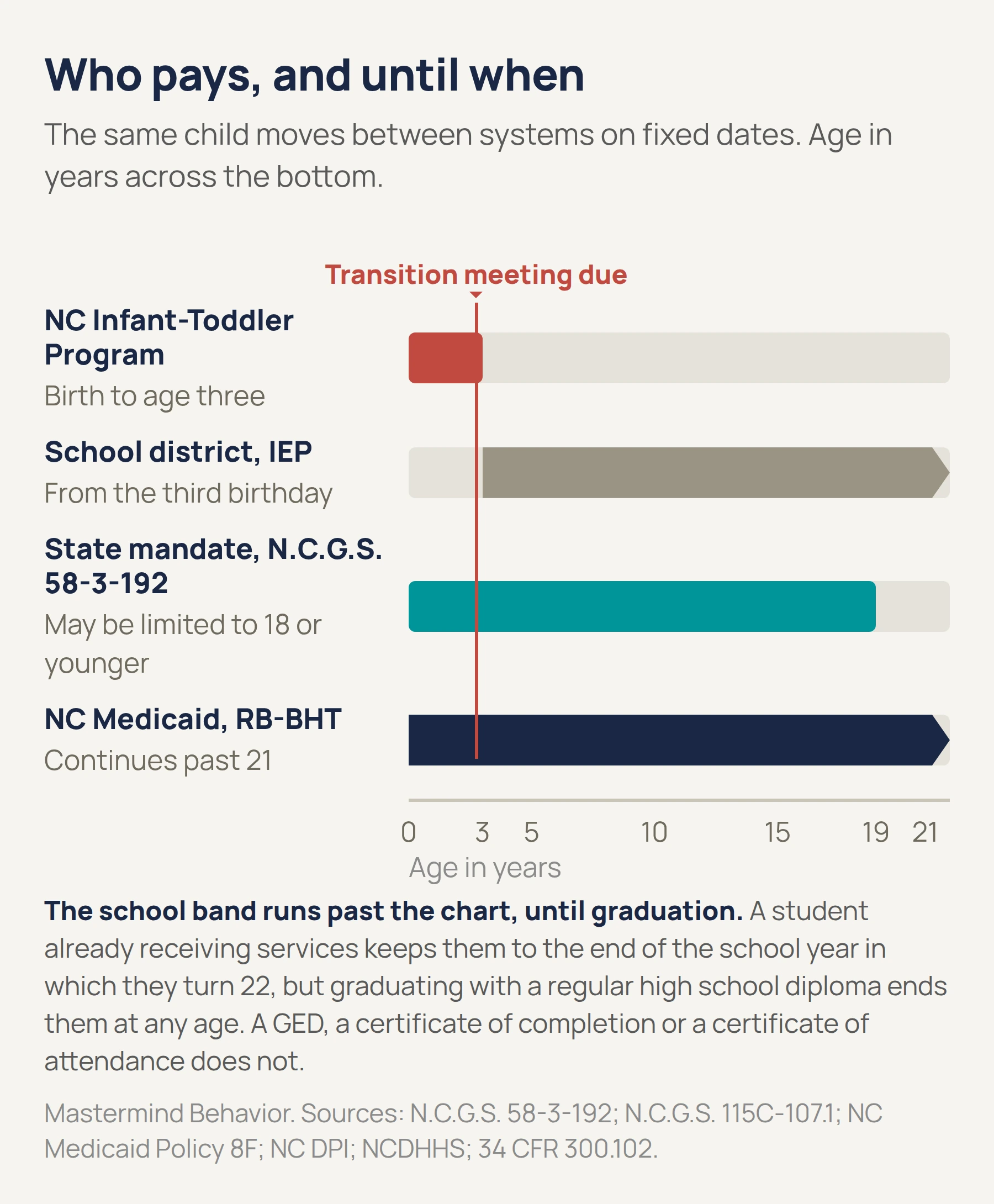
The age limit is permissive, not exclusionary. Coverage for adaptive behavior treatment "may be limited to individuals 18 years of age or younger." Read that carefully: the statute lets a plan apply that limit, and the screening, diagnosis and treatment obligation in subsection (b) is not written with an age limit at all.
There is no visit or hour cap in the statute. The limit it sets is the annual dollar maximum, and nothing else.
A diagnosis is a diagnosis. Autism spectrum disorder is defined "by the most recent edition of the Diagnostic and Statistical Manual of Mental Disorders (DSM) or the most recent edition of the International Statistical Classification of Diseases." And no insurer "shall terminate coverage or refuse to issue, amend, or renew coverage to an individual solely because the individual is diagnosed with autism spectrum disorder or has received treatment for autism spectrum disorder."
The $40,000 figure is not the number
Every page you will read says North Carolina caps ABA at $40,000 a year. That was true in 2015. It has not been the live figure for years.
The statute permits a maximum benefit of "up to forty thousand dollars ($40,000) per year," then immediately indexes it: "beginning in 2017 and for subsequent years, the amount shall be indexed using the Consumer Price Index for All Urban Consumers for the South Region," measured against the index as of March 2015 and "rounded to the nearest whole thousand dollars."
Ten years of indexing means the ceiling in force today is meaningfully higher than $40,000. We could not find the current indexed amount published on any primary source, so we are not going to print a number we cannot stand behind. Ask your insurer for the current indexed maximum in writing, and cite the indexing clause if they quote you $40,000. A plan quoting the 2015 base is quoting a figure the statute stopped using in 2017.
Two other things worth knowing about the cap. It applies to adaptive behavior treatment specifically, not to everything the mandate covers. And most first-year programs do not reach it: typical recommendations run 15 to 25 hours a week, which generally sits inside the annual maximum at contracted rates. Families tend to meet the ceiling at higher hour counts, in longer treatment years, or when copays and coinsurance push the family share up. If the obstacle is the family share rather than the coverage decision, our round-up of financial aid programs sets out what else is available.
NC Medicaid
NC Medicaid covers ABA under the name Research-Based Behavioral Health Treatment, governed by Clinical Coverage Policy 8F. The current version carries an amended date of 1 August 2026.
It is an entitlement, not a slot. Policy 8F carries the standard EPSDT provision, under which service limits "may be exceeded or may not apply as long as the provider's documentation shows that the requested service is medically necessary 'to correct or ameliorate a defect, physical or mental illness, or a condition'." That makes medically necessary RB-BHT mandatory for beneficiaries under 21 rather than optional.
North Carolina does not stop at 21. CMS approved RB-BHT for beneficiaries over the age of 21 effective 1 July 2021, "when the intervention provided is supported by credible scientific or clinical evidence, as appropriate for the beneficiary's age range," and Policy 8F was updated to match. This is unusual. Most state Medicaid autism benefits end at 21, and for transition-age young adults it is the difference between a plan and a cliff.
Prior authorization is required, and the window narrows as hours rise. Services are delivered "under a prior authorized Treatment Plan that has measurable goals over a specific timeline for the specific beneficiary being treated as developed by a Licensed Qualified Autism Service Provider (LQASP)," and services provided without it "are not considered for payment or reimbursement except in the case of retroactive Medicaid eligibility." For plans of 16 hours a week or fewer, Medicaid covers "up to 180-calendar days for the initial authorization period". Above 16 hours, that drops to "up to 90 calendar days". Being under 21 does not change it: "the fact that the beneficiary is under 21 years of age does NOT eliminate the requirement for prior approval."
Who is allowed to deliver it. Three tiers. A Licensed Qualified Autism Service Provider writes the treatment plan and may supervise or deliver treatment; recognized types include a physician, licensed psychologist, licensed psychological associate, occupational therapist, speech and language pathologist, licensed clinical social worker, licensed clinical mental health counselor, licensed marriage and family therapist, and licensed behavior analyst. A Certified Qualified Professional "provides, supervises, or provides and supervises RB-BHT pursuant to a Treatment Plan developed by a LQASP." A paraprofessional delivers under that plan and must be "supervised or observed to modify behavior interventions by a LQASP or C-QP." The policy also sets an oversight floor: "at least ten percent (10%) of all services under CCP-8F that are provided by a paraprofessional must involve the observation and direction of the paraprofessional by a LQASP."
Where the request goes depends on whether your child is in NC Medicaid Direct or a prepaid health plan. Check before submitting, because services "provided without prior authorization by the PHP" are not covered.
A note on the State Health Plan
State employees and teachers are covered through the State Health Plan, which operates on its own framework rather than under the mandate above. We have not verified its current autism benefit terms against a primary source, so this page is not going to characterize them. Ask your plan directly for the age limit, the annual maximum and the prior authorization route, and get the answer in writing.
Under three: the Infant-Toddler Program
Before your child's third birthday, the relevant system is not insurance and not the school. It is the North Carolina Infant-Toddler Program, delivered through the NC Early Intervention Section, which is "part of the NC Division of Child and Family Well-Being." Services reach families locally: "sixteen Children's Developmental Services Agencies (CDSAs) across North Carolina work with local service providers to help families help their children succeed."
It serves children from birth to three.
Cost should not stop you calling. "No family is denied services because of the inability to pay." Treat that as the operative sentence.
Anyone can refer, including you. "Referrals to the ITP can be made by phone, email, fax, letter, in person at your CDSA, or by completing and submitting the NC ITP Referral Form." A referral needs the child's name, date of birth, address, telephone number, the parent's name and the reason for concern. Eligibility runs on either a documented developmental delay or an established condition with a "high probability of resulting in developmental delay." If you are still working out whether there is anything to refer, start with the early signs of autism.
Three and over: what the school does, and does not do
On the third birthday, responsibility for educational services moves to your school district. "In NC, on the third birthday of a child with a disability, the responsibility for services shifts from the Department of Health and Human Services (Part C program) to the Department of Public Instruction."
A transition meeting is held "as early as nine months before, but no later than 90 days before your child's third birthday," and where the child is found eligible "the IEP must be written and consented to (e.g., start date) no later than the child's third birthday." A representative of the public school unit is invited to the transition planning conference with your permission. We cover that handover, and the later ones, on our page on transition planning in North Carolina.
Eligibility and services are decided by the IEP team: "the IEP Team determines if the child is a child with a disability under NC 1500-2.4 as well as the educational needs of the child (NC 1503.2.2)."
The distinction that saves families a lot of frustration: an IEP and an insurance authorization answer different questions. The IEP exists to deliver a free appropriate public education, so it turns on educational need. The mandate and Policy 8F turn on medical necessity. A district declining to write a service into an IEP is not a finding that the service is unnecessary, and an insurer authorizing hours does not obligate the school. Policy 8F says as much from the Medicaid side, excluding "services provided to teach academic subjects or as a substitute for educational personnel."
If you are denied
Most initial denials are not a permanent no. They are a no to this documentation, in this format. Insufficient evidence of medical necessity, hours above what the reviewer thought warranted, a mismatch on the authorization form. All of those are answerable.
Step one: the internal appeal. Read the denial letter word for word, because the stated reason is usually narrower than the headline. Ask your BCBA for additional clinical justification, expanded treatment plan detail or progress data that speaks to the specific objection. Then submit in writing, referencing the mandate or the applicable Medicaid policy, and answering each item in the denial directly.
Step two: Smart NC. North Carolina runs external review through Smart NC, the consumer assistance program inside the Department of Insurance, which arranges review by an independent review organization. Note the agency: this is the Department of Insurance, not the Department of Health and Human Services.
You have 120 days from receiving your insurer's final decision on appeal. The other conditions are that your coverage type is subject to external review, that the denial was "an insurer's medical necessity determination," that "you had coverage in effect with the insurer at the time the services were requested," and that "the service for which coverage was denied appears to be a covered benefit."
If it is urgent, expedited review is available "in cases where the time involved in obtaining a final decision can have an impact on a person's health," with a decision "within three days" of submission. The expedited route can be used without finishing the internal appeal first.
It is free. Smart NC will talk you through it on 855.408.1212.
It does not reach everyone. External review "does not apply to self-funded employer health plans," to "Medicare or Medicaid," or to dental, vision, Medicare supplement, long-term care, specified disease, workers compensation, credit or disability income coverage. If you are on Medicaid, your appeal runs through the Medicaid process instead.
One local thing worth knowing
North Carolina licenses behavior analysts, which many states do not. That is good for quality and it has a side effect: the provider network here is smaller than in neighboring states, and insurer in-network panels can be narrower as a result.
So if your first call reveals no in-network ABA provider near you, do not stop there. Ask specifically about out-of-network exceptions and single case agreements. They are more common in North Carolina than families realize, and they exist precisely because of that supply constraint.
Why Mastermind Behavior
Almost none of what is on this page is written down anywhere a parent would think to look. It came out of the session law, a Medicaid clinical coverage policy, the Department of Insurance, and the state's early intervention and special education rules, read line by line and dated so you can see how current it is. That is the same work we do with families every week, because the funding conversation is not an afterthought for us. It is usually the first one. Mastermind Behavior is a BCBA-owned provider delivering in-home ABA therapy across North Carolina, New Jersey and Georgia, and we will help you work out which of the systems above applies to your child, what your plan is actually obliged to cover, and whether a denial is worth appealing. If we are not the right fit for your family, we will tell you that as well. You can talk it through with us before you commit to anything.
Sources
Every figure on this page was checked against these documents on 11 August 2026.
- N.C. Session Law 2015-271, An Act to Provide Coverage for the Treatment of Autism Spectrum Disorder.
- N.C.G.S. 58-3-192, Coverage for autism spectrum disorder.
- NC Medicaid. Clinical Coverage Policy No. 8F, Research-Based Behavioral Health Treatment for Autism Spectrum Disorder. Amended 1 August 2026.
- NC Medicaid. Research Based Behavioral Health Treatment for Autism Spectrum Disorder, bulletin on CMS approval for beneficiaries over 21, effective 1 July 2021.
- NC Department of Insurance, Smart NC. Request an External Review.
- NCDHHS. About the North Carolina Infant-Toddler Program.
- NCDHHS. Early Childhood Transitions in North Carolina: A Parent's Guide.
- NC Department of Public Instruction. Policies Governing Services for Children with Disabilities, amended March 2021.
- 29 U.S.C. 1144(b)(2). ERISA saving clause and deemer clause.
- US Department of Labor, Employee Benefits Security Administration. Filing a Claim for Your Health Benefits.