Vitamin D and Autism: What the Evidence Supports
Autistic children do tend to have lower vitamin D levels. That is not the same as vitamin D treating autism. What the evidence supports, and what it does not.


Vitamin D is one of the few autism topics where the research is genuinely interesting and genuinely unresolved at the same time. That combination makes it easy to overstate in either direction, so this article separates three questions that often get merged into one.
- Do autistic children tend to have lower vitamin D levels? Fairly consistently, yes.
- Does that mean low vitamin D helps cause autism? Unproven, and the association alone cannot answer it.
- Does taking vitamin D treat or prevent autism? The evidence does not support that claim.
Most of the confusion in this area comes from treating an answer to question 1 as if it settled questions 2 and 3.
What the association research shows
Studies comparing autistic children with other children have repeatedly found lower circulating vitamin D. The pattern also appears before diagnosis: a 2026 meta-analysis of 15 studies found that mothers with higher vitamin D levels in pregnancy had a modestly lower likelihood of having a child later diagnosed with autism, a relative risk of 0.91.
That is a real and repeatedly observed finding. It is also, on its own, unable to tell you which way the arrow points. At least three explanations fit the same data equally well:
- Low vitamin D contributes in some way to autism risk.
- Autism leads to lower vitamin D, because autistic children more often have restricted diets, spend less time outdoors, or have sensory reasons to avoid the sun.
- Something else influences both.
Observational studies cannot separate these. Only trials can, and this is where the story changes.
What happened when researchers ran the trials
Two randomized trials have now tested the actual proposition, one in pregnancy and one in infancy, and both came back negative.
In a trial published in the American Journal of Clinical Nutrition, pregnant women were randomly assigned high-dose or standard-dose vitamin D3, and their children were assessed at age 10. Higher vitamin D levels that mothers already had before the trial were associated with lower autism risk, echoing the observational picture. But the supplement itself did nothing: high-dose supplementation "was not associated with risk of autism or ADHD". The same study contained both the encouraging correlation and the disappointing experiment.
The second trial followed 366 children given either 1,200 IU or 400 IU of vitamin D daily from two weeks to two years of age, then measured autism-related traits at ages 6 to 8. The 2026 result was as close to nothing as a result can be: a difference of −0.002 on a standardized trait score.
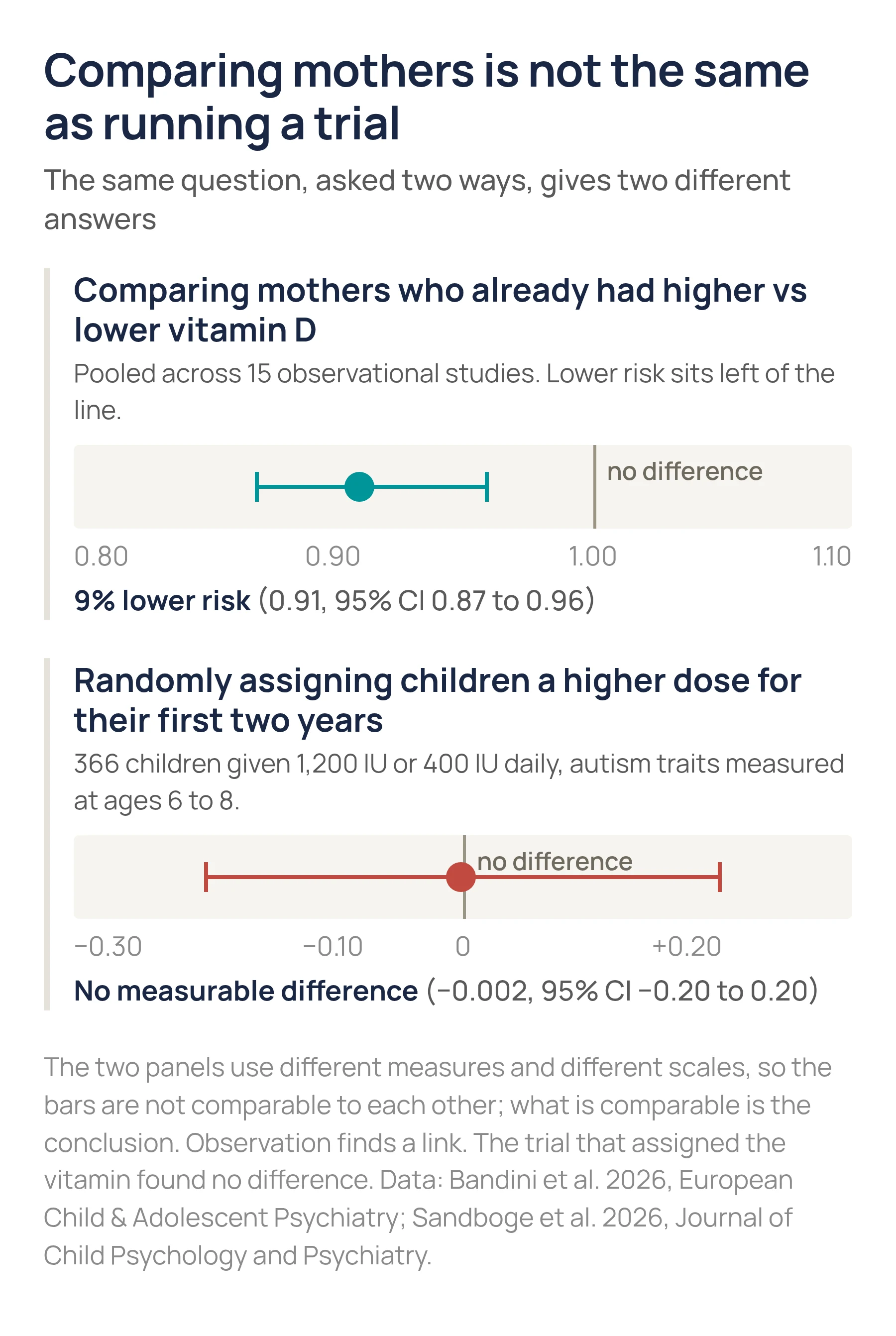
This gap between what we observe and what we measure when we intervene is the single most useful thing to understand about nutrition claims in autism. Mothers with higher vitamin D differ from mothers with lower vitamin D in many ways at once: diet, time outdoors, general health, income, whether they were already taking prenatal vitamins. Randomly assigning the vitamin removes all of those differences, and when researchers did that, the effect went away.
Why the prevention claim does not hold up
This is where a lot of published material, including the earlier version of this page, went wrong.
The most widely circulated claim is that vitamin D during pregnancy cut autism recurrence in high-risk families from 20% to 5%. That figure comes from a single 2016 study by Stubbs and colleagues. Its actual design:
- 19 women. That is the whole sample.
- Open label. Everyone knew who was taking what.
- No control group and no blinding. The 20% comparator was a historical figure from earlier literature, not a group of women followed alongside.
- Published in Medical Hypotheses, a journal created for speculative proposals rather than settled findings.
One of 19 children was diagnosed. At that sample size, a single case either way moves the headline percentage by more than five points. The authors were candid about this themselves, describing the work as "a preliminary study with very small numbers" that was uncontrolled, adding: "We did not have a control group, nor was there blinding."
A study like that is a reason to run a proper trial. It is not a reason to tell parents what to take. The proper trials have now been run, and they are described above.
The dosing problem
The previous version of this article listed specific doses: 5,000 IU per day during pregnancy, 1,000 IU per day in infancy, and a weight-based treatment dose of 300 IU per kilogram per day for an autistic child. We have removed all of them, and the reason matters.
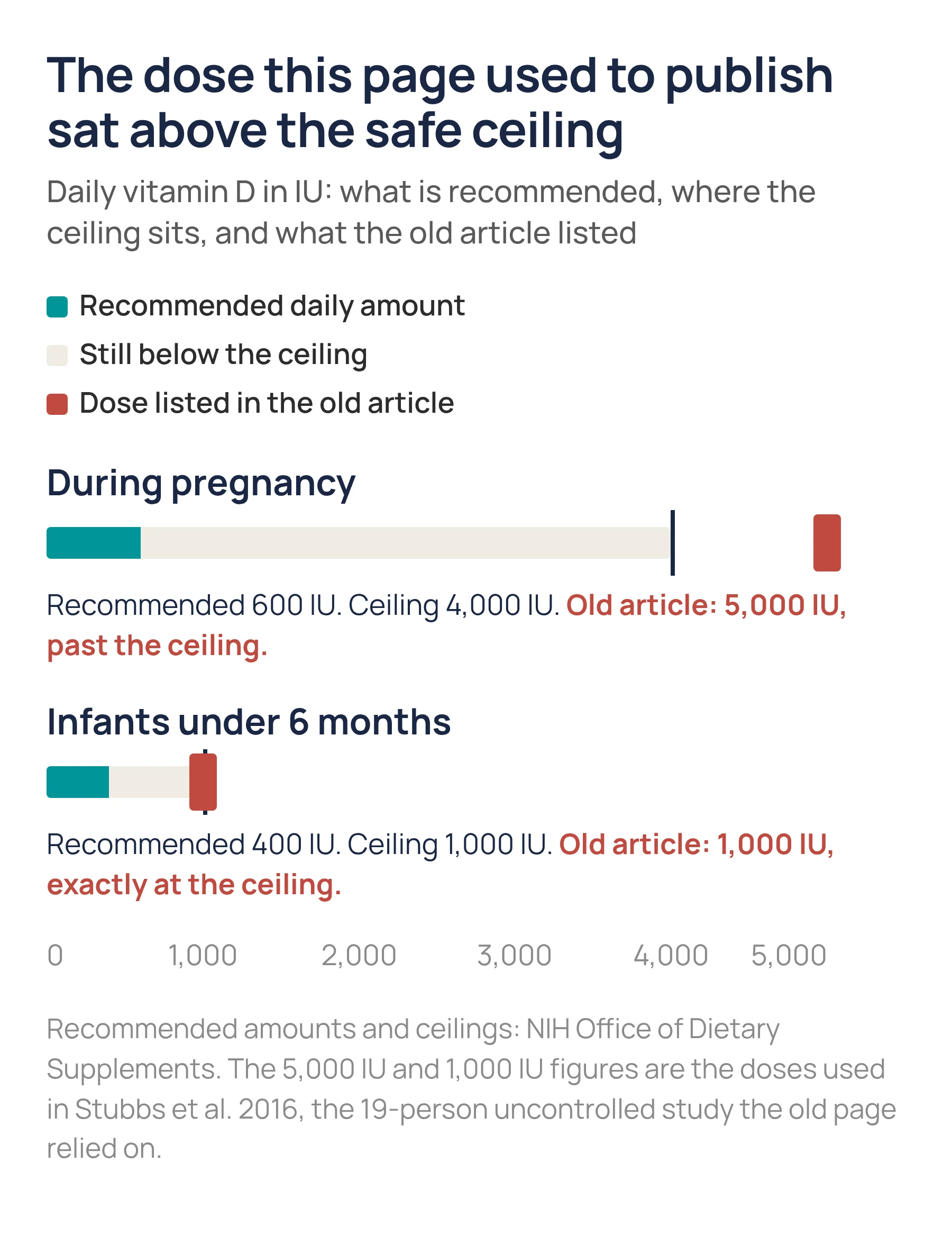
The tolerable upper intake level for vitamin D in adults, including during pregnancy, is 4,000 IU per day. The figure previously published here sat above it. For infants under six months the upper level is 1,000 IU per day, so the infant figure sat exactly at the ceiling. Both numbers came from the 19-person study described above.
The weight-based figure deserves its own note, because it scales with the child. At 300 IU per kilogram, a 20 kg six-year-old would be given 6,000 IU a day, twice the 3,000 IU ceiling for that age group.
Publishing those doses on a therapy provider's website, next to a claim about reducing autism, came close to functioning as dosing advice. That is not our role, and it was not safe. Vitamin D dosing during pregnancy or infancy is a conversation with an obstetrician or pediatrician, ideally informed by an actual blood level rather than a number from an article.
What about vitamin D as a treatment?
Trials have also tested supplementation in children already diagnosed. A meta-analysis of randomized trials covering 349 children found a small but significant improvement in hyperactivity scores, and no significant difference in core autism symptoms or other co-occurring difficulties.
In fairness, the picture is not unanimous. A smaller 2020 meta-analysis pooling three studies and 203 children did report improvement in autism rating scores. We weigh it less because it rests on fewer studies and fewer children than the analysis above, and because the larger randomized trials described earlier point the other way. We mention it because leaving out the study that disagrees is exactly the habit that produced the article we are replacing.
What is reasonable to conclude
Vitamin D deficiency is worth identifying and correcting, because deficiency is bad for bones, immune function, and general health. That is reason enough, and it applies to every child.
Autistic children may be at higher risk of deficiency for practical reasons: selective eating is common, and so is limited time outdoors. Asking your pediatrician whether a level should be checked is a sensible question.
What the current evidence does not support is treating vitamin D as an autism treatment, or as something that prevents autism. That conclusion now rests on randomized trials rather than on absence of evidence, which makes it considerably firmer than it was a few years ago.
What the causes actually look like
For context on where autism does come from: the largest study ever conducted, Bai et al. 2019 in JAMA Psychiatry, followed 2,001,631 children across five countries and attributed roughly 80% of autism liability to inherited genetics, with maternal and shared-environment effects at 0.4% to 1.6%. Whatever role nutrition plays, it operates in a small remainder rather than the main story. If what you want is a plan rather than a supplement, that is what in-home ABA therapy is for. We cover that evidence, and the guilt that often comes with it, in our article on whether emotional neglect causes autism, and in our look at what can and cannot be prevented.
FAQ
Should I have my child's vitamin D level checked?
It is a reasonable question for your pediatrician, particularly if your child eats a narrow range of foods or spends little time outside. Treat it as general health rather than autism treatment.
Does vitamin D during pregnancy prevent autism?
Current evidence does not support that. The study most often cited for it enrolled 19 women, had no control group, and appeared in a hypothesis journal. When the question was put to a randomized trial that followed children to age 10, supplementation made no difference.
What actually helps my autistic child?
Evidence-based therapy, matched to your child's goals, with parents involved. If you're in New Jersey, Georgia, or North Carolina, our team can walk you through what that looks like.
References
- Bandini L, Vinceti B, Urbano T, et al. The impact of maternal vitamin D levels during pregnancy and risk of autism spectrum disorder and attention deficit hyperactivity disorder. European Child & Adolescent Psychiatry. 2026;35(7):2083-2102. doi:10.1007/s00787-026-03059-7
- Aagaard K, Møllegaard Jepsen JR, Sevelsted A, et al. High-dose vitamin D3 supplementation in pregnancy and risk of neurodevelopmental disorders in the children at age 10: a randomized clinical trial. American Journal of Clinical Nutrition. 2024;119(2):362-370. doi:10.1016/j.ajcnut.2023.12.002
- Sandboge S, Seppälä V, Lintula S, et al. Vitamin D supplementation in the first 2 years and autism spectrum traits at 6-8 years: a randomized clinical trial. Journal of Child Psychology and Psychiatry. 2026;67(7):1004-1014. doi:10.1111/jcpp.70110
- Li B, Xu Y, Zhang X, et al. The effect of vitamin D supplementation in treatment of children with autism spectrum disorder: a systematic review and meta-analysis of randomized controlled trials. Nutritional Neuroscience. 2022;25(4):835-845. doi:10.1080/1028415X.2020.1815332
- Song L, Luo X, Jiang Q, et al. Vitamin D supplementation is beneficial for children with autism spectrum disorder: a meta-analysis. Clinical Psychopharmacology and Neuroscience. 2020;18(2):203-213. doi:10.9758/cpn.2020.18.2.203
- Stubbs G, Henley K, Green J. Autism: will vitamin D supplementation during pregnancy and early childhood reduce the recurrence rate of autism in newborn siblings? Medical Hypotheses. 2016;88:74-78. doi:10.1016/j.mehy.2016.01.015
- Bai D, Yip BHK, Windham GC, et al. Association of genetic and environmental factors with autism in a 5-country cohort. JAMA Psychiatry. 2019;76(10):1035-1043. doi:10.1001/jamapsychiatry.2019.1411
- National Institutes of Health, Office of Dietary Supplements. Vitamin D: fact sheet for health professionals. Recommended dietary allowances and tolerable upper intake levels. Accessed August 11, 2026.